
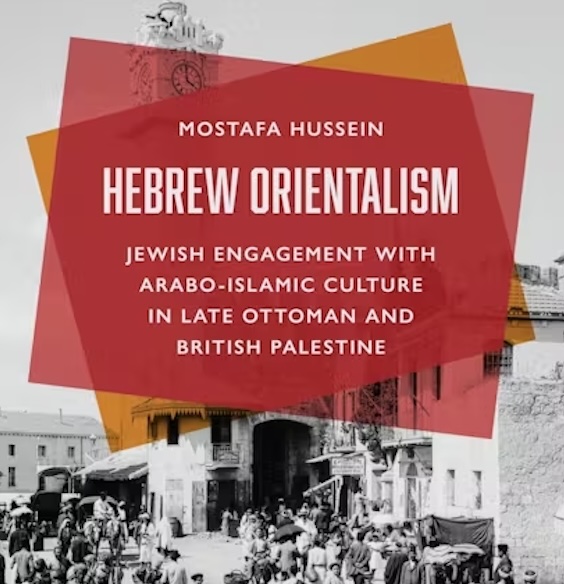
( Middle East Monitor ) – It is often claimed that early Zionist settlers into Palestine in the late 19th and early 20th centuries, were indifferent to or would ignore Arab, Muslim and Palestinian culture. Mostafa Hussein challenges this view in his new book Hebrew Orientalism: Jewish Engagement with Arabo-Islamic Culture in Late Ottoman and British Palestine.
The book grapples with the emergence of orientalist scholarship that emerged among Jewish settlers and Palestinian Jews during this period. Far from ignoring the Arab world, these Zionist thinkers sought to engage with it and use it to develop a new Jewish identity. Most of the writers examined by Hussein produced their works outside institutions such as universities and were thus less motivated by the incentives and views espoused by the likes of the Hebrew University of Jerusalem’s Oriental Institute established in 1926. Different individuals within the Hebrew Oriental movement produced work that was in response to their own experience, circumstances, engagement and beliefs. We find a variety of different views among these Jewish Zionist writers with regards to Palestine and Palestinians.
From 1881, following an assassination attempt on Tsar Alexander II of Russia and the outbreak of an anti-Jewish pogrom in the Russian Empire, some Jewish families started to flee to Palestine. Before leaving Eastern Europe, some of them asked for the guidance from Rabbi Yehiel Michael Pines, who was an ardent supporter of a Jewish national settlement in Palestine, to ask him on how to treat Palestinians. His advice reflected the dual nature of the 1880s early Zionist sentiment. On the one hand he asserted the respectful treatment of the Palestinian neighbour, but on the other hand Jews should exert control over them and behave justly. So, while he was advising coexistence, it was coexistence within a hierarchy. Encounters between Jewish settlers and Palestinians during this period took place primarily in the countryside as many first wave Zionist settlers acquired land and became farmers who relied on Palestinian labour and agricultural know-how. It is in this context we start to see the first Hebrew Orientalists, ‘the unique aspect of the Orientalist approach taken by Hebrew writers in late Ottoman Palestine lies in the way they balanced their sense of nationalist allegiance with their portrayal of Palestinian Arabs. These writers managed to depict the Palestinian Arabs as both competitors and individuals with innate connection to the land.’
Within the world of the Hebrew Orientalists, local Jewish writers played a huge role not only mediating between European settler Jews and Arab populations, but also helping the wider Jewish world to understand Arab culture and using it to create a new Hebrew culture. A key figure is Jerusalemite scholar Abraham Shalom Yahuda (1877-1951), who wrote on the origins of the Arabs and traces Jewish history through Arab sources. Yahuda is an interesting figure as he is very much part of the late cosmopolitan Ottoman culture, which enabled equality in citizenship and fostered ties between different religious communities. His scholarship, while arguing Arabs are not a specific ethnic group unlike the Hebrews, Arabs and Jews are very much cousins and are both semites. Another Jerusalemite writer of Iraqi descent, Isaac Yahuda, was a part of both the Zionist and Arab intelligentsia; he was intertwined with the broader Nahda movement. He was dedicated to the advancement of Arab-Islamic knowledge and was able to publish an anthology of medieval Arabic poetry, which he did by accessing Arab and Islamic libraries, particularly the Al-Khalidiyya library in Jerusalem, which for Hussein shows, ‘the fluidity of social and cultural intercommunal relations in late Ottoman Jerusalem that did not distinguish between members of various communities based on their religious identity.’
The types of ideas that emerged from the period varied from exclusionary to inclusionary of the Palestinian Arab population. Some saw coexistence and integration into the Arab World as part of the Zionist project. Indeed, Arabic knowledge and culture was seen as crucial for developing Jewish identity and ‘re-indigenising’ them to the region. However, much of this shifted after the British seized and occupied Palestine in 1917. The Hebrew Orientalists underwent a transition along with the wider Zionist movement – the British vision for Palestine was the end of the multilingual and multicultural Ottoman cosmopolitanism to be replaced by cultural and ethnic monoculturalism. These changing circumstances also meant the creation of a new hierarchy that saw Mirzahi and Sephadi Jews lose their position to European Ashkenazi Jews.
This also moved the needle in favour of expulsion of Palestinians and Jewish only sovereignty over the land becoming the dominant Zionist position. But as Hussein notes, while the Hebrew Orientalists may have had various visions of the future, it was still part of a settler-colonial project, ‘recognizing settler colonialism’s enduring nature- its temporal quality- offers a valuable lens through which to examine the proliferation of Hebrew Orientalism.’
Hebrew Orientalism aims to offer a more nuanced view of the movement and highlight their differences, contradictions, circumstances and how events helped to evolve their ideas. Hussein has provided a very readable, thoughtful and insightful account of the intellectual movement, which will be of interest to students of history and scholars of settler-colonialism.
 Unless otherwise stated in the article above, this work by Middle East Monitor is licensed under a Creative Commons Attribution-NonCommercial-ShareAlike 4.0 International License.
 © 2026 All Rights Reserved