
By Jasim Al-Azzawi | –
( Middle East Monitor ) – In the current state of tension between the Jewish state and the Islamic Republic of Iran, the situation has come to a critical juncture. What was once a series of regional skirmishes has now escalated to a sophisticated, three-way defense of Iran against the Israeli threat. This has come about through the Chinese and Russian “force multipliers” that can neutralize the West’s most potent tactical advantages: stealth and accuracy.
The end of invisible incursions
The most significant development has been the deployment of China’s YLC-8B 3D long-range surveillance radar. This is not just a cosmetic move; rather, it is a fundamental threat to the Israeli and American air forces’ tactical doctrines.
This system operates at the UHF frequency and uses physical principles to render the stealth capabilities of the latest fifth-generation aircraft, such as the F-35 Lightning II, irrelevant.
The YLC-8B has a detection range of over 350 kilometers for stealth aircraft, giving Iran a critical window of opportunity to prepare against the Israeli threat. According to geopolitical expert Brandon Weichert, the deployment of the Chinese radar system has created a “trap” for the Israeli Air Force: “Iranian anti-ship and air defense systems, supported by Chinese intelligence, can detect threats in real-time.” This effectively counters the Israeli “shoot-and-scoot” tactic. Furthermore, according to a report by Defence Security Asia: “Earlier detection compresses decision cycles and forces attacking forces to commit additional assets to electronic warfare.”
The pivot: From Russian delays to Chinese speed
The reason Iran has turned to China for help is a result of the repeated delays by Russia in the sale of the S-400 Triumf system to Iran. Iran has sought to purchase the S-400 system to modernize its antiquated air defenses fundamentally. However, the repeated delays by Russia have been a result of their own procurement issues in the Ukraine conflict, as well as their desire to maintain a level of leverage against the Islamic Republic.
The most significant development has been the deployment of China’s YLC-8B 3D long-range surveillance radar. This is not just a cosmetic move; rather, it is a fundamental threat to the Israeli and American air forces’ tactical doctrines.
Although Russia has finally formalized its Comprehensive Strategic Partnership arrangement at the start of 2026, it nevertheless remains a “Tier 2” relationship compared with its partnership with either Minsk or Delhi. Iran has consequently turned to China as its “total solution provider.” In return for Iranian crude oil sold at a “handsome discount” of $10-$15 per barrel, China has expedited delivery of its HQ-9B, a long-range surface-to-air defense system, and its YLC-8B radar.
“Iran’s pivot towards Chinese air defense systems reflects eroding confidence in Russian reliability,” says a Hudson Institute report. “Beijing offers complete and deployable systems with flexible financial terms, something Moscow cannot match.” The frustration with Russia has been openly expressed by Iran’s former Parliament Deputy Speaker, Ali Motahari, who says, “Russia has given the S-400 air defense system to Turkey and Saudi Arabia, but does not give it to Iran, which has provided it with drone assistance.”
Digital sovereignty and the “security belt”
This defense belt has been made even more secure by Iran’s full-scale adoption of China’s BeiDou satellite navigation system, replacing the US GPS, which has rendered Iranian precision-guided munitions immune to the “GPS Denial” and spoofing tactics employed by the US during the “Twelve-Day War” last June.
Gloria Shkurti Ozdemir, writing for Politics Today, says, “Iran has been able to pursue its missile and UAV programs with strategic independence because of BeiDou.” She adds, “Immunity against American interference is now a reality.” China has been using its BeiDou system as part of its strategy to strengthen Iranian digital sovereignty by replacing Western software with its own, much harder-to-penetrate system.
The alliance is now transitioning from the server room to the sea. In mid-February 2026, the three nations plan to conduct their eighth “Maritime Security Belt” exercises in the northern Indian Ocean. These exercises, involving both the regular Iranian Navy and the IRGC, are planned to coincide with heightened tensions in the region, a clear indication of trilateral unity.
Moscow is careful to exclude a “mutual defense” commitment to Iran to avoid being dragged into a conventional war. Its technical assistance ensures Iran remains a thorn in the side of Western interests, distracting US resources away from Eastern Europe.
Strategic imperatives and US policy
The strategic implications for the US are critical. The “maximum pressure” strategy is being bypassed by a “maximum integration” strategy between Tehran, Beijing, and Moscow.
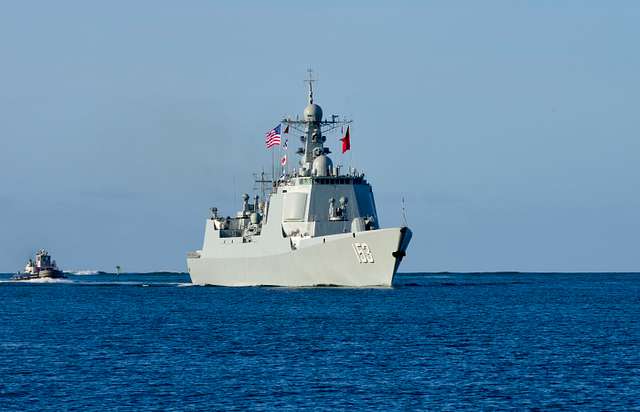
PEARL HARBOR (Jun. 29, 2016) The Chinese People’s Liberation Army (Navy) (PLA(N) Luang II class guided-missile destroyer Xian (153) arrives at Joint Base Pearl Harbor-Hickam for Rim of the Pacific (RIMPAC) 2016. US Navy. Public Domain. Via Picryl
China currently imports 1.4 million barrels a day of Iranian oil. The “Persian Fortress” is a matter of national industrial life for China. As Modern Diplomacy explains, “Beijing views the Mossad’s success in penetrating the Iranian interior as a direct threat to its economic interests and its Belt and Road Initiative.” Moscow is careful to exclude a “mutual defense” commitment to Iran to avoid being dragged into a conventional war. Its technical assistance ensures Iran remains a thorn in the side of Western interests, distracting US resources away from Eastern Europe.
The US strategy of isolating Iran is now a dead-end street. As Joe Kawly explained in an article published by Alhurra, “China enables endurance, not escalation… it helps Iran sustain capability while staying below the threshold that would trigger direct US retaliation.” The US is now faced with a Middle East in which the “Axis of Resistance” is now a technologically buoyant front supported by the world’s second-largest economy. As “round two” approaches, any attack on Iranian territory now faces a wall of Chinese sensors and a Russian alliance that has now gone past the point of no return. The Middle East may have officially lost its uncontested airspace.
The views expressed in this article belong to the author and do not necessarily reflect the editorial policy of Middle East Monitor or Informed Comment.
Via Middle East Monitor )
 Unless otherwise stated in the article above, this work by Middle East Monitor is licensed under a Creative Commons Attribution-NonCommercial-ShareAlike 4.0 International License.
 © 2026 All Rights Reserved