
Ann Arbor (Informed Comment) – The illegal Israeli-US attack on Iran on February 28, 2026, set off a regional conflagration. The Israelis and the US hit targets in 24 Iranian provinces, likely concentrating on ballistic missile sites and anti-aircraft batteries, as well as Iranian Revolutionary Guards Corps (IRGC) bases. Strikes killed dozens of high government officials, including Iran’s clerical Leader, Ali Khamenei, 86, the minister of defense, the head of the IRGC, and secretary of Iran’s Defense Counsil Ali Shamkhani, among others Over 200 Iranians were killed, including 85 little girls at a girls school in a provincial town.
Despite the deaths at the top of the government, the state is unlikely to collapse.
Trump’s killing of a major ayatollah is a declaration of war on the world’s 200 million Shiite Muslims. There will likely be significant security blowback from it.
Although Israeli Prime Minister Benjamin Netanyahu and US President Donald Trump duplicitously cited Iranian “nuclear ambitions” as a pretext for the war, they were replaying the “weapons of mass destruction” gambit from George W. Bush’s Iraq War. Iran has never been assessed to have a military nuclear weapons program. It had a civilian nuclear enrichment program. That program was destroyed last June by Israeli and US bombardment. So it can hardly be a pretext for war now. The aim is clearly regime change.
Never miss an issue of Informed Comment: Click here to subscribe to our email newsletter! Social media will pretend to let you subscribe but then use algorithms to suppress the postings and show you their ads instead. And please, if you see an essay you like, paste it into an email and share with friends.
In retaliation, Iran hit Israeli targets with several waves of missile strikes. The IRGC said that it hit Ramat David Air Base and the Israeli Ministry of Defense in the HaKirya area of Tel Aviv, as well as Beit Shams and Ashdod military equipment factories. Tehran also said it had bombed the Israeli naval base and the warship construction complex in the city of Haifa. Israeli television showed destruction in several cities, including burning houses in Bat Yam. Israeli military censorship makes it impossible to gauge the damage. One Israeli woman was killed and 121 Israelis had to be treated for (mostly minor) injuries.
Iran also lashed out at the Gulf Arab monarchies, several of which lease military installations to the United States. The Iranians targeted 14 US bases in the region. The Kuwait airport was hit, but anti-drone defenses blocked a strike on a US naval base there. Iranian missiles and drones hit the US naval headquarters of the Fifth Fleet and the airport in Manama, Bahrain as the oppressed Bahraini Shiite population cheered.
In the United Arab Emirates, the major container port of Jebel Ali, the iconic Burj al-Khalifa hotel, and the airport were hit. These Iranian strikes were perhaps the most consequential in the region, since Dubai is a tourism and finance hub and depended on the illusion that it was safe and glitzy. It could be that the UAE just lost a lot of expat expertise. It will certainly suffer billions of dollars of damage to its economy as a result of the closure of its airport, the loss of tourism, and the exodus of some expat businesses.
It is not clear what tactical advantage Iran’s remaining leaders think they can gain by attacking their pro-American Arab neighbors, with some of which Tehran has sometimes had at least correct relations.
The IRGC announced that it had closed the Strait of Hormuz to shipping, and there are reports of British and other vessels turning around in the Arabian Sea and declining to try to enter through it into the Persian/Arab Gulf. British authorities, however, insisted that the Strait was open. Some 20 percent of the world’s petroleum is exported through Hormuz and if it really were closed, it would cause a massive spike in petroleum prices.
US naval officers have told me that they do not believe Iran has the capacity to close the Strait, though admittedly that was in the days before drone warfare. Since container ships and oil tankers require insurance, however, Iran’s threat may be effective in another way. The Financial Times reports that insurers are cancelling some policies and raising prices for others 50%. So Iran’s threats may effectively close the Straits to a lot of shipping.
The war is likely to be short, since neither Israel nor the United States have the sheer number of bombs needed to carry on for more than a week or two. It is also likely to fail in its goal of regime change, since such a change has almost never been effected from the air. As an army brat, I no doubt bore people pointing out that you need boots on the ground to take territory. The air force theorists have been promising success with carpet bombing since the Vietnam War, and it has never panned out. The US heavily bombed Afghanistan for 20 years and still lost.
At the moment there is an oil glut, so the war may not affect petroleum prices dramatically in the short term. If it goes on a while, prices will spike.
One effect of this war to watch out for is its effect on China. China imports 5 million barrels a day of petroleum, 1.3 millions of it from Iran. The Iranian oil is heavily discounted because it is essentially smuggled to avoid US sanctions. It is transported by a “ghost fleet” that runs with transponders off, and is unloaded by tankers flagged as Malaysian or Indonesian in South China. South of Shanghai there are small private refineries that don’t have international assets that the US can sanction, and they don’t deal in dollars. China has benefited from this cheap Iranian oil.
If the war causes a long-term reduction in Iranian petroleum shipments, that development could have a negative impact on China, putting up gasoline prices. In addition, China is losing 400,000 barrels a day of Venezuelan petroleum after Trump essentially stole the Venezuelan production. There will be no immediate crisis, since China has enormous petroleum stockpiles.
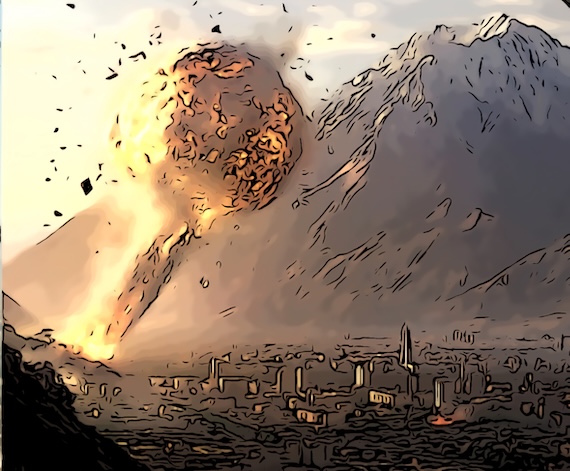
Missiles over Tehran. Digital.
China, however, has in any case likely hit peak petroleum, and its imports were already predicted to fall every year from here on out. High gasoline prices or even shortages could impel Chinese consumers to turn even more decisively to EVs. You could also imagine new government incentives. Late last year electric vehicles reached a tipping point in China, accounting for 51% of new car sales. Of course, there are lots of older internal combustion engine (ICE) cars on the road, but the government could offer incentives for people to sell them to the government and buy an inexpensive EV instead. China now makes some EVs that sell for as little as $4500, coming down to $3000 with incentives. One of the advantages of EVs is that technological advances will drive down their prices enormously in the coming decade, whereas ICE vehicles remain expensive.
EV sales in China have been sluggish this year so far, given that some subsidies have been discontinued by the government. But the government could put them back if there is a gasoline crisis.
In India, as well, an oil crisis will bump up EV sales, including of electric bikes.
Although some hawks are imagining that Trump’s war on Iran is a great victory that will strengthen his hand with China, it could backfire on him by impelling China to electrify transport even faster amid its sustainables revolution. China would be unwise to depend on imports of oil and liquefied natural gas in the current strategic environment.

 © 2026 All Rights Reserved