
Ann Arbor (Informed Comment) – Oil prices hit $120 early Monday morning in Asia, for the first time since the initial shock of the Russian invasion of Ukraine in 2022. But today’s increase was different, since the price skyrocketed fully 30% in one day, something that hasn’t happened for decades. In response, the South Korean stock exchange plunged 8% and trading was halted for the second time in four sessions, according to CNBC.
The Persian Gulf is often called the cockpit of the world economy. But that imagery implies that we are all on an airplane together and someone in the cockpit is piloting it.
We all know, from seeing thrillers, what would happen if someone blows up the cockpit of a plane in the air.
And that, my friends, is what Donald Trump has just done. The plane is going down, and we are on it.
Everyone, and I mean five-year-old children, knew that if the US and Israel attacked Iran it would close the Strait of Hormuz and that petroleum and gas production facilities would be idled or would be in danger of substantial damage.
Only the nincompoops in the White House did not make this calculation. Israeli Prime Minister Benjamin Netanyahu, who, according to Secretary of State Marco Rubio dragged the US into this war, likely knew it but did not care. Trump is supplying Israel with stolen petroleum from Venezuela, though even the price of that will spike.
The global petroleum market is slightly segmented but for the most part it is just one big market. If supply decreases, everyone’s prices go up. It doesn’t matter if your country produces its own oil, because the price is set by global, not national, demand. Hence, Brent futures hit $119.04 and West Texas Crude reached $118.46. They are pretty much in tandem.
Stock markets plunged in Asia on Monday morning, and the Dow in the US seemed set for another big thousand-point descent.
All this is happening because 20% of the world’s petroleum comes out onto the market through the Strait of Hormuz, which is closed. Further, about fifty percent of fossil gas cross-border trade consists of Liquefied Natural Gas on container ships, and a fifth of LNG comes out from Qatar and the United Arab Emirates through that same Strait.
Qatar has declared Force Majeure and ceased producing natural gas, since there is no place to store it and it cannot be exported. If someone has drones and wants to stop exports through the Strait of Hormuz, hitting a gas tanker would be easy and very, very effective. As in, big fireworks. Qatar knows this.
Kuwait and the United Arab Emirates have cut substantially back on oil production, again, for lack of storage capacity. If you can’t export it on supertankers, then where would you put it?
Gasoline and diesel prices will rise substantially, as will the cost of jet fuel, so look for pricier airplane tickets this spring and possibly summer.
Trump imagines that oil prices will fall after the war ends. But that depends on when the war ends, and how much damage is done in the meantime. Will Iran take revenge for the Israeli strike on 12 of its civilian oil depots in the capital of Tehran by hitting neighbors’ oil facilities?
Trump is rumored to be toying with seizing Iran’s Kharg Island, from which 90% of its oil is shipped. It will certainly be sabotaged if the US military attempts such a thing, just as Iraqi oil production was often sabotaged during the US occupation in the first decade of this century.
If oil facilities end up being bombed, as Iran’s oil depots were on Sunday, it could take a decade just to put out the fires. We saw this in Kuwait after the Gulf War. One suspects that if the US takes Iran’s oil, the Iranians, who have lots of Shahed drones, will lash out at their oil-producing neighbors, inflicting substantial and long-lasting damage.
So it may not just be a matter of halting military operations and turning back on the spigots.
Moreover, if the world economy tips into recession, getting back out of it will require more than just ending the war. Once market confidence is shaken, restoring it typically takes time. Moreover, if you have bankruptcies and lack of investment, the very tools to restore it will have been damaged.
As I will explain below, when the world petroleum market loses 20% of its supply, the price doesn’t go up 20%. It goes up much more than that, and Monday’s 30% spike is only the beginning.
Despite the availability of cheap and dependable solar and wind power, many countries still unwisely depend on fossil gas to generate electricity. Pakistan, India, Bangladesh and some other Asia countries won’t be able to run their factories without it, though over time India could switch to renewables or more coal. Such switches can’t be done quickly.
Plus they may not have the gasoline and diesel to transport the goods once they are produced, or the transport may be so costly that it raises their prices significantly.
The Gulf states and Iran produce other things from their hydrocarbons than oil, including fertilizer ingredients such as sulfur, urea and ammonia. Fertilizer is necessary for modernized agriculture in places like India. Depending on how long the war goes on, it could hurt agricultural production in Asia and produce increases in food prices or even food shortages globally.
The Gulf is also a major producer of sulfur for sulfuric acid, which is used in nickel and copper mining and processing. Indonesia gets 75% of its sulfur for nickel production from the Gulf.
Nickel is used in making stainless steel. Copper is necessary in consumer electronics, pipes and plumbing, and industrial machinery. All of them can expect to see price rises as a result of Trump’s Iran War.
As for why the crisis is so dangerous, it is because demand for gasoline and diesel is what economists call “inelastic.” If you commute to work in an internal combustion (IC) engine car, and gasoline goes to $5 a gallon, you have no choice but to pay it or else you won’t be able to get to work. Consumers will all compete to buy even pricier oil products because they have no choice. Since strong demand will still be there if the price rises, a 20% cut in supply doesn’t produce a 20% increase in price. Consumers aren’t dropping out of the market for gasoline on a significant price rise, so the price goes on up.
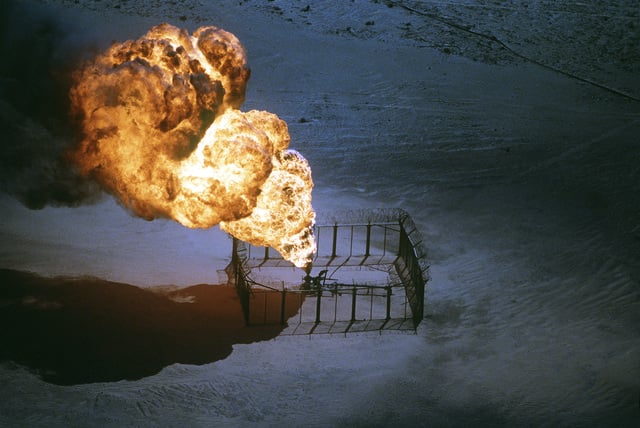
File photo: Iraqi troops set Kuwait oil rig afire at end of Gulf War. Subject Operation/Series: DESERT STORM. Country: Kuwait(KWT). Scene Camera Operator: TECH. SGT. Perry Heimer. Public Domain. Via Picryl .
Likewise, supply is relatively inelastic. While high prices will bring marginal producers back online and increase supply over time, those marginal producers have shallow fields and they can’t replace the supply of the Gulf countries. Moreover, it takes a long time for them to come online. Once oil equipment falls fallow and isn’t used for a while, it deteriorates and needs repairs and replacements to work again. Saudi Arabia is one of the few petroleum producers that could ramp up production and try to take the edge off the looming shortage, but it has to export half or more of its oil through the Persian Gulf, so it cannot “flood the market” to offset Iran’s closure of the Strait.
Some economists worry that Trump has set the US up for a round of 1970s-style stagflation, with rising prices but no increase in GDP.
Russia will benefit enormously in the short to medium term, as China, India and others turn to its petroleum to make up for the Gulf loss. This is bad news for Volodomyr Zelensky.
Likewise, China is well-positioned to reduce its reliance on oil and gas imports by further ramping up its use of electric vehicles and renewable power production for electricity. Half of new car purchases in China are now EVs, and where the drivers get a lot of their electricity from wind and solar or from rooftop solar, they will be cushioned from the hydrocarbon price spike in a way that Americans will not.

 © 2026 All Rights Reserved