
( The San Diego Union-Tribune ) – Political analysts may well mark the last day of February 2026 as the day the world crossed a line it may not easily step back from, when the U.S. and Israel engaged in a war with Iran with no clear end in sight, raising fear of another “forever war.” However, a historian like me would argue that San Diego County entered this war as early as 2019.
The county is home to Camp Pendleton, Naval Base Coronado and Marine Corps Air Station Miramar, all of which have been mobilized over the last three years by both the Biden and Trump administrations to aid Israel since it was attacked by Hamas on Oct. 7, 2023.
This includes the San Diego-based aircraft carrier USS Abraham Lincoln, or the Abe, the flagship of a carrier strike group often deployed to the Gulf of Oman off the coast of Iran. As early as 2019, President Donald Trump ordered the Abe deployed there to deter Iran, demonstrating that tensions between this president and the Islamic Republic have been simmering for a while.
The front cover of the May 11, 2019, edition of The Economist magazine featured an image of the Abe with the words “Collision Course: America, Iran and the Threat of War.”
That month, Trump’s national security adviser, John Bolton, tweeted that “The United States will continue its maximum pressure on the Iranian regime until its leaders decide to change their destructive behavior, respect the rights of the Iranian people, and return to the negotiating table.” On the same day, Trump announced to reporters at a White House press conference, “What I would like to see with Iran, I would like to see them call me.” This language resonates today, with Trump again claiming U.S. actions are done on behalf of the Iranian people and seeking a deal, hoping that the current fighting will induce Iran back to the negotiating table.
The Abe avoided war then, but the most Googled search terms were “World War Three” and “How did World War One begin?” in January 2020 after Trump ordered the assassination of an Iranian general, Qassem Soleimani, on Iraqi soil. Now fears of a World War Three or at least another “forever war” again seem a possibility.
Since 2023, not only the Lincoln has left San Diego and headed to the Middle East. Local aircraft, including a squadron of stealthy F-35C strike aircraft from Miramar and two helicopter squadrons from Coronado’s Naval Air Station North Island, have as well. Along with the USS O’Kane, a vessel that fires the Tomahawk cruise missile that has been America’s weapon of choice against both Iraq and Iran, these deployments mean that at times roughly 6,500 personnel have been regularly deployed in an undeclared war with Iran.
The Abe is currently participating in the ongoing campaign against Iran and was targeted by Iranian missiles last weekend that fell short of the vessel. There have been no local fatalities in this war yet.
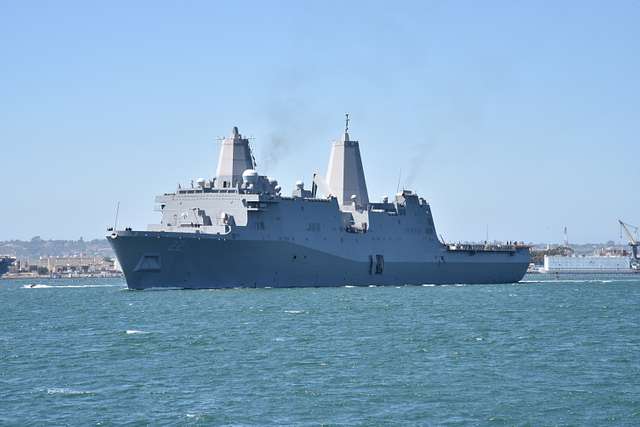
File Photo.Amphibious transport dock USS San Diego (LPD 22) transits San Diego Bay from B Street Pier (U.S. Navy photo by Mass Communications Specialist 2nd Class K. Cecelia Engrums). Public Domain. Via Picryl
Yet since 2001, San Diego County has been shaped by the forever wars in Iraq and Afghanistan, with many veterans living here who served multiple tours in both places. Those wars have also sent a whole generation of refugees fleeing those conflicts to this area, including Afghans in Vista and Iraqis in El Cajon. San Diego has a large Persian community. It is not hard to imagine a new wave of Iranians seeking to leave the war zone with hopes of reaching the U.S.
The war that appears to have begun Saturday actually began long ago, during the first Trump administration. If it has lasted that long, it raises the question of whether the current conflict will end within the “four weeks” Trump has promised. Regardless, it needs to be recognized as America’s third Gulf War. The 1991 Gulf War lasted six weeks. The 2003 Iraq war ostensibly ended in less than a month. Yet that war did not end when George W. Bush declared “mission accomplished” on a carrier off the coast of San Diego, with an insurgency erupting and the Islamic State emerging, a terrorist group that still exists today. The unintended consequences of this third Gulf War remain just as harrowing.
Reprinted with the author’s permission from The San Diego Union-Tribune

 © 2026 All Rights Reserved