
Yakov Rabkin is Professor Emeritus of History at the University of Montreal. He is the author, most recently, of Israel in Palestine and Zionism Decoded in 101 Quotes.
Montreal (Special to Informed Comment) – People that remember their past suffering often believe that memory gives them moral clarity. Yet the history of Zionism shows that the memory of persecution can just as easily be turned into a source of self-righteousness and impunity. Two spring Jewish festivals—Purim and Passover—enjoin Jews to remember slavery and a threat of total annihilation, raising issues that resonate in the ongoing war against Iran and the continuing violence against the Palestinians.
Purim and Passover, celebrated one month apart during the full moon, mark redemption, deliverance, and liberation. Both occurred outside the Holy Land, Purim in Persia, and Exodus that Passover celebrates, in Egypt. Both happened when hope was all but lost. In the story of Purim, a royal decree was issued “to destroy, massacre, and exterminate all the Jews, young and old, children and women, on a single day…”. In Egypt, perhaps, the most desperate moment in the Israelites’ tribulations ensued when, fleeing the Pharaoh’s army, they found themselves squeezed between the sea and the desert as they heard the pharaonic chariots approach.
The two redemptions are commemorated differently. Purim is celebrated for one day, while Passover lasts seven or eight days. Hallel, psalms of gratitude, is recited on Passover but not on Purim. Purim comes and goes, but the Exodus from Egypt is recalled in the context of over fifty commandments, such as the kiddush (blessing over wine) which ushers in the Sabbath every Friday night.
This reflects different paths of redemption. On Purim we witness a court intrigue with Esther, an intrepid woman at the centre of the action. The book of Esther, which relates the story of Purim, does not mention God’s name even once. Conversely, on Passover, the main actor is not human; the splitting of the sea that enabled liberation is presented as divine intervention. And the Haggadah, the text read at the Passover seder (ritual meal), emphasizes that the divine intervention was direct: “Not through an angel, not through a seraph, not through any emissary”.
Recognizing an immaterial deity is not easy. Suffice it to recall the biblical episode of the Golden Calf, when the Israelites came to worship a newly cast idol, proclaiming “This, Israel, is your god, who brought you up out of Egypt.” It is common for people to cling to objects, endowing them with holiness. This is why, according to the Talmud, God commended Moses for breaking the Tablets of the Law. Though unquestionably “holy”—fashioned by God himself—they had to be shattered in reaction to the people’s idolatry.
Chief Rabbi of Great Britain, Lord Jonathan Sacks once remarked: “Holiness is not a property of objects. It is a property of human acts and intentions.” Similarly, Israeli scholar Yeshayahu Leibowitz affirmed that “The idea of holiness as an immanent property of things—persons, locations, institutions, objects, or events—is a magical-mystical concept that smacks of idolatry.” This should be an important lesson for those who celebrate Passover: it is not a history of Jews liberating themselves from slavery to settle on “their” land, not a celebration of a people or their prowess.
In the story of Purim, the main causes of the royal decree threatening imminent destruction were wounded pride and greed. Haman, the powerful vizier, was offended by Mordechai the Jew, who refused to bow down to him. Haman also promised to pour the wealth of the victims of the planned mass murder into the royal coffers.
The cause of the Egyptian slavery was xenophobia. The Pharaoh feared the Other: “Look, the Israelite people are much too numerous for us. Let us deal shrewdly with them, so that they may not increase ….” This led to enslavement, increased oppression and, when this did not assuage the Pharaoh’s fear, infanticide: he ordered the midwives: “When you deliver the Hebrew women, look at the birthstool: if it is a boy, kill him; if it is a girl, let her live.”
Revenge is natural. This is why the Torah not only forbids it but instructs the Jews to be mindful of the impression they make even upon those who have persecuted Jews in the past. Moses, for example, is concerned about Egyptian public opinion, even though the Egyptians exploited his people during more than two centuries of slavery. The Torah, speaking of Egypt, stresses gratitude towards the Egyptians, and not revenge. Indeed, it was to Egypt that the Israelites fled from famine in the Land of Canaan and were warmly received there. The Torah is well aware that gratitude, rather than rancour and revenge, is what makes us human.
Past suffering can be transformed into a potential for hatred and violence. In Israel, this transformation has been achieved through educational policies shaping a particular kind of collective interpretation of the tragedy. Rather than dealing with the trauma in order to free society from it, Israeli mainstream maintains and perpetuates it. This is how the memory of the Nazi genocide is weaponized to justify dispossessions, deportations, and even genocide of Palestinians. This brutality is claimed to be required to establish and maintain a state reserved for one ethnic group in a land that has long been home to a diverse population.
No wonder that many Israelis, just like the Pharaoh of yore, see Palestinians as the “demographic bomb”. Israelis are imprisoned in the fear of sharing the land, a prospect perceived as an existential threat. Rank-and-file Israelis, as well as their leaders, routinely refer to Palestinian resistance as Nazis.
This vengeful brutality is all the more immoral because Israelis, rather than directing it at the Germans and other Europeans, many of whom were perpetrating the genocide, direct their ire at the Palestinians, who played no role in the tragedy of European Jews. Most of Israel’s wars have been fought to perpetuate the Zionist nature of the state—that is, to resist the idea of living in equality with the Palestinians. In other words, the main cause of violence in the region is the perpetuation of the Zionist apartheid, grounded in the belief that antisemitism is eternal and universal and that only “the Jewish state” can protect the Jews.
The current military assault on Iran, unleashed in February 2026, is also rooted in the question of Palestine. Israel seeks to eliminate the last major state committed to Palestinian rights by rendering Iran dysfunctional through subversion, decapitation, destruction, or fragmentation.
One of the moral teachings of Passover is consideration towards the Other, towards someone who is different. The Torah links the prohibition of xenophobia, of oppressing people who are different, directly to the Israelites’ past suffering: “You shall not wrong or oppress a stranger, for you were strangers in the land of Egypt.“
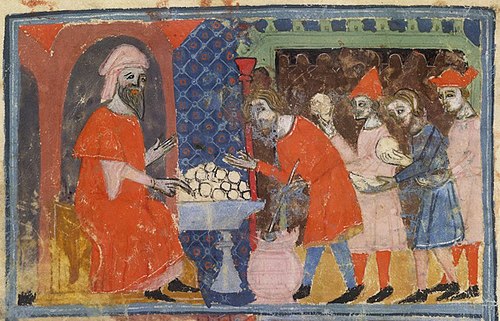
The master of the house distributing the matzot (unleavened bread) and the haroset (sweetmeat). From the Haggadah for Passover (the ‘Sister Haggadah’). BL. Public Domain. Via Wikimdia Commons
This prohibition is not easy to follow; this is why the Torah repeats it dozens of times, more than any other commandment. But some reject this idea in principle. Vladimir (Zeev) Jabotinsky, the founder of a stream of Zionism that is the precursor of Likud that nowadays rules Israel, expressed a political philosophy that one can recognize in Israel’s behaviour, including its genocide in Gaza. In an essay characteristically titled “Homo homini lupus” (Man is Wolf to Man), he wrote in Russian in 1910:
“Sometimes we base too many rosy hopes on the fallacy that a certain people has itself suffered and will therefore feel the agony of another people and understand it and its conscience will not allow it to inflict on the weaker people what had been earlier inflicted on it. But in reality it appears that these are mere pretty phrases … Only the Old Testament (sic) says ‘you shall not oppress a stranger; for you know the heart of the stranger, seeing you were strangers in the land of Egypt’. Contemporary morality has no place for such childish humanism. … A nation’s substance, the alpha and omega of the uniqueness of its character – this is embodied in the specific physical quality, in the component of its racial composition.”
In 1948, Albert Einstein and other Jewish intellectuals condemned Jabotinsky’s right-wing Zionism as fascist. The evolution of Israeli society has since shown that all political Zionism, not only this variety, contains seeds of fascism, which may take time to sprout. Nowadays, in the wake of the genocide in Gaza and Israeli bombing of Iran, more and more people, hitherto sympathetic to Israel, are concluding that the Zionist state, in its structural xenophobia, resembles Hitlerite Germany. Thus, former U.S. Assistant Secretary of Defense Chas Freeman recently remarked that the Israeli cabinet includes “people who make Nazis look humane”.
One can see an unbridgeable antagonism between Judaism and Zionism. In celebrating Passover, it is important not to transform the festival of freedom into a celebration of pride, supremacy, and impunity.

 © 2026 All Rights Reserved