
Informed Comment

Thoughts on the Middle East, History, and Religion

Juan Cole is President of the Global Americana Institute

Wednesday, December 13, 2006

The New Middle East Cold War: Saudi/Israel/Lebanon versus Iran/Syria/Iraq/Hizbullah

Helene Cooper with Hassan Fattah of the NYT has the scoop that Saudi King Abdullah told US VP Dick Cheney two weeks ago that if the US withdrew precipitately from Iraq, the kingdom would have little choice but to support the Sunni Arab guerrillas. The Saudi government had pledged to the US not to do so as long as US troops were in Iraq. But it is alleged that Saudi oil millionaires privately already send money to the guerrillas. Saudis, as Wahhabi Muslims, belong to a sect that is to the right of Sunnism. But the Wahhabi tradition dislikes Shiites and in any Sunni-Shiite struggle, the Wahhabis will come in on the Sunni side.

This item is no surprise, of course, and I have brought up this likelihood a number of times myself. What is remarkable is that it is being stated by the Saudi leadership and published in the press. The Saudis are usually circumspect. If they are leaking this sort of thing, their hair must be on fire with anxiety.

Cooper also reports the abrupt and mysterious resignation of Saudi Ambassador to the US Turki al-Faisal after only 22 months in Washington. Prince Turki has been an effective diplomat and has done a lot of outreach work, addressing ordinary American audiences (a style very unlike that of Prince Bandar bin Sultan, his long-serving predecessor). Prince Turki is the only Saudi official I know of publicly to espouse Gandhian principles of non-violence for the Palestinian cause. I met him more than once and was impressed by his humanity and acumen. I'm sorry to see him leave Washington. There are rumors that he is leaving to become foreign minister of the kingdom. If that were the case, I should have thought the promotion would be announced along with his resignation, which he called a "retirement." The way this is being handled looks more to me as though he lost some big policy fight with the establishment in Riyadh. But we shall see.

The Saudis are usually important to the formulation of US policy in the Middle East. W. is now rudderless, with Rumsfeld gone and Cheney neutered by the November elections. Prince Turki's departure in addition to hysteria about a regional guerrilla war in Iraq on the part of the Saudi King are an element of instability in White House policy-making that we could have done without.

Meanwhile, a de facto Israeli-Saudi alliance appears to be building against Iran and the Shiites. Israeli Defense Minister Amir Peretz is now saying that the 2002 Beirut peace plan put forward by then crown prince--now King--Abdullah of Saudi Arabia must be the basis for going forward with an Arab-Israeli peace process. Abdullah got the Arab League to offer Israel full recognition and political and economic relations if only they'd go back to the 1967 borders and recognize a Palestinian state.

At the time, then prime minister Ariel Sharon dismissed Abdullah's plan rather rudely. But now Israel has been bloodied by a Lebanon war that it lost on points to Hizbullah despite its clear military superiority. Bashar al-Asad of Syria pointed out that every generation of Arabs hates the Israelis more than its predecessors. Iran is emerging as a new hegemon in the eastern stretches of the Middle East.

Bush and Israeli Prime Minister Olmert hoped that the Lebanon War of last August would finish off Hizbullah. Instead, Hizbullah put up a respectable resistance to the Israeli military. Now, Hizbullah and its Christian allies loyal to Michel Aoun have staged enormous daily protests aimed at bringing down the reform government of Fuad Seniora, and they may even succeed. Hizbullah is allied with Syria, which is allied with Iran.
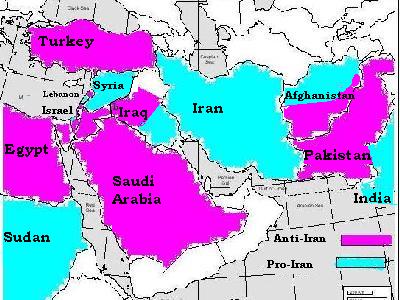


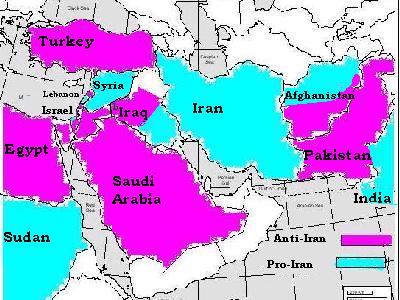
While Saudi Arabia, Jordan and Israel are unified states in this new alliance, their de facto allies in Lebanon and Iraq include the bloc of Saad al-Hariri in the Lebanese parliament and the Kurds and Sunni Arabs in Iraq.

Iran gets support from Syria and Shiite Iraq and from Hizbullah in Lebanon.

Palestinian Prime Minister Ismail Haniyeh went to Tehran recently and got pledges of $120 mn. in aid. Haniyeh while there pledged never to recognize Israel. Iran has Shiite clients in Iraq now, and is reaching into the Levant with its patronage for Hizbullah and Hamas.

Iran's farce of a "conference" on the Holocaust is a way of underlining its government's complete rejection of a two state solution and of a Zionist state in the Middle East. Iran's leaders support a maximalist Hamas vision of a fundamentalist Muslim Palestinian state in all of historical Palestine, which requires the dissolution of the Israeli state. Since Israelis tend to justify their state project with reference to the Holocaust, the Ahmadinejad faction in Iran is replying with Holocaust denial as a counter to this argument. Note that other prominent Iranians, such as former President Mohammad Khatami, accept the Holocaust and have lambasted Ahmadinejad for questioning it.

So Israel is up against determined enemies on its borders, which it has not been able to crush militarily, and which are political clients of Iran. Iran does not pose a conventional military threat to Israel, but Tehran is able to put pressure on it through support of asymmetrical operations, which it hopes can make the Israeli state collapse in the same way that the Soviet state collapsed. The Israeli leadership believes that Iran is trying to get a nuclear weapon, even though there is no good evidence for an Iranian nuclear weapon program (as opposed to a civilian nuclear research program).

I have been told that the Israeli leadership is extremely anxious about Iran becoming a nuclear power, and sullen about the outcome of the Lebanon war. They are further demoralized by the Baker-Hamilton Commission report, which calls for US talks with Iran. The Israeli leaders interpret this passage as a surrender by Washington to Iran's nuclear ambitions, and are preparing for the possibility that they might have to take on Iran themselves. This extreme anxiety about a nuclear Iran (which is at least 10 years away even if it is trying, according to the US National Intelligence Estimate) may have driven Olmert to make his gaffe of openly admitting that Israel has weapons of mass destruction. That gaffe has resulted in calls for his resignation. For one thing, in strict US law, it should result in sanctions by Congress. Olmert, battered by the outcome of the Lebanon War, and now accused of having loose lips of the sort that got Mordechai Vanunu an 18-year prison sentence, is desperate for a political breakthrough of the sort that might come from a realignment of Middle East politics.

Saudi Arabia is equally frantic about the possibility of a nuclear Iran, and is moreover apoplectic that the US delivered Baghdad into the hands of Iraqi Shiite fundamentalists allied with Iran. Saudi Arabia fears Hizbullah in Lebanon as an Iranian cat's paw in the Arab world. The Khomeinists of Iran and south Lebanon believe that Islam is incompatible with monarchy (Khomeini said, "there are no kings in Islam.")

Israel, Jordan, Saudi Arabia and (de facto) the 14 March Bloc in Lebanon are ranged against Iran, Shiite Iraq, Syria, Hizbullah and Hamas. Neither Israel nor Saudi Arabia can openly admit to the tacit alliance for fear of anger from their own publics because of objectionable parties to it. But this is how things are shaking out.

Now the Saudis are openly saying that this new Cold War in the region could turn hot. If you don't own a bicycle, I'd buy one, because a regional war of the sort Saudi Arabia said it feared would potentially cut off 20 percent of the world's petroleum.

34 Comments:

At 4:50 AM, Blogger Christiane said...

The use of the term "cold war" concerning the policy of the US in the ME strikes me as a clear euphemism. With the exception of the Vietnam war, the cold war was mainly characterized by a strong ideological campaign (like now in the ME, with the so-called clash of civilization), but at the military level they had a strategy of containment, contrary to that adopted in the ME, where the US aggressively and illegally invaded Iraq. In the ME the US is now clearly pursuing a goal of conquest/controll and of oil grab (or why would Bush government build permanent bases, trying to avoid any vote of the Iraqi parliament against a timetable for troops withdrawal).

 
At 5:32 AM, Blogger Kevin said...

Dr Cole,
Would it be more accurate to consider the Wahhabis to the right of the Sunnis or as the extreme right within the Sunnis?
I have a more general question too. I should have learned the answer to this long ago, we all should have. Imagine how WW2 would have turned out if we did not realize that the Nazis and Stalinists were natural enemies or that even anti-Stalinist Russians would rally around their nation. How are we willing as a nation to go forward so blindly? If you know anywhere that provides a good answer to the following question, please just point me at it.

What is the actual nature of the conflict between Sunnis and Shias?

A lot of people lately are saying that the Sunnis and Shias have been at each other's throats since the death of Ali. Is that actually true? Or is it a more modern conflict that identifies with quite old historical events?
In my minimal study of the history of the area, the earliest clear reference I find to outright Sunni vs Shia conflict is the long struggle between the Safavids and the Ottomans over what is now Iraq.
I have read over and over again about the death of Ali, but get the impression that that is not the real reason. In the same way, the Northern Irish conflict is not really about religious doctrine or about historical events from the 1600s and 1700s but rather an ethnic conflict between Protestants transplanted from Scotland and aligned with the British and the Catholics who were there longer and were aligned against the British.
Thank you

 
At 6:02 AM, Blogger Loki Epona Phoenix said...

Someone should have asked the Iraqis what they really want for a government, as maybe, like some misguided "Christians" here, they want to be ruled by their clergy. And, if the Iraqi people have been swayed to the side of the "insurgency" there is nothing more we can do.

It is possible the Iraqi people want to be self-governed, like we are, and resent having their elections run by a foreign country. And, do not like a government, of which, appears to be hand-picked, puppets, like in Iran in the 80's.

Why, can't we let other countries decide how to be their country, all by themselves?

-Mark Robert Gates

Please read my blogs:
http://lokieponaphoenix.blogspot.com/
http://wellnessempowered.blogspot.com/

 
At 6:59 AM, Blogger Lifexpert said...

I have a bicycle, but somehow that doesn't make me feel any better.

 
At 8:22 AM, Blogger illyia said...

I hope you know how widely you are read. We, the People, value your informed comments greatly.

 
At 9:11 AM, Blogger Spin proof said...

Describing Iraq's Shi'ites as Iran's allies as a huge generalization. Most are anti-Iran in fact.

Basra was Iraq's second city, but the devastation was so large it is now third after Mosul.

Hakim's Badr gangsters, virtually a branch of the Iranian Revolutionary Guards, used to conduct killing raids in the very south that the doouble agent want for his son now.

 
At 9:12 AM, Blogger James said...

Are Wahhabis not also Sunnis?

 
At 9:17 AM, Blogger wishblog said...

So that means that the best way to become a trillionaire overnight is to overthrow the House of Saud. The largest payoff in history. Bump off a few hundred princes and their dependents , and control 20% of the world's oil. The Spanish Main wasn't even in the running, the Conquest of India, the Destruction of the Aztecs. Chicken feed.

The Looting of Iraq would have been almost as good a deal, but that didn't work, did it?

 
At 9:18 AM, Blogger Brian said...

Syria seems like it's the loose piece in its block. It's real concerns are power in Lebanon and the return of the Golan Heights, and I'm convinced they're serious about trying to restart the diplomatic process with Israel. The question, then, is how likely that is, and whether the Israelis can persuade Bush it is a good idea, since the U.S. will probably have to at least hold its rhetorical and diplomatic fire during the process.

I doubt Syria is willing to engage in serious talks unless Olmert affirms the Rabin deposit. Normally I'd feel Olmert couldn't sell such a deal in his present political state; however, the addition of Avigdor Lieberman to his Cabinet is interesting. Lieberman is hawkish, justifiably seen as racist within Israel, and has really creepy ideas about political culture, but he's also not opposed to withdrawing from territory. How does he fit into the Golan game?

 
At 9:34 AM, Blogger johnMccutchen said...

Bush certainly does appear "rudderless". This new alignment, in effect that recommended by the ISG, is at odds with Bush's politics in Iraq. The confusion possibly accounts for the delay in announcement of Bush's new plan. I suspect that Bush also wants to launch a new charm offensive in early January which he can carry through his State of the Union.

I'd also not be surprised to see a change in the Iraqi leadership, useful as a fulcrum for the new PR offensive if nothing else.

It is buy time, time.

 
At 10:28 AM, Blogger JHM said...

The (Temporarily) Secret GOP Plan for Victory in Iraq

The New York Times leads, and the Wall Street Journal tops its worldwide newsbox, with the White House announcing that Bush would delay presenting his new strategy for Iraq until next year instead of before Christmas, as was initially the plan.

On the other hand, lest anybody madly doubt that the Crawfordites have a brave new strategy down at the ranch, here's some reassurance:

President Bush has decided the general direction he wants to take U.S. policy on Iraq and has asked his staff to work out the details as he wraps up a highly public review of the war and its aims.

(If they weren't such grinches, they'd unwap it under the tree on the morning of 25 December.)

 
At 10:34 AM, Blogger John Koch said...

A dire situation! If so, is complete US withdrawal to home shores a good or bad idea? The anti-imperialist Naderites would favor an internationalism limited to global warming treaties and "humanitarian" interventions managed by unelected UN and NGO careerists. Anti-imperialists of the Right, meanwhile, would beef up home defense (and walls), and limit international presence to a few forward military bases, spaceborn devices, and aircraft carriers. Neither has a solution for the plethora of contradictions in the Mideast. Neither are there good prospects for continued intervention, whether it be the Neocon version [go to war with all Islam], or that of their nemesis [pull the plug on UN Resolution 181], either of which certainly entail far more trouble. So do isolationists get the "aye"?

 
At 10:41 AM, Blogger ent lord said...

In the meantime, Gaza and the West Bank are coming apart. The US and Israel persuaded the EU to stop supplying assistance to the Palestinians until they admitted Israel has the right to exist and to renounce violence. (even if they did, what would it mean? Such concessions usually are just windowdressing to be discarded when expedient). Israel has the areas gerrymandered by checkpoints and No-Go zones so to get from Nablus to Ramallah can take a week or more. Israel arrested most of the Hamas cabinet members, depriving the Palestians of leadership, threatened any bank that transmitted funds to the Palestinians so that funds have to be smuggled in in person. This is in addition to their policies of extrajudicial executions and armed incursions into the areas at will.
Some Palestinians have noted that not only has Israel taught a new generation of Palestinians to hate them but that they are also destroying the fabric of Palestian culture. Since unemployment is 40% and commuting difficult, to take a new job means to move to a new town which means leaving family and friends behind or uprooting your family. Those left behind you may not see again for years. The structure of Palestinian society is becoming less dependent on traditional structures and the young can find structure only within militias or other such organizations.
This week it looks as if Fatah and Hamas are engaged in a street war for control but a few weeks ago, supposedly Hamas based in Gaza was fighting Hamas based in Damascus for control so it appears the US and Israeli goal of complete anarchy has been realized. I suppose the US would call these "birth pangs".
The population of Israel is around 6,592,000 (2002) while Gaza is 1.1 M (2000) and the West Bank is 1.1M (2000). Given the numbers are very dated, it has to be remarked that for Israel, with a Jewish population of around 5,273,600 and a nonJewish population of 1,318,400 with a surrounding Arab population of 3.1M or about 4,418,400, it would be logical to prefer a peaceful state alongside it instead of a wall and complete isolation from Gaza and the West Bank.

 
At 10:57 AM, Blogger SandSkeptic said...

Deadly But Not Serious

If you believe that the Saudis aren't already hip deep supporting Sunni insurgents, would you be interested in buying controlling shares in the Iranian atomic arms development industry? Special insider ground-floor get-in-early price!

And, since the bulk of US casualties are being generated by the Sunni insurgency, why aren't US forces already headed for central Wahhabbiya, like Sherman marching through Georgia? "Don't swat flies; clean up the manure pile." Not to denigrate Saudis of any religious persuasion, but to say in Vietnam-era terminology, go to the source of the problem.

But that goes to the crux of W.-ian strategy, supported by high levels of the US military: They need, absolutely require, a problem that seems serious and won't go away, but which really doesn't hurt the US too seriously, so seriously as to actually elicit a decisive conclusory response.

With the Cold War gone, and no credible fleet anywhere on the horizon, what would justify spending such large sums for defense forces that have no plausible military opponent?

Now we are being asked to spend ever larger sums to "fight" ever-smaller foes, with no demonstrable effect, except that the threat supposedly continues to grow.

We invaded Aghanistan and Iraq to quash Al Qaida, yet succeeded in neither place. But AQ wouldn't even show up on most charts of military strength.

Terrorism as a public health menace ranks down there below drowning in swimming pools.

And military means are of no use in fighting against it. So why would adding a few thousand more troops decrease the level of violence? It's not clear what US troops are doing with their time except becoming terribly exhausted, but whatever it may be, it's not effective. And what are even trained Iraqi military supposed to do, except fight each other even more bloodily?

Time to pack it in guys. Is another 6 or 18 or 36 or 60 months going to make the point any clearer?

If you want to re-deploy troops, do so in Saudi Arabia, Pakistan, and Israel. Let them bear a share in the burdens of keeping the regional peace.

As for the lovely scare-scenario in the post, what would a regional war between the Saudi/Israeli/Lebanon League and the Iranian/Hizbollah Alliance actually look like? A right proper joke except for all the bodies lying around. Strategically, not one of them could get significant numbers 50 miles beyond their borders for any length of time. But we are supposed to quake in our boots and become paralyzed about being cats-paws for Iran and SA in the region, all over the prospect of some large regional war.

Withdrawing our troops now would not diminish our influence in the region, it would lay the groundwork for rebuilding the real foundations of our strength. Replacing our top leadership would do even more.

 
At 12:44 PM, Blogger johnf said...

If this is true, then political Washington would appear to be split down the middle. It has recently been reported, I believe, that Cheney is strongly supporting the Shi-ite camp in Iraq, while Baker et al would seem to be trying to resuscitate the old US/Sunni alliance.

This leaves the Decider with one foot precariously on each tectonic plate.

Also, from what I can work out - my head is hurting - Cheney (and presumably the neo-cons) are on the opposite side to Baker and the Israelis.

As we say in Britain - "Shome Mishtake Shurely."

 
At 12:58 PM, Blogger buermann said...

"Prince Turki is the only Saudi official I know of publicly to espouse Gandhian principles of non-violence for the Palestinian cause"

That's cute. I bet when he was Chief of the Foreign Intelligence Service in the 80s he was urging Gandhian principles for the Mujahideen just like that, "An eye for an eye makes the whole world blind. Here, have a stinger missile."

 
At 1:18 PM, Blogger karlof1 said...

Pepe Escobar provides additional insight, http://www.atimes.com/atimes/Middle_East/HL14Ak01.html

As for Saudi oil, there's discussion of its production capability seemingly daily at www.theoildrum.com, the lastest of which details Saudi cutting of deliveries for bilateral contract holders in Asia. If you understand Matt Simmons' argument in his "Twilight in the Desert," you'll know that there's well documented speculation that Saudi production has peaked--especially its "conventional" light-sweet crude, which would seem to be confirmed by recent export levels. This means that there's no way for the oil market to be flooded causing a price decline. Indeed, further discussion shows exports of oil and finished products to be in decline despite prices being high.

A wild card not mentioned is the Saudi Shia. They have many a Wahhabi pogrom to exact revenge for.

Oh, and all those undiscovered oil fields the IOCs and Cheney/Bush think are in Iraq are located in Anbar. So the bipartisan Imperial party still backs the Cheney/Bush oil grab, which is why impeachment is "off the table" and the institution of presidential impunity will not be punished--a de facto pardon. War will continue and likely escalate within and beyond West and South Asia. All of this to maintain a way of life that's destroying the natural world and will no longer be viable in a generation or so. Madness.

 
At 1:55 PM, Blogger quixote said...

Very informative post and interesting comments. Given how little any government has done in past decades about obvious looming environmental and geopolitical problems, I always knew we were headed for trouble. However, reading this is like seeing deeper into the future. It's like watching the roiling smoke of huge destruction move close enough to make out vast shapes in the murk.

I wanted to comment on a minor point: the wording people use about "believing in the Holocaust" or "accepting" it. It makes me feel as if I'm in one of those crazy "debates" about evolution. The Holocaust is a fact. You can go dig up the bones. Facts can be denied, but otherwise they just are. Nobody believes in lumber or light bulbs, or dead bodies, for that matter. They just are. By using the terminology of belief, we're in effect dignifying denial into something reasonable, instead of the psychosis or political calculation that it is. That means we're playing on the denier's field, instead of the much firmer ground where the facts are. That's a big mistake.

(I realize Juan is quoting, and these comments aren't directed at him. I'm just blowing off steam about the usage.)

 
At 2:09 PM, Blogger Brian said...

Kevin-

Countering the "centuries old enmity" canard on the Sunni/Shi'ite split has become one of my own blogging passions. You're right to distrust the media version - in reality, the two weren't even firmly divided until the 8th-10th centuries or so.

Since your real question is on the modern period, I'd just suggest keeping in mind that the "real nature" of the division is different in different times and places. Most of southern Iraq, for example, only converted to Shi'ism a couple of centuries or so ago, for specific political and economic reasons I forget. Al-Azhar, meanwhile, recognizes Shi'ism as a legitimate fifth school of Islamic law.

I think this and this give you a basic grip on the situation.

 
At 2:27 PM, Blogger Spin proof said...

I would like to have a go at answering Kevin's useful question:


What is the actual nature of the conflict between Sunnis and Shias?


The Islamic system starts with the Quran, which is literally the word of God. It can be divided into the stories of the earlier Prophets (the same Prophets of the Old and New Testaments,) and the prophet Mohammed including the Islamic doctrine.

The Quran is the main body of Islamic rules, but it is supplemented by the Shaiia (attributed directly to the Prophet Mohammed) and further by the work of the great Imams.

The differences between the sects stem from the Imams who provide details on the rituals (prayers etc.)

The Sunnis have four main sects plus minor ones too, not one.

The Shiias also have Imams, but the differences are largely political. They include grievances about the treatment of Imam Ali and his sons going back over a thousand years. Sadly, some Sunnis see them as deviant. Although they say the same about Sunnis from other sects too, it is the politics that makes it so dangerous.

The crafty Shiia elite are even better than the Vatican or the US TV evangelists. Najaf's main families claim to be descendants of the Prophet (aal al beit) and have access to the serious power and money the shrines provide. Moreover, good Shiias, from anywhere, should be buried in Najaf next to the deceased 'aal al Beit' to be blessed, thereby creating a large additional income to Najaf.

Other cities: Qum in Iran and Karbala and Kufa in Iraq also have shrines and religous schools and get a piece of the action, but there is a lot of rivalry and sometimes bloody struggle between the familes, and also nations!

To make things worse, outsiders find the differences between Sunnis and Shiias (which are really trivial but for the simple folks) an easy path to set off violent clashes by attacking mosques from either sect ..etc. This has happened many times in the past, with the wisemen finally settling the fight, but the potential is always there.

Disclaimer: I am not an expert, and have focused on the pragmatic not theological aspects.

 
At 2:49 PM, Blogger Anand said...

One of your best posts in a long time Juan.

There is an arrogance across the the American intellectual and political spectrum that assumes that America is the primary driver of global events, understating the large role played by other forces and other countries. If anything, this trend is stronger on the left that assumes that the US government is responsible for many (usually negative) events around the world, when in fact America has little influence on them.

America hasn't been the primary driver of events in Iraq for some time. Its about time we focus on trying to understand what's "actually happening" and why.

We can't solve Iraq's problems, but we can decide how we try to help Iraqis, and the many countries with influence in Iraq, solve Iraq's problems.

We also need to accept that even if we behave perfectly (which is impractical), the greater middle east may continue to have massive problems for a long time to come.

Regarding Iraq, we should offer $50 billion in additional military and economic grants to Iraq, a massive increase in the number of trainers and advisors embedded in the Iraqi Security Forces, plus a large increase in the number of American civil servants tasked with increasing the capacity and quality of Iraq's governance. [We should make it clear that we will not negotiate with anyone who captures American hostages. We have to be prepared to mourn their deaths the way we mourn and honor the sacrifices of our GIs.] Our help should be conditioned on Iraqis achieving a lot of very difficult benchmarks.

I think its clear that most US combat brigades are leaving Iraq no matter what happens fairly soon.

Of course, there is a good chance that in spite of our and Iraq’s best efforts Iraq could fail because of Iraq’s neighbors, Al Qaeda, organized crime etc.

But it’s the best shot that Iraq’s got. And we owe a moral debt to Iraq to help them as Iraqis try to succeed.

 
At 3:51 PM, Blogger Brian said...

I screwed up one of the links above. I meant to link to Matthew Yglesias's "You Go to War with the Militia You Have".

 
At 5:17 PM, Blogger erwyyk said...

The holocaust conference is indeed stupid and tasteless.

But it is equally annoying when israeli politicians venture to the nearest concentrationcamp everytime they are being critized for murdering yet more palestinians on land that Israel illegaly occupies.

The cynical exploitation of the victims memories for sinister political means makes ones stomach turn.

 
At 5:43 PM, Blogger Al Khidr said...

Juan,

This is one of your best posts and one that I'll be asking students to read.

I do not agree that the picture is as dire for the Israelis as you seem to indicate. Haniyeh is playing into their hands and the lobby has Congress under even more control than ever. They will continue to consolidate their position in the occupied lands and they will take advantage of the chaos in Iraq and the Saudis' fear of Iran and of their own Shi'ites in the oil fields.

BTW, it is my understanding that the Wahhabis consider themselves to be Ahl al-Sunnah wal-Jama'ah, though they are clearly an extreme from of that rather inclusive group.

best wishes,

Al

 
At 5:45 PM, Blogger copy editor said...

This is not that "new" of a Cold War

 
At 7:20 PM, Blogger gandhi said...

Further to Kevin's question:

A lot of people lately are saying that the Sunnis and Shias have been at each other's throats since the death of Ali. Is that actually true?

Professor Sadiq Wasfi (and his daughter Dahlia) puts things in perspective:

The divisions between the Sunni and Shia sects of Islam are more than 1400 years old, and throughout that history, there has never been armed warfare between them until U.S. forces invaded.

The Wasfis call for an immediate US withdrawal, with an international peace-keeping force taking over till elections can be held.

Some folks claim Bush's lack of engagement at this critical time is unpardonable, but I think it is actually a reflection of how sidelined Bush the Cheerleader has become, and just how volatile the situation in Iraq now is. The best thing Bush can do right now is STFU.

Let us HOPE AND PRAY that this major realignment in the Middle East might somehow lead to a real solution to the Palestinian tragedy, as all sides realize they too much to lose from all-out military engagement (of course, if such a miracle solution did somehow unfold, you can be sure Bush and the Neocons would immediately take full credit for bringing it about).

Oil was the real reason why the USA went into Iraq, and you can bet those big oil reserves will now become a major motivation for all the other players involved: so will the US media suddenly start talking about oil NOW???

There needs to be a wholesale agreement that the oil belongs to the Iraqi people, whatever their tribal or religious affiliations, and everybody else - Big Oil included - needs to just walk away. Can they do it? The alternatives are not pretty.

 
At 8:04 PM, Blogger king said...

Syria, on the basis of having an ally in Hizbullah and Iran, is more likely to side with the Shias than the Wahabis.

Furthermore, since Iran and Hizbullah are military enemies of Israel, while Wahabi countries aren't so much - Syria is likely to see a logistical ally in the Shias than in the Wahabis.

When the inevitable US withdrawal of Iraq occurs, Iran will swoop in and use hardened tactics to control the insurgency - it won't be pretty.

If Saudi offers the same level of support [to the insurgency] as now, no problem, if it allows increasing amounts of support - then it will be even less pretty.

However, Saudi will be forced to realize that supporting the insurgency in Iraq will mean that Iran will support the Shias in saudi - causing them the largest headache they have ever had since the kingdom was established. In favor of money/oil - they will stop supporting the insurgency.

The cost, however, will be the Shia-ification of Iraq. Most people don't really understand the Shia dynamic.

To Shias, and I am one, an Iraqi Shia govt would have higher authority than Iran. Iran will follow Iraq, not vice versa.

It will be a new age in the world dynamic, and it will be lead by the Ayatollahs ... again.

Please note, however, that this is in your best interests: No Shia nation has attacked anyone, for any reason, in hundreds and hundreds of years - nor do we intend to.

-
rahat

 
At 10:16 PM, Blogger Michael Murry said...

As far as I know, the European holocaust of WWII took the lives of six million Jews and six million non-Jews; not to mention tens of millions of otherwise unclassified victims. As well, none of this had anything to do with Americans or Palestinians. So why Americans should have to subsidize Eurpean Zionists to dispossess and exploit Palestinians simply escapes me. I think monumental chutzpah probably explains things.

As for for the epithet "isolationist" applied to those unafflicted with imperial American "butt-in-uninvited" proclivities, it smacks of nothing more than the typical American reactionary's need to label as a "syndrome" (i.e., symptom of a disease) any form of hard-won wisdom for the lack of which America keeps bleeding to death needlessly in IraqNam.

 
At 12:45 AM, Blogger Jack Mitchell said...

Great post. But why is the Sudan marked as pro-Iran on your map? Aren't they Sunni? What role do they play?

 
At 2:37 AM, Blogger Sailwmn said...

My head is still hurting as I try to wrap my brain around the mess that is taking shape in the Middle East and all the interests and roles of the various players. The one thing that comes to mind that makes my head hurt more that Juan Cole didn't bring up is this - What role does China play in this tragedy?

Yikes....

 
At 4:18 PM, Blogger Barbara said...

The Saudis will support the Sunni Arab guerillas? The significant qualifying phrase is "if the US withdraws".

Surely this is a story cooked up between Bush, Cheney and Saudis for their mutual benefit?

A little remarked upon recent phenomena: Saudi, Egypt and Gulf's uncharacteristically hectic diplomatic activity trying to buttress Lebanese govt, negotiate resolution of Hamas/Israel/Syria, force establishment of Palestnina state and now to prevent US publc opinion forcing another "Vietnam".

Aren't we witnessing a regional tsunami unleashed by the OIF earthquake?

 
At 4:47 PM, Blogger ivorybill said...

In this analysis of Iran's friends and enemies, there is a brief mention of the Kurds - with the assumption that they are allied with the Iraqi Sunni Arab community against Iran.

This is not necessarily true. I think the Iraqi Kurds are far more suspicious of the intentions of the Sunni Arab community in Iraq, and far more threatened by them, than they are of Iran. Which makes sense... the Sunni Arab community in Iraq is uniformly hostile to Kurdish autonomy and it's hard to imagine that, given history and the ideology of Arab nationalism, the Sunni population will ever accept the Kurds as equal citizens.

The map has it about right, with the Kurds resisting either a pro- or anti-Iranian policy. Although the PUK and KDP grant refugee status to Iranian Kurds but are not encouraging any violent acts or rebellion on the Iranian side of the border.

Perhaps the Kurdish issue is peripheral. However, the Kurds are highly important in this particular discussion, given their geographical location and past history of being divided by Iranian or Iraqi regimes in competition with one another.

 
At 11:36 AM, Blogger Murteza ali said...

And what reason does turkey have to be anti-iran? they have mutual interests in containing the kurdish problem.

 
At 3:10 AM, Anonymous Anonymous said...

That map is extremely misleading. Neither Pakistan nor Turkey are anti-Iranian. Pakistani sentiment actually is Pro-Iran. Sudan is not pro-Iranian or anti-Iran either. There are some other discrepancies with some countries in the Middle East. No country is anti-Iran, generally it is some governments like those of Saudi Arabia, Bahrain, Lebanon, and UAE which naturally feel threatened. Popular sentiment in Iran is either neutral or pro-Iran is the vast majority of countries.


Post a Comment

<< Home