
By Shirvin Zeinalzadeh, Arizona State University
(The Conversation) – Days of protest across Iran have left hundreds dead and many more injured.
Attempts by Iranian authorities to quell dissent through a near-total internet blackout point to the pivotal role that social media has played in organizing, spreading and documenting unrest.
The Conversation asked Shirvin Zeinalzadeh, an expert on the impact of media in collective action in Iran, to analyze how social media has been used during the mass protests and what its use reveals about protesters’ demands.
What has been the role of social media in the protests?
The dynamics of collective action in Iran and elsewhere have changed dramatically with the global spread of smartphones and digital technology.
This was first clearly visible during the Arab Spring, the series of uprisings across North Africa and the Middle East. During those events from late 2010, the phrase “We use Facebook to schedule the protests, Twitter to coordinate and YouTube to tell the world” first took hold.
And social media has played a role in the cycle of Iranian protests that took place since then: In 2017-2018, 2019, 2022 and, most recently, starting in December 2025.
Until the internet shutdown ordered by Iranian authorities on Jan. 8, there were numerous posts and videos documenting what began as the Bazaar protests against the falling value of Iran’s currency, the rial.
However, social media use has shifted significantly since the blackout. While posts will likely reappear once access is restored, the more striking development is the global online response to the shutdown itself.
Iranian diaspora communities and non-Iranians alike have used social media to share concerns about the blackout and about what may be happening inside Iran.
Instagram and Twitter are filled with such reaction, making this form of engagement unusually widespread and visible.
This level of attention appears even more pronounced than during the “Woman, Life, Freedom” protests following the 2022 death of Mahsa Amini, a Kurdish-Iranian woman detained by Iran’s morality police for not wearing a “proper” hijab.
At the same time, Iranian dissident news channels outside the country have become key but controversial sources of rolling information, shaping their own narratives from limited available reports.
Another thing to note about the social media element of the current protests is Reza Pahlavi. The exiled crown prince and son of the last shah of Iran ousted in 1979’s Islamic revolution has actively used social media to foment and sustain pressure on the Iranian government. This demonstrates how such platforms continue to be used to mobilize and encourage further protest within Iran despite the blackout.
How successful was the attempt to block internet access in Iran?
The Iranian government has said it had restricted internet access in an attempt to prevent the organization of protests by what they claim to be agitators and external influences.
The scale of the shutdown is unprecedented.
The blackout has lasted several days and has reportedly extended beyond mobile networks to include landline communications.
Reports suggest that some Iranians have turned to Elon Musk’s satellite-based internet service Starlink to transmit images, videos and messages. Even this alternative, however, is said to be facing interference from Iranian authorities.
There is little doubt that in the modern era, rapid and real-time communication plays a decisive role in how collective action is organized and publicized.
Despite the blackout, the Iranian government has continued to issue statements through its own social media channels, including those of the Supreme Leader, Ayatollah Ali Khamenei and President Masoud Pezeshkian. Both have claimed that legitimate protest will be heard, while warning that violence against public property will not be tolerated.
The blackout could, however, backfire on the Iranian authorities. If, once lifted, it results in a surge of messages and visual evidence, then it may only serve to inflame a second wave of international scrutiny and provoke stronger reactions from both external actors and people in Iran seeing the images for the first time. This could present further political and diplomatic challenges for the Iranian government.
How are the protests being reported in Iranian media?
Despite widespread restrictions, a small number of media sources remain accessible within Iran, with state-controlled Mehr News frequently cited as one example.
In the early stages of the unrest, state media adopted a relatively engaged tone, including the publication of official statements from the president that directly addressed the economic concerns underlying the protests. More recent reports from Iranian state TV channels, however, have focused primarily on the damage done to public property as well as the numbers of security forces killed or injured in the protests, labeling them “martyrs.” The point is to blame what it calls “terrorist actors” for the damage to property and life.
Given that the majority of Iranian news outlets are state owned, this narrative has been repeated with striking uniformity, demonstrating a high level of message discipline and coordination.
Research suggests that the tactic could work. A 2020 study found that pro-government propaganda reduces the likelihood of popular protest by approximately 15% the following day, with effects lasting between 10 and 15 days.
In this context, Iranian counternarratives, official news reports and coordinated social media messaging can be understood not merely as communication tools, but as mechanisms fundamental to government survival.
What do social media postings tell us about the protest?
Most online discussion of Iran is now being generated outside the country, largely by Iranian diaspora communities and expatriates. Dissident media channels have amplified this activity, maintaining continuous coverage of both the events themselves and the stated aims of the protests.
A clear pattern has emerged: What began with anger over the devaluation of the rial has quickly escalated into calls for revolution and the removal of the Islamic Republic government altogether.
These demands have been strongly reinforced by Pahlavi, who has increasingly tried to assume the role of de facto voice and symbolic leader of the movement.
What is also striking is how the overall tone of social media posts differs from what I would expect. In recent research, I used quantitative text analysis and machine learning to examine sentiment across multiple global protest movements. In several cases, anger and explicit calls for violence were far more pronounced than what I am seeing in Iran. To date, the Iranian online discourse has not reached comparable levels of outright calls for violent unrest. Rather, the overall tone remains relatively restrained.
Expressions of anger are less visible, with greater emphasis placed on raising awareness of the blackout and voicing nonviolent opposition to Khamenei.
How do the Iran protests fit a global pattern of Gen Z unrest?
Iran’s estimated youth population — under the age of 30 — is around 60% of the overall population. This generation relies heavily on digital technology to communicate, exchange ideas and document everyday life. Owing to long-standing internet restrictions, however, access in Iran is limited to a small number of platforms. Instagram remains the most widely available.
As seen in previous protest movements, particularly in Nepal last year, access to information and digital spaces is central to youth mobilization. In Nepal, Gen Z protests intensified when authorities attempted to restrict major platforms. What began as peaceful demonstrations escalated into violence between demonstrators and armed police, leaving many dead and injured. A similar pattern is evident across youth-led protests in other places, including Iran.
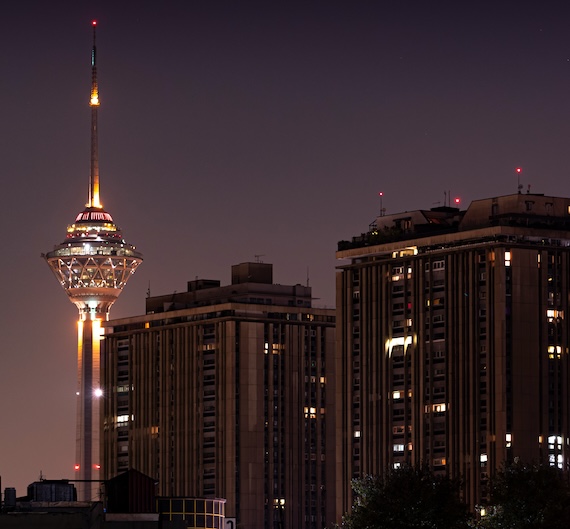
Photo of Tehran at night by Nima Ghazaei on Unsplash
Internet access acts both as a trigger for protest and as an essential organizational tool, enabling the sharing of information, mobilization of peers and real-time broadcasting of events.
The persistence of Iran’s protests despite the internet shutdown suggests that the mindset of younger protesters has not shifted. I argue that this is largely due to sustained external influence, whether through the Iranian diaspora, dissident media outlets or the limited social media content that continues to circulate via restricted access to Starlink.
Together, these channels continue to shape narratives and reinforce collective action.
Shirvin Zeinalzadeh, Graduate Teaching Associate, School of Politics and Global Studies, Arizona State University
This article is republished from The Conversation under a Creative Commons license. Read the original article.

 © 2026 All Rights Reserved