

Revised.
[Thanks to all our loyal and generous supporters for making our annual fundraiser a success! There is a lot of work to do, in both in informing the public and fighting disinformation, in 2026, and you have given us a sound basis to pursue it! Excelsior!]
New Year is a favorite subject in classical Persian poetry, though the Iranians celebrate it at the spring solstice, usually March 21, rather than just after the winter solstice. This difference leads them to adorn their New Year verse with springtime imagery, of flowers blossoming and once-isolated friends gathering again.
Saadi of Shiraz (1210-1291), the great poet, ethical teacher and Sufi mystic, wrote a ghazal or ode on the subject:
The dawn wind wafts the scent of the New Year
to friends’ delight and triumphant good cheer.
To you be blessings this and every year––
auspicious for you, this and every year
Above, when pomegranate blossoms blaze,
Don’t bother to light up the old fireplace.
Narcissuses wake up the eye of fate:
Shun spiteful foes, divert their baleful gaze.
Where is the rose? the green spring would exclaim:
Look at the nightingales lament and burn.
Without us the world has turned and will turn;
My friend, strive only to have a good name.
Likewise the fourth quatrain in Edward FitzGerald’s 1859 first edition of The Rubáiyát of Omar Khayyám is:
IV
Now the New Year is reviving old Desires,
The thoughtful Soul to Solitude retires,
Where the white hand of Moses on the Bough
Puts out, and Jesus from the Ground suspires.
اکنونکه جهانرا بخوشی دسترسیست
هر زنده دلی را سوی صحرا هوسیست
بر هر شاخی طلوع موسی دستیست
در هر نفسی خروش عیسی نفسیست
This is 13 of the Bodleian manuscript and #12 in my The Rubáiyát of Omar Khayyám, a New Translation from the Persian, which also has a fascinating historical exploration of where this poetry came from and its influence through the ages.
Heron-Allen’s literal translation is:
Now that there is a possibility of happiness for the world,
every living heart has yearnings toward the desert;
upon every bough is the appearance of Moses’ hand;
in every breeze is the exhalation of Jesus’ breath.
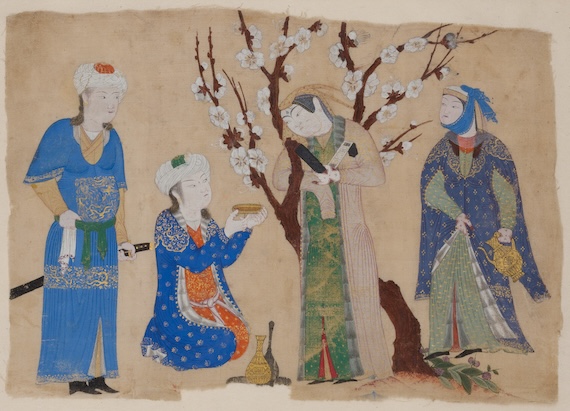
—-
Order Juan Cole’s contemporary poetic translation of the Rubáiyát from
or Barnes and Noble.
or for $16 at Amazon Kindle
——-
I explained elsewhere,
This is a poem with overtones of the Persian New Year, which falls on the Spring Equinox around March 21 and so coincides with the advent of spring.
Trees with white blooms like our magnolias or elderberries are being compared here to the miraculous white hand of Moses. Turning his hand white was one of his divine signs that God instructed the Hebrew prophet to use when he confronted Pharaoh:
Exodus 4:1,6-7
- “Then Moses answered, “But suppose they do not believe me or listen to me, but say, ‘The Lord did not appear to you.’… Again, the Lord said to him, “Put your hand inside your cloak.” He put his hand into his cloak; and when he took it out, his hand was leprous,[a] as white as snow. Then God said, “Put your hand back into your cloak”—-so he put his hand back into his cloak, and when he took it out, it was restored like the rest of his body—-”
This miracle is also mentioned in the Qur’an, and Persian poetry refers to it as a sign of renewal, since Moses can reverse the condition at will.
The other reference is to Jesus’ ability to raise the dead, as in Luke 7:11-14
- “11 Soon afterward he went to a town called Nain, and his disciples and a large crowd went with him. 12 As he approached the gate of the town, a man who had died was being carried out. He was his mother’s only son, and she was a widow, and with her was a large crowd from the town. 13 When the Lord saw her, he was moved with compassion for her and said to her, “Do not cry.” 14 Then he came forward and touched the bier, and the bearers stopped. And he said, “Young man, I say to you, rise!” 15 The dead man sat up and began to speak, and Jesus[c] gave him to his mother. “
This poetry takes a dim view of people who put off achieving their hearts’ desires. It is very much a poetry of “seize the day.” It advises against letting yourself lose hope, and urges that you express life-fulfilling passion.”

 © 2026 All Rights Reserved