
By Mina Fakhravar, L’Université d’Ottawa/University of Ottawa
(The Conversation) – Anti-government protests in Iran have killed thousands of people. The relative calm in the country today was imposed by force. Protests that began over economic collapse quickly evolved into an overt political uprising, as chants moved from demands for survival to outright rejection of the regime.
Since early January, repression has intensified sharply. Human rights organizations report thousands killed and tens of thousands arrested, while warning that the real toll is likely far higher, concealed through enforced disappearances, secret burials and executions carried out without due process.
The absence of reliable figures is one of repression’s central techniques.
Disposing of citizens
On Jan. 8, authorities imposed a near-total shutdown of internet and telephone communications. Families were cut off from one another, and the country was isolated from the outside world.
As an Iranian feminist researcher living in the diaspora, I was without news from close relatives and friends for nearly two weeks. When limited connectivity partially returned, information arrived only as fragments: unstable voice messages, blurred images, names circulating without confirmation.
This enforced silence reshapes how death is perceived. By cutting communication at the moment of killing, the regime creates a closed space of violence — without witnesses, verification, or collective response. Mourning is halted before it begins.
This confusion is deliberate. Fragmented information turns people with lives and faces into disputed numbers and uncountable bodies in overcrowded morgues. When a state eliminates witnesses, it does more than hide violence — it reorganizes power.
Cameroonian historian and political theorist Achille Mbembe defines “necropolitics” as a form of sovereignty exercised through the capacity to decide who lives and who’s disposable.
In Iran, the state is both repressing dissent and sorting lives. Protesters, political prisoners, ethnic minorities and increasingly women are positioned as expendable in the restoration of authority.
Executions without trial, enforced disappearances and the refusal to return bodies to families function as political messages addressed to the living: dissent will not only be punished, it will be erased.
Destroying livelihoods
The digital blackout is central to these efforts. By eliminating visibility, the regime has both concealed killings and transformed their political meaning. Violence becomes governable when it cannot be collectively seen, counted or mourned. Memory itself becomes something to dominate.
The blackout also destroys livelihoods. Thousands of Iranian women, excluded from formal employment by discriminatory laws and gendered hiring practices, rely on online micro-economies for home-based beauty services, tutoring, translation, handicrafts and small-scale commerce. When connectivity collapses, income disappears instantly.
This is gendered repression. By cutting digital infrastructure, the state dismantles the fragile autonomy women have carved out under structural exclusion, pushing them back into dependence, invisibility and unpaid care.
Death threats from the regime are openly displayed in public spaces. In recent weeks, banners reading “Either Khamenei or death” have appeared across Iranian cities, including at the entrance of the University of Tehran.
These are not slogans of allegiance. They are declarations of sovereignty over life itself, announcing that survival is conditional and obedience compulsory.
Targeting women
Medical professionals and human rights investigations have documented targeted shootings aimed at women’s faces, eyes and genitals, as well as sexualized violence during arrest and detention.
Families seeking to recover the bodies of slain women report being forced to obtain invasive forensic certificates prior to burial.
These practices turn female bodies into sites of political communication. The punishment targets not only dissent, but transgression itself. The “Woman, Life, Freedom” uprising revealed the regime’s deepest vulnerability: its dependence on controlling women’s bodies to sustain power.
The current escalation is retaliation. Physical violence against women is happening alongside attempts to erase the feminist meaning of the uprising itself.
Outside Iran, this reality is persistently misread. The revolt is frequently reduced to a confrontation with Islam and framed as a civilizational conflict between religion and modernity.
Such interpretations turn a political struggle into a cultural one. They’ve fuelled hesitation and selective solidarity in parts of the western left and Muslim communities, erasing decades of resistance directed not against faith, but against a regime that has used religion as an instrument of punishment, surveillance and death.
What is at stake in Iran is not faith — it’s power.
The Islamic Republic doesn’t govern through Islam as a lived religion but through Islam as institution: codified in law, enforced through policing and ultimately used as a tool to imprison, torture and kill. To view Woman, Life, Freedom as an anti-religious uprising erases a feminist political uprising that’s been unfolding since 1979, led by women who have continuously challenged compulsory veiling, gender apartheid and state violence.
Pro-royalists emerge
Recasting women’s demands as excessive or negotiable makes their suffering easier to dismiss. Repression is rendered abstract and economic collapse neutral, which obscures the fact that women continue to sustain everyday life under conditions intended to break them.
Repression inside Iran depends on silence; outside its borders, it operates through substitution. As internal voices fracture, the battlefield outside Iran is waged not with weapons, but with narratives. Other entities make efforts to interpret the situation from outside Iran when voices inside the country are silenced.
A pro-royalist stance, facilitated by access to western media and political platforms, has developed that advocates for Reza Pahlavi, son of the late Shah of Iran, taking over from the regime. It presents Pahlavi as a ready alternative to the Islamic Republic. Woman, Life, Freedom may not be openly opposed outside of Iran, but it is being gradually neutralized.
The royalist style of governing would be similar to the regime’s in that women’s bodies, deaths and courage would be forgotten once legitimacy was secured. Women’s demands would be dismissed as emotional, excessive or strategically inconvenient. Unity would be invoked to postpone equality, just as it was leading up to the 1979 Iranian Revolution.
Public interventions by prominent royalist figures have sought to deny the feminist nature of the uprising, reframing Woman, Life, Freedom as a generic nationalist revolt. In early January, Pahlavi removed the slogan Woman, Life, Freedom from his official platforms, a decision publicly criticized by activists and by the families of those killed during the 2022 uprising.
Scholars of exile politics have long warned that opposition movements risk reproducing authoritarian styles of governing when they gain legitimacy through visibility rather than accountability.
In the event of war to bring about regime change, militarization would once again define women as those expected to endure and sacrifice first. Feminist voices rejecting both dictatorship and militarized salvation are dismissed as divisive because they disrupt the masculine use force.
Iran faces a double erasure: violence imposed by a necropolitical state and reappropriation by patriarchal alternatives that promise change while sidelining women.
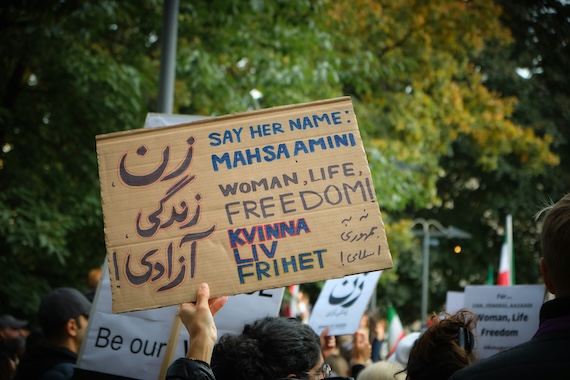
Photo by Artin Bakhan on Unsplash
Woman, Life, Freedom is not a relic. It’s a political fault line. If women’s centrality is conditional today, it will be erased tomorrow.
Mina Fakhravar, PhD Candidate, Feminist and Gender Studies, L’Université d’Ottawa/University of Ottawa
This article is republished from The Conversation under a Creative Commons license. Read the original article.

 © 2026 All Rights Reserved