
By Tara Ebrahimi | –
( The Here and Now ) – I’ve spent the last three days obsessively refreshing the New York Times app. Every few minutes there are updates: missiles raining down in Tehran, nearly 200 girls massacred by a bomb “accidentally” hitting their school in southern Iran, retaliatory attacks carried out by the country’s (few) allies, the death of the tyrannical Ayatollah Khamenei. But nowhere on the screen—no matter how far past the fold I read—is there coverage of the Ebrahimi family and what has become of them. Instead, I find locations that have been bombed and I enter them into Google Maps, plotting how far they are from my family’s apartment. I look at the red, inverted teardrop pinpointing their building, and I wonder if they will make it through this alive.
A lot of people have reached out to me with apologies and concern. I am both touched and annoyed. It’s nice to know that people care about you, but I have never felt so “other” as I do now. In my most spiteful moments, I envision these well-wishers thinking to themselves, “Oh, I know one of those people.” I picture them discussing current events at a cocktail party, casually throwing out that they have an Iranian friend who they had to check in on, proud of their diverse network. I’m being mean, I know.
Anger is just one of the many emotions bubbling up inside of me. It manifests in different ways. I think about the (few) people in my orbit who voted for Trump, and I’m so full of rage I genuinely consider calling them up on the phone and cursing them out. If YOU, John Smith, hadn’t voted for Trump, my country would be safe right now. I don’t have enough time to call 77 million people, but I can unequivocally say: you’re all either morons or assholes.
And yet I can’t blame it all on them, or even on Trump. My anger reaches back to the past, all the way to 1953 and the coup. So few Americans know that Iran wasn’t always an Islamic regime. The democratically-elected Prime Minister Mohammad Mossadegh nationalized Iran’s oil so that his country could benefit from their primary natural resource. The US couldn’t have that. So the CIA orchestrated a coup, overthrowing Mossadegh, and reinstalling Reza Pahlavi, the former Shah, who was essentially a puppet of the West. The 1979 Iranian Revolution was a direct response to this, and that’s when the Islamic Republic of Iran was born. And it has suppressed and terrorized its people ever since.
Speaking of suppression, I got into bed at 5:30pm last night and hid under the covers. I tried to distract myself with Bravo, online shopping, and wordplay games, but my mind kept rerouting itself to the children who were murdered while at school in the town of Minab. The phrase “rescue workers retrieved a severed arm” played on repeat in my brain. I am experiencing something akin to survivor’s guilt, watching my people and my country under attack, their lives upended and destroyed. Meanwhile, my life remains untouched, my daughter and son are safe in bed, their bodies intact—even though half of their blood is Persian.
I feel like I’m in Groundhog’s Day, reliving, over and over, an Iran at the brink of catastrophe. The mass murders the regime committed against its own people, resulting in 30,000 deaths in just two weeks; the 10-day war with Israel, (which the US claimed had significantly curbed Iran’s nuclear capabilities); the Woman, Life, Freedom protests of 2022; the precipice of war in 2020; the list goes on and on. From the constant fear of internal crackdowns and external war, to the failing economy and assault on civil liberties, Iranians haven’t known peace in decades. But they continue to stand up and fight for their rights, they continue to educate themselves to contribute to their society and the world, and they continue to sacrifice their lives so that their children can know a better day. Their bravery is something to behold. They are the descendants of Cyrus the Great, Darius I, the poets Rumi and Hafez, Nobel Peace Prize winners Shirin Ebadi and Narges Mohammadi. We could learn a thing or two from them as we watch our own civil liberties crumbling around us here in America.
I can’t help but think of my grandparents as I watch what’s unfolding. What would they have thought? My grandmother Nahid Joon never became a US citizen even though she lived in America for more than 40 years. Shortly before her death, she told me she wished she could be buried in Iran. My grandfather, whom I called Baba Amini, only became a citizen so he could vote for Obama. Although he was a great statesman and a powerful lawyer, Baba Amini cried often. He would tear up while reciting Persian poetry at the dinner table, he cried when he met his great grandson, he sobbed when he held my hand as he neared death. On the other hand, Nahid Joon never cried. I picture them glued to CNN in their apartment outside of Washington, DC, watching from afar as their homeland literally goes up in flames. She, crying softly. He, as silent as the eye of a storm.
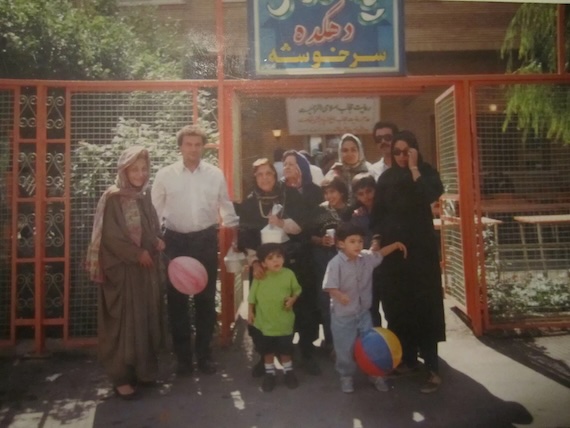
I’m no historian or political scientist, but even I know that regime change cannot come from external forces. It has to come from within. Khamenei may have been killed, but there is no organized opposition coming to step in and rule, there is no charismatic leader around which the people can coalesce, there is no one to save the day and liberate Iran. Instead, there is the Iranian Revolutionary Guard Corps (IRGC), the military that protects the interests of the Islamic Regime, and it is still very much alive. No one knows how this war will play out, but the likeliest scenario is that the IRGC will retain control, and whoever they tap to lead Iran will be even worse than Khamenei. Sure, they may be willing to talk to the US about minimizing their nuclear program, so I suppose in that regard, the war will be a success. That is, after all, how the Trump administration has framed this war: a crucial part of protecting America from an evil and vile Iran. But I have a hard time believing that’s what this is. This is Epstein. This is midterm elections. This is a narcissist vying for a Nobel Prize. But most of all, to Trump and the others, this is a game. It even has a game’s name: Operation Epic Fury. They don’t give a fuck if their own people die, why would they care about some brown people halfway across the globe.
I try to combat the images of war in my head with the snapshots of Iran I have mentally taken throughout the years. Amber-colored tea in a delicate glass fenjan sitting atop a round nalbaki. The tall cypress trees in the gardens of Shiraz. The smile of a distant family member who welcomed me into their home and insisted I eat until I could eat no more. The badgirs of Yazd, those great primitive air conditioning systems of the desert. Nahid Joon’s baklava. The blue mosaiced walls of the masjeds in Esfehan. The smell of the roses. The salt of the pistachios. The sound of children’s laughter, no different than here. My family’s open arms, ushering me back into the sweet embrace of my motherland.
Reprinted from The Here and Now with the author’s permission.
 © 2026 All Rights Reserved