
Informed Comment

Thoughts on the Middle East, History, and Religion

Juan Cole is President of the Global Americana Institute

Sunday, February 26, 2006

More Shrines Destroyed, 60 Killed
Sistani forms Militia


KarbalaNews.net reports that [Ar.] guerrillas blew up a Shiite shrine in Bashir, south of Tuz Khurmato. This Turkmen region near Kirkuk is largely Shiite. It was not clear how much damage was done to the shrine. The people of the region formed units to guard the shrines and places of worship from any further destruction.

The same source says that [Ar.] Iraqi officers announced that 20 guerrillas attacked the shrine of Salman the Persian. They killed the guards and placed explosives at the tomb, then blew it up, destroying it.

US military sources have later denied that the shrine was destroyed, though they said it did take rocket fire. The rocket was a dud, and did no damage, they say.
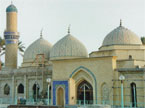


Salman al-Farisi was a companion of the Prophet Muhammad who advised the early Muslims on military tactics, and is said to have introduced the technique of digging a trench to trip charging enemy cavalry. Because he was from Iran, and because the Iranians largely became Shiites after 1500, Salman is especially beloved by Shiites. The desecration took place 24 hours after 48 Shiites were killed in the same region. They had been on their way to a peaceful demonstration against Wednesday's destruction of the Askariyah Shrine at Samarra.

Guerrillas also set off a bomb in the Shiite shrine city of Karbala, killing 8 and wounding 31.

In response to these further attacks on Islamic and Shiite shrines, Grand Ayatollah Ali Sistani called for the establishment of tribal levies to protect tsuch holy sites. He received a delegation of tribesmen from Kufa. Most of the rural clans of the Middle Euphrates are devoted to Sistani and woul be willing to provide such a militia. This proliferation of militias is however extremely worrisome.

In some of the best reporting on the role of the Shiite clerics in this crisis, Robert Worth and Ed Wong of the NYT reveal that the Americans in Iraq initially were powerless when the crisis broke out on Wednesday, and could only hope that the Shiite clerics would calm people down. They only gradually realized that the clerics were equally capable of stirring people up, and that the clerics themselves were under enormous pressure from enraged followers to do something.

This last point is why it is so dangerous for Sistani to form his tribal levies into a militia. He will be hostage in some ways to their enthusiasms.

The Iraqi army and American forces have stopped hundreds of pilgrims who had been in Karbala from heading north to Samarra.

NPR reported eyewitness accounts, corroborated by other reports, that the Mahdi Army took over several Sunni mosques in Baghdad and hung black banners from them. These banners signify the Twelfth Imam, who is associated with the tomb destroyed at Samarra. That is, the Mahdi Army took over Sunni mosques and rededicated them to the messiah of the Shiite branch of Islam, which is highly provocative.

Young Shiite nationalist Muqtada al-Sadr reached an agreement with a hard line Sunni organization to work to tamp down the communal violence.

Al-Hayat [Ar.] says that Bush called the major Iraqi politicians on Sunday to encourage them to go back to working on the government of national unity. He appears to have convinced the Sunni Arab leaders to come back to the bargaining table.

16 Comments:

At 5:01 AM, Blogger johnMccutchen said...

Bush's salvation is his worst nightmare

Violence began to recede following calls for restraint from Islamic religious leaders, including radical Shiite cleric Muqtada al-Sadr, whose own militia was blamed for many of the attacks on Sunnis.

On Saturday, al-Sadr's movement joined Sunni clerics in agreeing to prohibit killing members of the two sects and banning attacks on each other's mosques. The clerics issued a statement blaming "the occupiers," meaning the Americans and their coalition partners, for stirring up sectarian unrest.

"We demand that the occupiers leave or set a timetable for the withdrawal," the statement said.


AP

The "Firey" Cleric. That young man is going places. He'll be the nation's last best chance, a hail mary pass at the buzzer

 
At 5:32 AM, Blogger SandSkeptic said...

Power To The People?

The entre' acte between the elections (remember them?) and the formation of the new "government" is being filled first with the commedia of the cartoons-and-demonstrations and now with the tragedia of shrine-bombing and reprisals. Yet for some reason the new govt. refuses to be born. Khalilzad's outburst hints of one possible factor in the blockage--American pressure that the victors be denied the spoils. Not very democratic, but possibly well-advised.

Then there is the seeming rivalry between militias and groups such as those led by Sadr and Hakim. Is this where the real civil war is raging, or threatening?

While bombers bomb and militias act, the official police, the pick-a-number-between-one
-and-a-hundred battalions of Iraqi soldiers, not to mention the US military, all seem relatively power-
less to effectively intervene, leaving the poor taxpayer to wonder why we fund them.

As some forces try to raise tempers and force factions toward civil war, others call for calm. At the same time, blaming Americans is always popular. Perhaps this is the lowest common denominator on which all factions will be able to agree, and a burst of nationalism will unite all Iraqis in a call for Americans to withdraw post-haste. A win-win for all concerned.

Failing that, and failing agreement on a government, power seems to be devolving to the street, to militia leaders and local factions, i.e., to those natural groups that "civil society" theorists seem to like. Maybe some organization from the ground up will evolve if the politicians can't form something from the top down.

But more likely, organizations will outlast demonstrators, the civil war threat will recede, and the US will be left calling the shots for whichever group winds up in the ministerial halls. Whoever winds up in office will want to sell oil, and we'll be ready to buy. Whether the new office holders will be able to produce oil and get it to market remains to be seen.

 
At 7:27 AM, Blogger Clive of the Islands said...

Isn't it contradictory to report that the Mahdi army rededicated some Sunni mosques to be Shiite mosques and then in the next para to report that al Sadr has reached agreement with a Sunni organization to curb matters?

1. Is Sadr's Mahdi army disobeying Sadr's commands to seek unity?

2. Is Sadr duplicitous and giving his army disruptive orders while talking peace publicly?

Western reporting has similarly been full of Sadr contradictions these past few days. Why?

 
At 10:53 AM, Blogger SandSkeptic said...

What's the Point Here, Judge?

In this little MSNBC military puff piece approved by all the military PR types it went past, http://www.msnbc.msn.com/id/11569323/

we learn:

1.) We are not even pretending to be trying to win; "Senior military officials describe the Marine Corps' fight in western Anbar province more as an effort to contain an insurgency they expect to remain chronic in that area."

2.) We are still ceding sanctuary to the insurgency, as if we wanted them to keep on fighting against the odds for "a long war;" "Despite its proximity to the city, this area was visited surprisingly sporadically by U.S. troops over the last three years. Even now there are pockets where no American faces have been seen, and there still are no-go areas for U.S. troops where the roads are heavily seeded with bombs."

3.) If civil war breaks out, we're just kinda not sure what we might do, except try to stay above the fray and pull strings; "U.S. officials don't talk much about the prospects of civil war. It is unclear what role the United States would play if such a war broke out, but military strategists said American forces would be used to try to minimize violence but not to actually intervene between warring groups." Maybe that just sounds like a contradiction, and a feckless value-free stand that both sides might really be right.

4.) We seem to be considering leaving US troops in Iraq indefinitely, presumably making them Iraqi citizens at some point; "Following counterinsurgency doctrine, Ebel doesn't want to take areas and then leave them." OK, well, this point is just if you take the quote seriously and follow it to its logical conclusion.

5.) We seem to have given up on speed, mobility, firepower, and any mention of OODA loops; "So he moves his forces slowly, first establishing a checkpoint, then conducting patrols to study the area and its people, and then, after a pause, pushing his front line half a mile forward and putting up another checkpoint." It's like we are Chiang Kaishek in 1933 China surrounding Mao in Jiangsi, or maybe reading something in Karl Kraus' WWI novel, "The Last Days of Mankind."

6.) We seem to have lost any sense of why we might be in Iraq, though we have realized we aren't very good at it; "One of the surprises, they say, has been that an Iraqi soldier, even one who is overweight and undertrained, is more effective standing on an Iraqi street corner than the most disciplined U.S. Army Ranger."

So either Reporter Ricks is really good at sneaking great quotes past his minders, or the PR types have no clue as to what is going on or how it might sound to the folks back home, many of whom care more about this fight and the people in it than some in the US chain of command seem to.

Come on Ump, call this game off on the grounds of confusion, and let's get home before it gets dark.

 
At 11:08 AM, Blogger Yusuf W. said...

(Second attempt -- I wish this was simpler.)
I was heartbroken to learn of the bombing of the shrine of Salman al-Farisi, more than by any of the other terrible news of this past week. We Muslims desecrate his memory all the time -- the portrayal given him by his namesake, Salman Rushdie, is an extreme example, but all of us are guilty in some measure by dishonoring his model. Here i refer especially to the words of a very wise Turkish imam attached to the Fethullah Gulen movement, whom I once heard ask: "Would any of us have recognized Salman while he was still a fire-worshipper?" In other words, who among us can see others for their essence and the fullness of what they are to become through divine grace, rather than attaching ourselves to their external identities? It is in this light that I am disturbed by this attack -- who could possibly claim this Companion as Sunni, or Shiite, or Salaf, or anything else, and use him as a pawn in a war among believers that is utterly proscribed by definition?

 
At 11:10 AM, Blogger fillerbuster said...

You wrote that the NYT did some of the best "reporting" that the U.S. was left helpless in hopes that clerics would step in. How is what the NYT published "reporting?" Looks like a naked, unattributed assertion to me:

"Earlier, as the critical moment of Friday Prayer approached, American officials and their allies were left almost helpless, hoping oughthat Iraq's imams would step up to calm the crisis. But that hope gave way to the realization that the clerics could do as much harm as good, and for the first time since the toppling of Saddam Hussein, the Iraqi authorities imposed a daytime curfew to keep people from attending the sermons."

 
At 12:18 PM, Blogger InplainviewMonitor said...

More grey PR from NYT

Once we compare the NYT coverage of younger clerics position with AJ and wiki, it becomes clear that NYT simply takes the US / offical Iraqi position as an axiom. So, they blame Sadr for the sectarian violence and even talk about his "anti-American crusades".

This absurd language alone qualifies the NYT article for crude PR because "crusader" is a regular Islamist anti-American cursing. That is, NYT simply uses the old "I am no idiot, you're an idiot" rule.

In fact, we have no way to know who exactly does what in Iraq, so AJ makes it clear that Sadr blames pro-US forces for the destruction of Askariya shrine. In return, he is blamed for fueling the sectarian violence.

1. ROBERT F.WORTH, EDWARD WONG. Younger Clerics Showing Power in Iraq's Unrest
The violence and new militancy has come in part from a competition among Shiite factions to be seen as the protectors of the Shiite masses.

The main struggle has been between the leading factions, both backed by Iran, and their spiritual leaders.
Many of the retaliatory attacks after the bombing were led by Mahdi Army militiamen loyal to Moktada al-Sadr, the Shiite cleric whose anti-American crusades have turned him into a rising political power.

His main rival, Abdul Aziz al-Hakim, a cleric and the leader of the Supreme Council for the Islamic Revolution in Iraq, or Sciri, defended the right of Shiites to respond to the bombing. He has shown a new willingness to publicly attack the American role in Iraq, once the preserve of Mr. Sadr, and he also commands a powerful militia, the Badr Organization.

2. AJ. Iraq violence flares despite appeal
In Basra, al-Sadr appeared at a rally to call for Muslim unity against US occupation and summoned his many followers to hold joint prayers next Friday at Sunni mosques, especially those damaged in the past days' violence.

Shortly afterwards, journalists heard a loud blast nearby that turned out to have been in a Shia mosque.

Though al-Sadr's black-clad al-Mahdi Army militia have been accused by officials of taking part in attacks on Sunni mosques, al-Sadr himself, his influence rising within the ruling but factionalised Shia Islamist bloc, denies ordering violence.

However, the Shia show of force after the bloodless destruction of the Golden Mosque in Samarra has exceeded any sparked by earlier attacks and may strengthen the rival militia leaders' hands in negotiations with Sunnis and with fellow Shias.

3. Wiki on Askariya Mosque bombing

 
At 12:28 PM, Blogger Egypt Steve said...

Juan, could you comment on the theological reasons behind the desecrations of the tombs of Shi'i saints. Obviously the immediate purpose is to enrage and inflame people, but my understanding is that the Wahhabi al-Qaeda types are also on general principles completely opposed to saint verneration, even of companions of the Prophet. I have heard that even in Saudi Arabia, elaborate historical tombs associated with Companions and other early Muslim figures have been closed or demolished.

 
At 1:27 PM, Blogger johnMccutchen said...

NEWS ANALYSIS
Best Case Scenario:Analysts See Lebanon-ization of Iraq in Crystal Ball


By Borzou Daragahi and Megan K. Stack, Times Staff Writers
February 26 2006

As it was from the very beginning,
Is now and ever shall be...Amen

Welcome home from Mars Busheviks, Hillary. Hope you enjoyed your flight

 
At 1:33 PM, Blogger Mark said...

AP has reported a rocket attack that failed to do significant damage to the Salman shrine. This appears to be the first report in English of a ground attack that did significant damage.

The inability of world media to verify whether or not the shrine was blown up, so close to Baghdad, seems remarkable. You'd expect reports by now even in the era of horse and telegraph -- or dispatch rider.

 
At 3:47 PM, Blogger Charles said...

While the news so far is fragmentary for those of us who don't read Arabic, and while clearly security is tighter now than it was before the bombing in Samarra, there seems to be a very different MO.

The Askariyah bombing was very well-planned. Minister Jaafar's estimate of 16 hours required seems wildly at odds with the capacity of modern equipment. But he has a point:
* The pillars at Askariyah were drilled. That tends to be noisy and require lots of power. Unless one has very specialist equipment. Atlascopco.com is a major supplier in the area and I would speculate some of their equipment could comfortably do the drilling in an hour or so.
* The guards were, as far as I can tell, not killed, though the amount of rubble left that unclear. For that to happen without gunfire speaks of high training on the part of the attackers (or really bad or absent guards). It could mean that the attackers either wanted witnesses to describe them publicly, that they had penetrated shrine security, or that they were for some reason trusted by the guards.
* Other attacks on shrines have been more of the frontal assault variety, leading to lots of dead. Basra had a bathroom bomb, too small to have much effect. None of what I have seen shows any sophistication.
* It's hard to tell from photos, but the Askariyah bomb seems to have been designed to wreck the dome rather than permanently destroy the overall structure. I understand from Wikipedia that the dome is from 1905 (note: Wikipedia also says that 75% of the structure is destroyed, whereas my uncalibrated eyeball says that about that much will be salvaged). If this is correct, it could point to a desire to destroy a symbol. It probably would have been easier to level it than to do what they actually did.

All in all a fascinating incident, but vastly better as an object of analysis than to have to live through.

 
At 5:47 PM, Blogger newark said...

If there is a civil war, would the sunnis have any chance? The wasit, maysan, and basra province borders are open to the revolutionary guards and qods force. Syria would probably stay neutral as to not upset hezbollah and amal thereby closing the upper euphrates river valley(Qaim, Haditath, etc.) to sunni reinforcements. Sure salafis could try to cross the jordanian and saudi borders but it's all desert with no towns to hide in like the upper euphrates and the tel afar region. And the kurds would easily take mosul, kirkuk and surrounding areas. An iraqi civil war would seem more to be most similiar to the Croat-Serbian war(a complete landslide) than the Bosnian War(stalemate.)Seems to me to be 3:1 sunnis would get cleasned of babil, diyala, and baghad and left with only mostly anbar.

 
At 6:05 PM, Blogger the actual rod said...

Dr. Cole, given the realities of the day and the always aggressive posturing of the Bush Administration, could you please comment on the 'Khuzestan Gambit'? Do you think it is likely that the United States will attempt to sever Khuzestan from Iran and declare it an independent state? What outcome would you predict as a result of this action (aside from $150-a-barrel oil, which is a given)?

 
At 10:07 PM, Blogger Rabbitvoz said...

You know the thing which scares me the most is the realisation which began about the time of the provoked cartoon riots, and has matured for me now, is this.

There are just as many braindead sheeple and moronic dittoheads among the Islamic Nations as among our Corporatocratised Western Nations.

God help us but we are headed for a clash of the lowest common denominators in both our cultures.

Those of us who see are complicit to the degree we are not screaming, kicking and scratching and biting and fighting every last inch of the way.

We are all Muslim terrorists in our turn otherwise.

 
At 10:49 PM, Blogger Charles Patton said...

Is it just me, or is someone trying really hard to get Iran to intervene in Iraq and/or declare war on the United States?

 
At 9:13 AM, Blogger András said...

Salman al-Farisi, one of the most beloved Companions of the Prophet Muhammad, is a hero of the early Muslim community who helped save Medina from attack by the pagan Quraysh tribe. He is admired not only by Shiites and Sufis, but by all Muslims, including traditional Sunnis everywhere. The destruction of his tomb at al-Madai'n is likely to be welcomed only by the Wahhabi/Salafi sectarians. The Wahhabi Saudi religious authorities have been quietly destroying sites associated with Salman al-Farisi in Medina for years now. The destruction of his tomb in Iraq seems to me not only a sign of the Sunni-Shii civil war in Iraq spiraling out of control, but also of the growing ideological "Wahhabization" of the Sunni insurgency.


Post a Comment

<< Home