
( Middle East Monitor ) – Israeli policies and measures directed at Palestinians in the West Bank have steadily intensified since the current right-wing government led by Benjamin Netanyahu came to power at the end of 2022. These policies became more explicit in the aftermath of the 7th October attacks the following year, and increasingly actionable with Donald Trump’s return to the presidency, a shift openly welcomed and endorsed by Netanyahu, members of his government, and their political base. While these measures are not detached from the structural policies that Israeli authorities have gradually entrenched in the West Bank over past decades, their recent evolution has brought them together into a coherent system. Taken as a whole, they outline Israel’s emerging vision for the future of the West Bank, a vision that is in no way separable from how it envisages the future of Gaza.
A series of major aggressive and threatening measures that have marked Israel’s policies toward Palestinians and their land in the West Bank over the past two years point to a deliberate strategy, one that lays bare the occupation’s objectives for the territory. The sharp and unprecedented rise in the number of Palestinians killed, wounded, detained, and imprisoned during this period, alongside the demolition of homes and refugee camps and the forced displacement of tens of thousands from their communities, signals a new Israeli policy. It reflects a profound disregard for Palestinian lives and for their future, a reality that cannot be separated from the crimes committed against hundreds of thousands of civilians in the Gaza Strip, and from the vast destruction inflicted on its neighborhoods and civilian infrastructure during the latest war. This trajectory also coincides with a surge in settler violence, one that has reached its peak in recent months. Israeli authorities openly acknowledge their inability, or unwillingness, to rein in these attacks, an admission that points to far more dangerous roles settlers may be expected to play in the period ahead.
The recent deployment of checkpoints and iron gates, which sever the territorial continuity of towns and villages across the West Bank and paralyse daily life for Palestinians, cannot be separated from a broader policy aimed squarely at undermining the standing of the Palestinian Authority itself, and complicatind the life of people. The West Bank economy now stands on the brink. These barriers, and the chronic congestion they produce, have imposed severe economic disruption on the population. This has unfolded alongside the cancellation of most work permits for Palestinians employed inside the Green Line, a workforce exceeding one hundred thousand. The result has been the loss of nearly one fifth of the West Bank’s income. At the same time, Israel has deliberately targeted the Palestinian Authority through economic pressure. It continues to withhold clearance revenues, which account for more than two thirds of the Authority’s budget. The latest phase of this policy began gradually in 2019, then escalated sharply after 7th October, justified by shifting and unconvincing pretexts. Accordingly, debts have mounted, and public employees and retirees, whose numbers exceed one hundred thousand, have for years been denied their full salaries. The policy is not incidental. It is systematic, and it is reshaping the political and economic landscape of the West Bank.
The picture becomes even clearer with Israel’s flooding of Palestinian banks with excess shekels, while denying them the ability to transfer or dispose of the surplus. By imposing tight restrictions on financial transfers within areas under the Palestinian Authority, Israeli authorities are effectively choking the entire financial system. These measures also obstruct the Authority’s ability to meet its financial obligations to Israeli energy, electricity, and utility companies, helping to explain the recurring shortages in the supply of these essential services to Palestinians. At the same time, the Palestinian banking sector is living under constant strain, driven by Israeli threats to revoke the banking indemnity granted to Israeli banks when dealing with their Palestinian counterparts, a framework known as correspondent banking. If such a step were to be carried out, Palestinian banks would be cut off from operating through Israeli intermediary banks in their external transactions. The result would be nothing short of the collapse of banking activity across the Occupied Palestinian Territory as a whole.
The current Israeli government appears to be exerting sustained pressure to weaken the Palestinian Authority, guided by two competing visions held by different factions within the ruling coalition. The first is embraced by Benjamin Netanyahu and the military establishment. It does not oppose the continued existence of the Authority, but only in a sharply curtailed form, stripped of powers even beyond the limits set by the Oslo framework. Such an arrangement would deprive the Authority of meaningful popular representation, a core component of statehood, a process that is already unfolding step by step. The second vision is championed by Finance Minister Bezalel Smotrich, who rejects the Palestinian Authority outright and calls for the termination of its role altogether. In its place, he advances a model based on allowing a form of limited self-rule for Palestinians, confined to densely populated areas of the West Bank. Despite their differences, the two approaches converge on a shared objective, one that closely mirrors what Israel is seeking to impose in Gaza. The core idea is to permit Palestinians to manage their daily affairs, but only within rules and conditions dictated by the occupation. Whether through a weakened Palestinian Authority, deprived of real agency, or through a handpicked administrative body whose operation is organized under Israeli oversight, the outcome Israel is pursuing remains the same.
These developments unfold against a clear Israeli trajectory toward the full annexation of the West Bank, a course through which Israel seeks to settle, in practice, the question of imposing sovereignty over the land, even without a formal declaration. Such a path stands in direct violation of international law and runs counter to the stated positions of the international community. Over the past two years, settlement expansion in the West Bank has accelerated at a pace surpassing earlier phases, marking a qualitative shift rather than a continuation of the status quo. From its outset, the settlement project in the West Bank was designed as a gradual, structural process. Over decades, it engineered a new reality that privileges incoming Jewish settlers at the expense of the indigenous Palestinian population. The Oslo agreements failed to reverse this trajectory. On the contrary, they entrenched it by dividing the West Bank into three administrative categories, with most of the territory designated as Area C and placed under full Israeli control. Although these arrangements were meant to be temporary, limited to a five-year transitional period ending in 1999, Israeli control not only persisted but expanded and deepened in the years that followed.
In recent years, particularly following the ascent of Benjamin Netanyahu’s current right-wing government to power, the political influence of the settler movement has expanded markedly. Its ideas have moved from the margins to the center, shaping official policy and guiding state practice. Settlement projects have begun to signal a drive to decisively settle the struggle over land with Palestinians. The scale of settlement construction has risen to alarming levels, while the retroactive legalisation of settlement outposts has become routine, in ways unseen before the current government took office. Over the past two years, Israeli authorities have not issued a single building permit to Palestinians in areas designated as Area C. At the same time, they are systematically demolishing homes and institutions built without permits, permits that are effectively impossible for Palestinians to obtain in these areas. Annual demolition orders targeting Palestinian structures in Area C now exceed one thousand. A similar pattern is unfolding in East Jerusalem, where land confiscations and demolitions are intensifying in ways that pose a serious threat to the city’s Palestinian demographic fabric. In Jerusalem as well, Israeli authorities have begun implementing the long-stalled E1 Project, a plan frozen for two decades due to American and international opposition. The project effectively splits the West Bank in two, severs the city from its Palestinian hinterland, and places vast stretches of Palestinian land under Israeli control.
In the West Bank and East Jerusalem, Israeli authorities have embarked on a dangerous shift, the systematic land settlement process known as registration in the Israeli land registry, or Tabu. Through this process, land is recorded under Israeli jurisdiction and assigned a final legal owner, in a manner deemed definitive and immune from appeal. The recent Israeli decisions prioritizing the settlement of Palestinian land, meaning its registration under Israeli law, focus primarily on areas classified as Area C, which comprise roughly two thirds of the West Bank, as well as East Jerusalem. This approach has also begun to extend into areas classified as Area B, constituting a direct encroachment on the sovereignty of land under occupation. Following its occupation of the West Bank in 1967, Israel froze land registration in 1968. In East Jerusalem, the vast majority of land was likewise left unregistered after the city’s occupation, largely due to the complex political conditions that followed. Today, Israeli authorities impose stringent and often prohibitive requirements for proving land ownership. When owners fail to meet these conditions, the land is reverted to state ownership. A bill recently advanced in the Knesset would allow Israeli Jews to acquire such land, further complicating an already coercive process. Taken together, these measures point toward a systematic stripping of Palestinians of their land, transferring ownership to the occupying authorities and entrenching irreversible control on the ground.
In the West Bank and East Jerusalem, Israeli authorities have moved to suffocate the work of UNRWA. Its headquarters in Jerusalem have been demolished, its presence there effectively erased, and its privileges in the West Bank revoked. Refugee camps have come under direct attack. Schools, health clinics, and homes have been destroyed. Tens of thousands of Palestinians have been forcibly displaced from these camps. These measures strike at the heart of the Palestinian refugee issue and the rights attached to it. They form part of a broader effort to bring a decades-long struggle to a close on terms dictated by the occupier, and to deny the rights of the indigenous population. The escalation is particularly grave in refugee camps located in areas classified as Area A, nominally administered by the Palestinian Authority. The mass demolitions and collective displacement carried out there mark a dangerous shift, one that points to even harsher measures ahead.
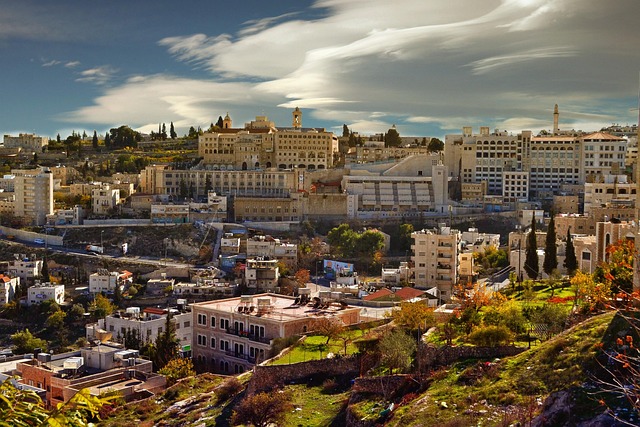
Image of Bethlehem by Gerd Altmann from Pixabay
In light of these developments in the West Bank, any formal declaration of sovereignty or annexation has effectively become a procedural step. The occupation has already entrenched its control in substance, long before any official announcement. In Gaza Strip, recent developments have been equally revealing. The appointment of an administrative committee for the Strip, the decision to shut down dozens of international humanitarian and non-governmental organizations, and the reopening of the Rafah Crossing in a degrading manner, under the direct management, authority, and supervision of the occupation, all lay bare the role Israel seeks to assume in Gaza. It is the same role it envisions for the West Bank, and has been working steadily to impose. The question, then, is unavoidable. Is there a unified and coherent Palestinian, Arab, and international position capable of confronting the occupation’s plans, now laid out in full view? Europe has demonstrated, in confronting Russia’s assault on Ukraine, its capacity to adopt a firm and unified stance in defense of international law. It has also shown, in the Greenland case, a willingness to challenge the will of the United States when that will conflicted with its own interests and understanding of sovereignty. The question today is whether Europe is prepared to reassess its position, to do justice to the Palestinians, and to confront Israel, in a cause whose legitimacy no state in the world can credibly deny, nor the historical injustice inflicted on a people who have paid the price of this failure across successive generations.
The views expressed in this article belong to the author and do not necessarily reflect the editorial policy of Middle East Monitor or Informed Comment.
 Unless otherwise stated in the article above, this work by Middle East Monitor is licensed under a Creative Commons Attribution-NonCommercial-ShareAlike 4.0 International License.
 © 2026 All Rights Reserved