
Asian and European countries left exposed as the war in the Persian Gulf disrupts oil and gas supply chains look again at their energy mix.
In early March, Iran’s Islamic Revolutionary Guard Corps (IRGC) responded to US and Israeli attacks against the country by threatening to attack any ships using the Straits of Hormuz. In response, maritime insurers have suspended insurance cover for shipping firms in the Gulf, and hydrocarbon producers there like Kuwait have cut production. On March 7, the country’s Kuwait Petroleum Corporation said “Iranian threats against safe passage of ships through the Strait of Hormuz” was one factor in its decision to implement a “precautionary” cut in crude oil production. In addition, Iranian drone and missile strikes have caused fossil gas producers like Qatar to cut production and exports too.
Strait Closure Sees Deep Industry Fears Materialise
Iran’s closure of the Strait of Hormuz in response to an attack against it has long been a major fear of national governments and the global energy industry. Around 20% of the world’s oil supplies travel through the chokepoint, as does about 20% of global Liquefied Natural Gas (LNG) supplies. Asian countries are especially exposed to an energy price shock if the Straits remain shut over the coming weeks, as 89% of the crude oil and oil condensate volumes passing through the Strait are shipped there, together with 83% of the LNG. However, European states who switched from Russian energy suppliers to the Gulf following Moscow’s invasion of Ukraine are also vulnerable to the fallout.
Fallout to Hit European & Asian Economies
In Asia, there has already been a scramble by countries like Thailand and China to ban most exports of oil and gas products like liquefied petroleum gas and diesel. Meanwhile South Korea issued a precautionary alert over possible disruptions to its energy supplies and is in talks with refineries about releasing some of its strategic petroleum reserve to counter any shortages. The South Korean industry minister said the government would need to monitor the situation closely, as “…it is difficult to predict when the [Middle Eastern] conflict will end,” but that its response to any energy supply interruptions would be “timely.”
In Europe, where the European Union needs to refill gas storage infrastructure that was emptied out over winter, tighter global Liquefied Natural Gas supplies will increase timelines and raise costs. France, Spain, Italy, the Netherlands and Belgium are the biggest LNG exporters in the EU. Italy and Belgium pare articularly exposed to disruptions in their gas supply from Qatar, which provides 30% and 8% of their LNG respectively. The emirate has shut down its Ras Laffan LNG export complex after it was hit by Iranian drones and begun leasing out its now-idle LNG tankers. Qatar’s energy minister said it would take the country “weeks to months” to return to normal deliveries even if the war ended immediately.
China Insulates Itself
Despite relying on Iran for 13% of its crude oil imports, Beijing is less exposed to the fallout from the conflict there than might be expected, compared with other Asian states or to European nations. Chinese policymakers have mitigated some of the pressures facing them through other policies, such as building up a significant crude oil stockpile in 2025. While entering talks with Tehran to allow safe passage to oil and gas cargos through the Straits of Hormuz, it has also turned to Russia as an alternative energy supplier. Beijing has also significantly increased its ability to generate electricity from coal rather than oil or gas in recent years.
Nevertheless, China’s decision to invest heavily in a transition to a green economy has also helped buffer it from Iran’s decision to turn the Strait of Hormuz into a chokepoint for the global economy. Car buyers bought an estimated 13.2 million electric vehicles there in 2025, around 53% of all new car sales there last year. The growing electrification of the country’s vehicle fleet is cutting into Chinese demand for petroleum imports. Beijing is also installing more renewable energy sources to generate electricity at home than any other major economy, installing 360 gigawatts (GW) of wind and solar capacity in 2024, or over half the globe’s renewables additions that year. Geopolitical instability in the Middle East will accelerate this ongoing green transition away from hydrocarbons.
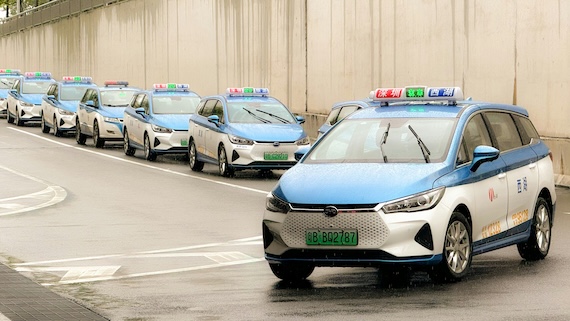
Photo of electric taxis in China by The Transport Enthusiast DC on Unsplash
Other States Likely to Accelerate Renewables, Electrification
For trade reasons, Beijing has faced resistance from EU policymakers about allowing Chinese-made electric vehicles, wind turbines and other green products into the bloc. But both European and Asian governments are likely to follow the Chinese playbook of developing greener transport and power sectors that don’t rely as much on external hydrocarbon exporters for fuel and energy. Asian states like South Korea that looked set to replace coal power-generation with LNG instead of renewables may reconsider the wisdom of relying upon LNG suppliers like Qatar or even the US after the current conflict. The White House’s actions have triggered an energy shock for allied nations that US energy exporters stand to benefit from, at least in the short-term.
Even before the US-Israeli attack on Iran, the EU had already been accelerating its switch to clean power production, as the bloc worked to break free of energy dependency upon Russia. However, Iranian attacks on shipping in the Strait and energy infrastructure in Gulf countries will damage European perceptions of the region as a safe alternative energy supplier to Moscow, incentivising renewed stress on domestic renewables production there. Over a quarter of the bloc’s energy was produced from domestic renewables sources already in 2024, per the European Environment Agency in 2025. Electric vehicle uptake is also increasing in EU states, per the European Automobile Manufacturers’ Association’s data in January.
Conclusion
From a geopolitical point of view, domestic sources of renewable energy make for a much safer energy alternative for global economies. The US and Israeli attack on Iran and Iran’s response by closing the Strait of Hormuz has demonstrated the flaws in the current global energy industry model and helped vindicate early adopters like China of the shift to green energy sources and technologies. The post-conflict race by other countries to catch up with Beijing is likely to bring down the price of goods like wind turbines or electric vehicles globally by improving innovation and cutting distribution costs. The Gulf states and Iran are likely to remain major hydrocarbon exporters for many years following the conflict, but precedents set in this conflict will ensure that energy importers will always hedge against a repetition too.

 © 2026 All Rights Reserved