
33 Dead in Civil War
7 US Troops Killed over Weekend
Basra in Chaos as Tribes Feud
On Monday, scattered bombings and shootings left at least 33 persons dead by my count. Dozens more died over the weekend in fighting between guerrillas and US troops. Al-Zaman says that security has collapsed in Basra, with fighting between tribesmen and the Supreme Council for Islamic Revolution in Iraq. Reuters reports that on Monday:
MOSUL: Guerrillas detonated a bomb in the northern city, killing one policeman and wounding 2 others.
RAMADI: Heavy fighting between local guerrillas and US troops left 8 dead and 9 wounded.
BALAD RUZ - Guerrillas shot down 4 primary school teachers in Diyala Province an hour's drive from Baquba.
WAJIHIYA: Guerrillas east of Baghdad fired a mortar shell that landed on a civilian home, killing a seven-year-old girl and wounding 7 members of her family.
BAGHDAD: Five members of a family in the capital were shot dead.
MAHAWEEL: Guerrillas detonated a bomb that wounded 3 policemen and left a civilian bystander dead.
KARBALA: A policeman who had earlier been abducted showed up dead in the Shiite shrine city on Monday. (Two ex-Baathists were also assassinated.)
AMARA: A mortar attack on a British base wounded one soldier seriously in the leg and inflicted minor injuries on three others.
BASRA: Tribesmen of the Marsh Arab Karamisha [Gramsha] tribe killed 11 policemen in and around Basra. They may have been taking revenge for the killing of one of their clan chiefs by persons dressed as special police commandos, a unit heavily infiltrated by the Badr Corps of the Supreme Council for Islamic Revolution in Iraq.
Al-Zaman/ AFP report that the security situation in Basra has collapsed in the wake of the killing by persons dressed as Iraqi policemen of Shaikh Hasan Jarih al-Karamishi, the head of the al-Karamisha tribe in Basra. Firefights subsquently broke out in several districts of the city at a time of political vacuum in the central government. Majid al-Sari, adviser to the Minister of Defense, said that individuals from this tribe came out into the streets of the city heavily armed and killed 11 policemen in the course of an attack on a police station in the Dair quarter to the south of the city. They also burned down two buildings used as party headquarters in the Intisar district of the Dair quarter by the Supreme Council for Islamic Revolution in Iraq.
(In the time of Saddam, the Marsh Arab tribes--who typically had dwelled in the marshes of the south as fishermen and smugglers, were most often forbidden from entering urban Basra, but this prohibition has broken down).
Al-Sari said that for the last month, Basra has been afflicted by a mass of assassinations, equalling one each hour of the day. (That would be 24 a day, and 720 for the month). Sources in the city allege that the police are helpless to intervene, and indeed refuse to go out to the crime scene to attempt to capture the assassins, since they would take fire from tribesmen supporting the assassins, who belong to their tribe.
Two organizations, Rebels of the Uprising and the Revenge of God (Tha'r Allah, a branch of the Badr Corps) staged demonstrations Sunday and Monday against Governor Muhammad Misbah al-Wa'ili in protest against the collapse of security in the city.
Al-Zaman's sources told it that Basra is in chaos and dominated by militias and lawless gangs. Automobiles with darkened windows cruise the streets, armed militiamen within, who impose their law on the city. These sources blamed Kuwait and Iran for the situation, alleging that their intelligence services are funding and arming the Iraqi militias for their own purposes. Tribal firefights between the Marsh Arab Al-Bait Sa'idah tribe and the Bani Mansur are common-- as is fighting between Bani Ammar and Al-`Ashur. The sources say that Basra is without authority save that of the militiamen. The major political parties are unable to dampen down the violence because they are so divided against one another.
Basra is boiling these days and tempers run hot, with highs of 106 degrees Fahrenheit (41 C.). It gets no electricity for most of the day, especially in the al-Hayaniyah and Abu al-Khasib districts, where there are demonstrations every evening against the lack of services.
President Jalal Talabani is so alarmed by the situation that he and his vice-presidents, Adil Abdul Mahdi (SCIRI) and Tariq al-Hashimi (Sunni religious) have opened a hotline to government security forces in Basra. Al-Sari requested that the central government withdraw the security file from the local authorities and turn it over to the new Iraqi army.
The governor of Basra, al-Wa'ili, is trying to fire the police chief. He complains that the Basra police have not undertaken a single investigation of the hundreds of recent assassinations. He further charges that some in the Iraqi border patrol and the army have suspicious ties to the assassins. Al-Wa'ili also charges that two clerical representatives of Grand Ayatollah Ali Sistani are involved in the collapse of security. [This charge is not plausible, and may reflect al-Wa'ili's allegiance to Ayatollah Muhammad Ya`qubi, the spiritual leader of the Fadila Party, a rival of Sistani.)
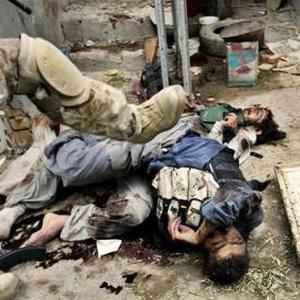
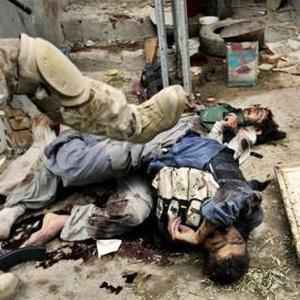
For those with the stomach to see what the aftermath of Iraq's daily violence actually looks like, Afterdowningstreet.org has posted dozens of never-before-seen photographs of the violence. Those of us who have seen war know that it involves blood. This one has not for the most part, if one were to judge by US television and the US print press, an editorial decision that I find cowardly and inexcusable. Warning: One of the photos is reproduced below.
Over the weekend, the US military fought engagements against Sunni Arab guerrillas in the area south of Baghdad, killing 41 suspected insurgents. On Sunday during the fighting, a guerrilla shot down a US helicopter. Guerrillas also killed other GIs over the weekend, bringing the US death toll for the last 3 days to 7.
The US military admits that the guerrilla fighters in the area south of Baghdad are "bold and getting bolder" in their attacks on Iraqi and US forces.
Sunni Arab religious leaders of the Association of Muslim Scholars rejected the US characterization of the fighting south of Baghdad, saying that many civilians had fled their homes at the US advance and had been killed. The US military maintained that the dead were guerrillas.
President Jalal Talabani shot down a suggestion that Prime Minister-designate form most of a cabinet but leave Defense and Interior for later. Talabani has a keen interest in who has these two security-related posts, since the Kurds want to keep the central government in Baghdad weak and toothless. If he let al-Maliki become prime minister before filling these cabinet positions, he would lose his leverage over who is appointed to them down the road.
Sunni vice president Tariq al-Hashimi yielded to pressure from Iyad Allawi, who insists that Defense be filled by a Sunni Arab from his list. The religious Sunni Arab party had wanted the position for itself. The unspoken objection there was that the religious Sunni Arab politicians are suspected of having links with the guerrillas fighting the insurgency, and no one thinks it is a good idea to give them the ministry of defense. On the other hand, the Allawi list has ex-Baathists who might pack Defense with other ex-Baathists, which would not please the Shiites or Kurds.
Some in the British press are openly saying that Basra is lost and that Prime Minister Tony Blair's assurances show he is living in an alternative dimension. Whether it is true or not, saying it shows some spunk that is mostly lacking over here.
Warning: What follows is a graphic image:

8 Comments:
The British 'policy' in Iraq is in free fall now. Senior MPs from Blair's party want him to justify the presence of the troops who have been shown being protected by the Iraqi police!
The Brits are basically hostages to the militias who will hit them whenever threatened by the US or even the Iraqi forces.
There is also a serious danger they could be forced to flee en-mass because of their small number and reluctance to hit back.
Blair is now incredibly weak, and being turned into a punch bag. The British officers have been making strong statements against the occupation, and something will soon have to give.
This should be a lesson to the USA who want to, actually have to, withdraw most of the troops leaving the remaining ones to face the music.
A British withdrawl will also add the South to the US responsibility.
Juan:please comment on the alegations of Cry Wolf that the wave of death squads is organized by the US much as those of Latin America under Reagan and the very same John Negroponte
Crying Wolf: Who is behind the Death Squads in Iraq?:
Viewers should be &aware that due to the nature of the subject, some images within this movie are of a disturbing nature. The implications of the evidence are even more disturbing.
http://www.cryingwolf.deconstructingiraq.org.uk/index.html
Can someone please explain or point to resources that explain the use of the word ‘tribes’ to describe demographics in Iraq? What does it mean in this context? I presume that middle class Iraqis don’t have much allegiance to ancestral tribes, right? It must be lower classes? Are neighborhoods or towns organized along these lines? It’s always been a baffling designation.
Thanks,
Seth
US media avoidance of graphic war violence may not be mere cowardice or political passivity.
The "afterdowningstreet" site you cite presents the photos as "war trophies." Whatever their alleged source or purpose, doesn't the Geneva Convention prohibit publication of corpse photos for propaganda purposes?
That aside, were you to insist that US media feature more gore, it might instill an effect contrary to what you might expect. Relatives of US vicitms might sue the publishers, and the Right would insist that most of the Iraqi dead were vicitms of al Qaeda, "proving" how important it is to fight Osama in Baghdad and not here.
The military would also go ape, since the sanctity of the profession depends on keeping its most gristly aspects off-scene (the literal meaning of ob-scene). Surgeons, undertakers, and butchers need the same professional curtain.
Finally, the most likely consequence might simply be prohibition of cameras and the court martial of violators. The bad-news messenger usually losses.
I would like to answer the very useful question from irradiated_pig
The ancient Iraqis where the first urban people in the world. It all started with the first irrigation networks and tribal squabbles about water distribution. Written Laws where created to settle the disputes first and then to enable communal grains storage, trading, bureaucracy, courts, temples, schools, etc.
However, tribalism remained in the rural areas, and to this day. So it is not a matter of classes. It is where people live. Over 60% of Iraqis are urban BTW.
Arab tribes have for centuries accepted the authority of the state.. unlike the Kurdish tribes.
Britain and France first promised the Kurds independence, but later reneged for fear of endless fueds, so they dumped the problem on Iraq.
Some city dwellers do maintain tribal allegiances above that of the state, particularly in Kurdish cities and in slums inhabited by people who recently immigrated from the countryside.
Urban Iraqis take an interest in their tribal origins, but it is a bit like the Scots' interest in their clans.
The Baath party banned the use of family names in the early 70s in order to dilute tribalism. The first name of the grandfather was used instead of family name.
But as Saddam's grip on power started to weaken he turned to tribal sheiks for help, which is exactly what the Yanks did after the invasion. The rise of tribalism can only be temporary though because the tribes, Arab at least, want a higher authority to prevent the endless fueding and bloodshed among themselves. That higher authority does not exist right now because the USA has turned Iraq into a failed state. It will soon return after the Yanks clear off. Just wait and see.
"On Monday, scattered bombings and shootings left at least 33 persons dead by my count. [City by city list of violence.]"
"Al-Zaman/ AFP report that the security situation in Basra has collapsed in the wake of the killing by persons dressed as Iraqi policemen of ....[more details of civil war]"
Given that this is the largely the consequence of the US spending close to half a trillion dollars to export democracy to Iraq, we should all give thanks this money was not used to purchase type A flu vaccines for Asian poultry workers and to develop an avian flu vaccine for all of us.
I do not believed we could have survived that.
The new frontier of the UK media
With Iraqi war spinning out of control, British media situation also gets worse and worse. What happens is that news titles use to say only about British loss numbers which are minimal. As for overall situation on the ground, finding any meaningful info become pretty hard.
Now it appears that British occupation forces have major problems with controlling Basra.
Meanwhile, Blair and New Labour lose whatever remains of their respectability, S.Bell's cartoons turn unamusingly gruesome. Sadly, there is more and more of the most yellowish stuff which was previously confined to Murdoch's the Sun.
1. The British lose Basra
TAKING Basra was unexpectedly easy for the British army during the invasion of Iraq in 2003. The 7th Armoured Brigade spent a fortnight on the outskirts of Iraq’s second city before it entered, fearing street fighting and civilian casualties. Instead the fabled Desert Rats were greeted by an excited crowd, some handing flowers to infantrymen who were happy to put them in the barrel of their guns. It is hard to think of a starker contrast with the murderous hostility which the British military faces in the city today.
The RAF Lynx helicopter shot down last week by a shoulder-launched missile is a stark illustration of how bad the situation has become. When troops rushed to retrieve the bodies of their five comrades, they were showered with stones and abuse. This is now the norm. British troops who once kept the peace in Basra now seldom venture outside their garrisons. They use helicopters as air taxis; it is too dangerous for them to travel by road. This, not the events of April 2003, marks the fall of Basra.
In Prime Minister Tony Blair's parallel universe, the loss of the Lynx and its crew was an "isolated incident" that has been "magnified" by the media (to use the words scripted for Des Browne, the new Defence Secretary).
2. Oliver Poole. After seven British deaths in a week, Basra's police chief is linked to terrorists
Re Irradiated_pig query on tribes in Iraq, traditional assumptions are that urbanization undercuts and eventually eliminates tribal loyalties, replacing them with broader economic class or profession loyalties. I.e. the emergence of an urban middle class is assumed to be necessary for the formation of nation-based political loyalties. That might be true over, say, 3-4 generations, but only if the economic/social structures change. In Iraq the process did begin to change things from '75 on, but you're only talking about one or two generation here. To this add that every government from the Ottomans onwards (except perhaps Qasem - '58-'63) have fallen to the temptation to play to the existing tribal political structure, thus reinforcing to old tribal loyalties rather than encouraging their demise. To the point - urbanized Iraqis with degrees from Oxford and driving Landrovers anywhere in Iraq certainly can be and often are tribal in political behavior, particularly when the central government offers none of the security and other elements given by the local government - the tribe. Don't make the mistake of thinking someone with tribal loyalties is of necessity "primitive" or rural.
Post a Comment
<< Home
