One Ring to Rule Them
The wholesale destruction of all of Lebanon by Israel and the US Pentagon does not make any sense. Why bomb roads, bridges, ports, fuel depots in Sunni and Christian areas that have nothing to do with Shiite Hizbullah in the deep south? And, why was Hizbullah's rocket capability so crucial that it provoked Israel to this orgy of destruction? Most of the rockets were small katyushas with limited range and were highly inaccurate. They were an annoyance in the Occupied Golan Heights, especially the Lebanese-owned Shebaa Farms area. Hizbullah had killed 6 Israeli civilians since 2000. For this you would destroy a whole country?
It doesn't make any sense.
Moreover, the Lebanese government elected last year was pro-American! Why risk causing it to fall by hitting the whole country so hard?
And, why was Condi Rice's reaction to the capture of two Israeli soldiers and Israel's wholesale destruction of little Lebanon that these were the "birth pangs" of the "New Middle East"? How did she know so early on that this war would be so wideranging? And, how could a little border dispute in the Levant signal such an elephantine baby's advent? Isn't it because she had, like Tony Blair, been briefed about the likelihood of a war by the Israelis, or maybe collaborated with them in the plans, and also conceived of it in much larger strategic terms?
I've had a message from a European reader that leads me to consider a Peak Oil Theory of the US-Israeli war on Lebanon (and by proxy on Iran). I say, "consider" the "theory" because this is a thought experiment. I put it on the table to see if it can be knocked down, the way you would preliminary hypotheses in a science experiment.
The European reader writes:
'When I was in Portugal I also watched a presentation by a guy who works for the ministry of energy in that country, a certain [JFR].
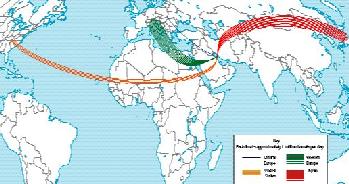
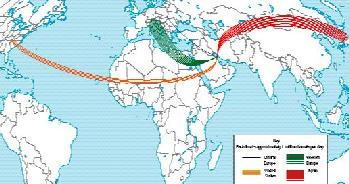
He started his presentation with the growing need for oil in China and India. He stressed that China wants to become the 'workshop' of the world and India the 'office' of the world. both economies contributed combined some 44% to world economy growth during 2001-2004. He compared the USA, Japan, India and China to giant whales constantly eating fish. They had no fish near them so they started to move. He explained that the Persian Gulf is the 'fish ground', the 'gas station' of the world.
Later on he explained the . . . hypothesis . . . that says demand for oil will continue to grow. also for natural gas, which is even better than oil. Sadly the existing production is getting smaller, these fields are getting emptied. [One oil major] seems to believe that the gap between demand and existing production will become so large by 2015 that economic growth cannot continue. Yet there is hope on the horizon.
JFR strongly denied that there is going to be an oil peak. He says, and the oil multis seem to agree with him [- my link, JRC], that there is more than enough untouched oil and natural gas. The stupid thing: it is further to the east. Partly in Russia, but most of all, in Iran.
JFR explained to the astonished audience that Iran was the most valuable country on the planet. They have one of the biggest holdings of gas and oil reserves in the world. second in gas, second in oil. On top of that they have direct access to the Persian Gulf, the Arabian Sea and the Caspian Sea what makes them a potential platform for the distribution of oil and gas to South Asia, Europe and East Asia. JRF called Iran 'the prize' . . .
The disaster in Lebanon actually was also part of JFR's presentation. He explained that the US government is 100% convinced, fanatically and completely convinced, that both, Hamas and Hizballah are creatures of Iran and that Iran uses them to undermine US goals in the region . . .
The presentation got kind of freaky then. He said the US government wanted to stop state-controlled Iranian or Chinese (or Indian) companies from controlling the oil. JFR says the US Government is convinced that this battle will decide the future of the world. It sounded like he was talking about 'the one ring' in lord of the rings. he who controls Iran controls them all. '
It is very important that some EU analysts see things this way. They are in contact with their American counterparts, and may be reflecting a wider North Atlantic view and speaking more openly than is common in Washington.
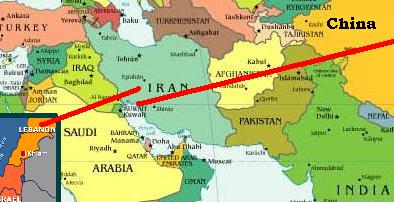
It is true that Iran's regime is hostile to US corporate and investment interests. Iran itself has substantial energy resources, many of them undeveloped, but they are locked up by state-owned Iranian companies.
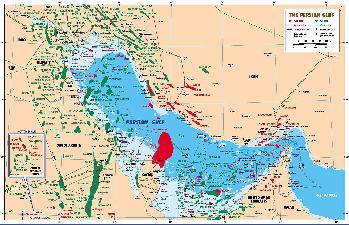
Iran is astride the Oil Gulf, which has the majority of the world's proven gas and petroleum reserves. Iran has a silkworm missile capability that could interfere with oil tankers in the Straits of Hormuz. It also has emerged as the most influential country in oil-rich South Iraq, which is, like Iran, Shiite Muslim.
Iran is no credible military threat to the United States, though US warmongers are always depicting it as such, rather as they manufactured ramshackle 4th-world Iraq into a dire military menace to the US, allowing for a war of choice to be fought against it.
The regime in Iran has not gone away despite decades of hostility toward it by Washington, and despite the latter's policy of "containment." As a result, US petroleum corporations are denied significant opportunities for investment in the Iranian petroleum sector. Worse, Iran has made a big energy deal with China and is negotiating with India. As those two countries emerge as the superpowers of the 21st century, they will attempt to lock up Gulf petroleum and gas in proprietary contracts.
(Since it is already coming up in the comments, I should note that the "fungibility" (easy exchange) of oil is less important in the new environment than it used to be. US petroleum companies would like to go back to actually owning fields in the Middle East, since there are big profits to be made if you get to decide when you take it out of the ground. As Chinese and Indian competition for the increasingly scarce resource heats up, exclusive contracts will be struck. When I floated the fungibility of petroleum as a reason for which the Iraq War could not be only about oil, at a talk at Columbia's Earth Institute last year, Jeffrey Sachs surprised me by disagreeing with me. In our new environment, oil is becoming a commodity over which it really does make sense to fight for control. See below.*)
In a worst case scenario, Washington would like to retain the option of military action against Iran, so as to gain access to its resources and deny them to rivals. If Iran gets a nuclear weapon, however, that option will be foreclosed. Iran may not be trying for a weapon, and if it is, it could not get one before about 2016. But if it had a nuclear weapon, it would be off limits to US attack, and its anti-American regime could not only lock up Iranian gas and oil for the rest of the century by making sweetheart deals with China. It also might begin to exercise a sway over the small energy-producing countries of the Middle East. (The oil interest would explain the mystery of why Washington just does not care that Pakistan has the Bomb; Pakistan has nothing Washington wants and so there was no need to preserve the military option in its regard.)
Even an Iranian nuke, of course, would not be an immediate threat to the US, in the absence of ICBMs. But the major US ally in the Middle East, Israel, would be vulnerable to a retaliatory Iranian strike if the US took military action against Iran in order to overthrow the regime and gain the proprietary deals for themselves.
In the short term, Iran was protected by another ace in the hole. It had a client in the Levant, Lebanon's Hizbullah, and had given it a few silkworm rockets, which could theoretically hit Israeli nuclear and chemical facilities. Hizbullah increasingly organizes the Lebanese Shiites, and the Lebanese Shiites will in the next ten to twenty years emerge as a majority in Lebanon, giving Iran a commercial hub on the Mediterranean.
China and India could get Iran, and Iran could get Lebanon, and as non-OPEC energy production decreases, the US and Israel could find themselves out in the cold on the energy front.
As for Iran, the DOE says this:
' Iran's largest non-associated natural gas field is South Pars, geologically an extension of Qatar's North Field. Current estimates are that South Pars contains 280 Tcf or more (some estimates go as high as 500 Tcf) of natural gas, of which a large fraction will be recoverable, and over 17 billion barrels of liquids. Development of South Pars is Iran's largest energy project, already having attracted around $15 billion in investment. Natural gas from South Pars largely is slated to be shipped north via the planned 56-inch, 300-mile, $500 million, IGAT-3 pipeline, as well as planned IGAT-4 and IGAT-5 lines. Gas also will be reinjected to boost oil output at the mature Agha Jari oil field, and possibly the Ahwaz and Mansouri fields. Besides condensate production and reinjection/enhanced oil recovery, South Pars natural gas also is intended for export, by pipeline and also possibly by liquefied natural gas (LNG) tanker. Sales from South Pars could earn Iran as much as $11 billion per year over 30 years, according to Iran's Oil Ministry. '

Persian Gulf Fields
and this is why Iran's reserves are even more important:
' The Persian Gulf contains 715 billion barrels of proven oil reserves, representing over half (57%) of the world's oil reserves, and 2,462 Tcf of natural gas reserves (45% of the world total). Also, at the end of 2003, Persian Gulf countries maintained about 22.9 million bbl/d of oil production capacity, or 32% of the world total. Perhaps even more significantly, the Persian Gulf countries normally maintains almost all of the world's excess oil production capacity. As of early September 2004, excess world oil production capacity was only about 0.5-1.0 million bbl/d, all of which was located in Saudi Arabia.'
Non-OPEC production will decline sharply in coming years, increasing the importance of the Persian Gulf region. The point about excess capacity is this: The US in 2005 produced over 7 million barrels of petroleum a day, but consumes all of it, and then imports two times that from abroad (using nearly 22 million barrels a day in 2005). So US petroleum is essentially off the market. But Saudi Arabia produces 9.5 million barrels a day and exports over 7 million of that. It doesn't use it all up at home. Even now, the excess production is in the Gulf, and that excess production will become more important over time.
It may be that that hawks are thinking this way: Destroy Lebanon, and destroy Hizbullah, and you reduce Iran's strategic depth. Destroy the Iranian nuclear program and you leave it helpless and vulnerable to having done to it what the Israelis did to Lebanon. You leave it vulnerable to regime change, and a dragooning of Iran back into the US sphere of influence, denying it to China and assuring its 500 tcf of natural gas to US corporations. You also politically reorient the entire Gulf, with both Saddam and Khamenei gone, toward the United States. Voila, you avoid peak oil problems in the US until a technological fix can be found, and you avoid a situation where China and India have special access to Iran and the Gulf.
The second American Century ensues. The "New Middle East" means the "American Middle East."
And it all starts with the destruction of Lebanon.
More wars to come, in this scenario, since hitting Lebanon was like hitting a politician's bodyguard. You don't kill a bodyguard just to kill the bodyguard. It is phase I of a bigger operation.
If the theory is even remotely correct, then global warming is not the only danger in continuing to rely so heavily on hydrocarbons for energy. Green energy--wind, sun, geothermal-- is all around us and does not require any wars to obtain it. Indeed, if we had spent as much on alternative energy research as we have already spent on the Iraq War, we'd be much closer to affordable solar. A choice lies ahead: hydrocarbons, a 20 foot rise in sea level, and a praetorian state. Or we could go green and maybe keep our republic and tame militarism.
=========
An informed reader writes:
"Jeffrey Sachs is right. Oil is fungible only after its out of the ground. The name of today's game is control of reserves, not markets. Example: china's deals in Latin America, US development of non-Nigerian African resource, etc."
86 Comments:
I'm not sure I understand...after Iraq, someone is crazy enough to believe we can turn Iran back into a client state?
Not much of an authority on peak oil but here are two links of interest.
The renegades at D-N-I seem particularly taken with the theory.
Pentagon and Peak Oil: A Military Literature Review
by Sohbet Karbuz (Energy Bulletin)
Join us as we watch the crisis unfolding
Kenneth S. Deffeyes (DNI)
As for me, I've long ago concluded that the "rational actor" model doesn't really explain much. Since when are human beings "rational"???? At least rational consistently enough to make the model worthwhile
Juan,
I don't doubt that the Neocons think very much like this. The other factor though, is that they are total screwups from the getgo. Whatever their objectives, they seem to pursue them with utter feclessness.
I can buy the notion that Israel intends to get rid of Hezbollah on its northern border, because Hezbollah acts as a check on Israel in dealings with Iran. If Israel attacks Iran, Iran doesn't have the technical capacity to reach Israel directly to retaliate but it can do so through the Hezbollah.
However, there are two problems with the oil theory.
First, the Iranians even now are perfectly happy to sell oil/gas/whatever else to the US. In fact, it is the AIPAC-inspired US sanctions laws that are preventing US companies from entering in deals with Iran.
Second, oil is fungible. Thus, the price of oil depends on the world trade and isn't set by any single country/company. Iran can only sell the oil/gas at whatever price the market sets, to any buyer.
Here's my theory: Israel is scared to death that some US president down the road will "Go to China" as Nixon did, but this time with Iran. In such a case, Israel will have the position of a Taiwan: kicked to the curb. A rapprochement between the US and Iran which doesn't run through Tel Aviv will be a danger to Israel's status as the US darling of the Middle East amd will threaten Israel's ambitons on the Mideast. After all, Iran is the largest, most populous and probably most stable nation of the Mideast, with immense resources, located in a highly strategic position, and with a great deal of influence on surrounding nations. It also potentially presents a huge market for the US. In short, Iran is a major obstacle to Israel's strategic ambitions. So, Israel has been consistenly trying to prevent any potential US-Iran rapprochement, and has instead been pushing for a US-Iran confrontation, in the hopes that the Iranians will fold in favor of Israel.
That's the big picture. Its just a theory but I passes the smell test.
Cheers
Fox News and the Senators at the 08/03/06 Senate Armed Services Committee Hearing are calling for a stike on the second "Body Guard", Iraq's Shite's, particullarlly Muqtada al-Sadr.
It would seem to me that Iran's best option would be to buy a few nukes from China in exchange for some sweetheart energy deals. The US & Israel won't attack a nuclear power, and while they'll kick up a stink at China, the US is so far in hock to China there's not a whole lot they can do about it, short of starting WW4.
Mordor does seem to be winning, God help us all.
It's very, very sad.
You are much more qualified to evaluate this guy's theory than I am. Perhaps you saw it? Is it wobbly or does the argument have any merit?
God help us all. We here on the West Coast are hunkering down, trying to go green with our solar panels on the hardware store and our bike lanes and public transit. Please, please, please can't we just make a lot of money inventing new alternative energy applications?
Your scenarios presume that there is enough oil and gas in Iran and the Persian Gulf to avoid a supply crunch. This premise may be simply false, though in the absence of reliable, publicly available information about reserves, nobody really knows. Unfortunately, if oil is indeed apporaching a peak, the likelihood of an attack on Iran is even greater as mankind begins a global game of musical chairs.
Wow! Awesome post. Addresses the hot issues. You put the working hypothesis out there for discussion, and there is quite a bit more to the problem than one can discuss in a short essay.
Peak Oil is the theory that oil field production follows a bell curve. At the peak rate of production, approximately have the reserves have been pumped; about half remains and it will be recoverable at declining rates.
Marion King Hubbert put forth the idea with respect to American oil fields in the fifties.. His prediction of a peak in 1970 missed by a few years due mainly to contribution from the Alaskan fields which were not in his calculations. He predicted world-wide production would peak in 2000. Ken Deffeyyes predicted world production would peak on Thanksgiving Day, 2005. He later adjusted the date to Dec. 17. Although the Thanksgiving date was partly in jest, the Dec. date is considered to be moderately accurate.
Matthew Simmons has studied Saudi production. He claims the Saudis are overproducing their fields. Overproduction causes a rupture in the continuity of the oil-bearing strata resulting in part of the reserve becoming permanently unrecoverable. Gone forever.
Simmons says that the Saudi fields will collapse rather than taper off. In other words, the world will lose 9.5 mbd withing a short period of time. Economic strife.
It would seem, then, that the effect of the insurgency, with the attacks on Iraqi oil facilities, may have done quite a bit to damage Saudi oil fields (because they had to continue to overpump rather than let increased Iraqi oil take up the slack). Ha!
Iran wants nuclear power because it then can save its precious fossil fuel for future use.
Natural gas is important for electric power generation. Without ample gas in Europe, Great Britain, which is at the end of the European pipelines, stands to suffer through bitterly cold winters without adequate heat if gas supplies become limited.
Consequences for the US and Israel are equally severe though slightly different.
Israel has the problem of inadequate water. Without water, there is no food.
Israel needs fuel for electric power and also for transportation. It stands to be totally without oil in a Shiite influenced Peak Oil world.
Israel is counting on, I think, Kurdish Iraq to supply it with oil but it needs to get the fuel to Israel.
Syria would be in a position to cripple Israel under this circumstance.
Israel has another problem. Natural gas is the feedstock for nitrogen fertilizer. CH4-->Nh4-->NO3. Coal can be used in replacement, but Israel's coal fields are tapped out. (That's a joke, son.)
Without intensive fertilization, Israel needs more land just to break even. Ergo, take Lebanon. Ergo, see to it that the Lebanese die of thirst, starvation, exposure or disease.
The US has a different problem. We have enough fuel and gas to maintain our population (or perhaps 200 million of us), but not our lavish SUV lifestyle. Our economy, right now in 2006, is based on expansion of the housing market. An oil crunch causes the suburbs to be uneconomical, big box stores to be unprofitable, and major unemployment looms.
Not to worry, Homeland Security has a re-education farm camp ready for you if you lose your job and fall behind on your payments. Just kidding. At least I hope so.
With a collapse of the housing market, and with competition from China, which holds our dollars in their savings accounts (testicles in hand, the heart and mind soon follow), the US stands to be defeated merely because we would have no economy, no money with which to import consumer goods or food, no manufacturing base to rebuild with, and no fuel to use to drive to ABC for elixor.
Basically, we are screwed. Even without upset, we are screwed. Best I can figure is that Cheney stole the election just so he and his pals could set up a system to protect themselves.
Now, if the US economic systems suffers a great decline, how will we be able to use our influence to protect Israel?
It is the potential of Iran getting a weapon which makes Israel scared simply because it means one act by Iran could ruin the Israeli dream, and the threat could make Iran invulnerable to blackmail.
From a global perspective (meaning, I would like to see life on the globe continue), an Iranian bomb is good for the US as it keeps us from doing something really stupids which could destroy us all.
There is more. Our vulnerabilities are greater than I have described, Israel's too, the evil intent of Cheney and Olmert worse than described, etc. but just the mechanics and interplay described here is a lot for one sitting.
My theories: The attack on general Lebanese infrastructure is meant to minimize the extent to which Hizbullah can be resupplied from outside the country. And, Israel wants to destroy Hizbullah's rocket capability before they graduate to longer-range rockets and unconventional weapons.
Cyrus Safdari :
First, the Iranians even now are perfectly happy to sell oil/gas/whatever else to the US. In fact, it is the AIPAC-inspired US sanctions laws that are preventing US companies from entering in deals with Iran.
Yeah, I agree. The problem from Big Oil's point of view is that they won't get the terms, practically confiscatory, they'd like from Iran and the neocons have sold them the idea that they can deliver US military muscle and with it the "whole enchilada", an earlier Republican criminal's term of concupiscent endearment.
In the midst of Israel's systematic "rubbling", as the neocons term it, of Lebanon we can see that they too are delighted to hop onto the economic warfare bandwagon of the Gangster Capitalist American dons of the neocon "family".
The choice is all-war, all-the-time in defense of injustice, run by an increasingly authoritarian mob; or a return to a smaller, less invasive American government and to economic competition along the dimensions of human ingenuity, technological prowess, and financial creativity. Creative dimensions along which Americans were once thought to excel, before we officially traded creativity for childish destructiveness as the characteristic definition of what it means to be an American.
All this talk of oil-determinism is the same sort of thinking that built the Maginot line. Most of the energy consumed in the US is wasted. Twenty-first Century technology is "etherealizing invention", in the phrase of Arnold Toynbee, away from the gross physical machinery of the nineteenth century and toward a subtler manipulation of natural materials and processes that is rising at the dawn of the twenty-first. The importance of raw fuel is not what it once was.
Unless, of course, you're trying, unsuccessfully, to run a fleet of aircraft carriers, tanks, helicopters and all the other machines of destruction and despoliation employed by the neocon dons in their turf battle in the Middle East.
Whatever I think of the Neocons they are strategic thinkers (it is how they got to where they are) and this analysis makes sense...I have believed from the beginning this is a proxy war against Iran, -- much like the German's pre World War II adventure in Spain -- and you have now provided the reasons. Thank you.
I suppose it's not a bad theory as theories go. But everything I've seen of the Bush Administration feels ad hoc to me with the exception of simply projecting power and somehow hoping chips will fall their way and that the oil will somehow flow in more abundance. I remember the neocons as late as the fall of 2003 talking about really cheap oil as a result of our invasion of Iraq. The thinking was always lame.
Some things to think about:
1) Iran needs more and more oil for its own needs. The percentage of its exports against total production is likely to drop over time. This may be related to their interest in nuclear power.
2) If just China alone were to become as industrialized as the US, there won't be enough oil to go around. That's a reality regardless of various peak oil scenarios. We need alternatives now but Bush prefers sitting on his ass.
3) LNG will be expanding but it's not the easiest stuff to deal with in huge volumes. For one thing, it leaks in the process of transporting it. There is a logic to natural gas pipelines that exceeds transporting it by ship. Again, this time because of our geographical location we need alternatives or various readjustments to top off our natural gas shortages.
4) The flip side for Eurasia (and Africa perhaps) is that pipelines are vulnerable to terrorists. It is in everybody's longterm interest to start cooling tensions down. What good are Iran's oil fields going to be if the Iranians get reckless or Bush gets even more reckless or the Israelis get reckless (there already?) and things get so out of hand that Iran's production begins falling for one reason or another, either through war or boycotts?
5) A lot of what is happening, at least from the American perspective, feels driven to some extent by American midterm elections. I'm not going to go into the whys and whatfors but there are some rational reasons why Bush would have been better off waiting a year (as despicable as I find such ideas) before dealing with Iran. Again, given the ad hoc nature of the way Bush and his advisers decide things, we may be seeing last minute scrambling before Bush loses support in Congress or we may be seeing the beginning of something even more stupid.
6) I have a strong hunch that even some of Bush's longtime campaign contributors who aren't making money off of oil are beginning to think: uh, wait a minute, as they fully consider the incompetence of the Bush Administration and some of the possible outcomes.
By the way, there is a good explanation for Israel's massive bombardment of Lebanon's civilian infrastructure: Jealousy. Israel was worried about the economic competition that Lebanon was starting to pose to Israel.
6 août 2006
Personnally, I believe in this theory, it makes a lot of sense. It rejoins what Emmanuel Todd wrote about America, even before the Iraq invasion. Todd was often interviewed at the time of the Iraq invasion, because like the Afghanistan war, the Iraq war seems to proove that he is right. Todd says that the emerging world power are now in east Asia, between Japan, China and India. That the main reserves of oil lies in ME and that the power of the American empire, like that of the UK before is declining. That the US now only has a military supremacy and that she will fight militarily in order to try to keep her power, but that this power is ineluctably declining, like that of Europe before her. Emmannuel Todd's book has been translated in English :
After the Empire : the Breakdown of the American Order
Some one in the comment section of Informed Comment or of Justworldnews (I can't remember) has provided a link to an essay written by an Israelian pacifist (Yossi Beilin in Haaretz ?) which interestingly stated that untill now, the US had always had a moderating influence on Israel hawks, but that after the arrival of Bush and the neocons (aka the theoricians of the "American empire") it was nomore the case. Contrary to what Informed Comments often writes this essay stated that the US is instrumentalizing the Israelian situation in order to get at Iran and Syria and not the reverse. I do also think that there is a US agenda behind the Lebanon destruction by Israel.
Another issue that might be important is water (this was touched on in one of the links posted above). Israel has long coveted Lebanon's water, which was one of the main reasons for its long occupation the last time. If this is corred we can expect an Israeli invasion and occupation of Lebanon up to the Litani river, and for this to last a loooooooooooong time.
Now I know why Iran might want a nuclear weapon, or several hundred, with a delivery system capable of hitting the US or Israel.
It seems that any country worth anything needs nukes like any expensive car needs an alarm.
This theory can explain the total destruction of Lebanon.
It looks like somebody is making their big move. Nobody in the media understands the plan; that's why Israel's response seems disproportionate.
They know what they're doing. And they know why.
Those Hezbollah rockets didn't start falling on Israel until after the invasion. Check it out.
So removing the rockets is not the motive.
And since Israel already occuppied Lebanon 10 years ago and left, why would they do it again, unless they had a different reason.
The US, Israel, and the UK are all in on it. They are completely in step with each other. Like oil companies setting gas prices.
I wouldn't bet on Iran being able to defend itself without nukes, judging from the Iraq-Iran war.
But if China, India, or Russia are wise to this "theory", then there might be some surprises in store, if this "theory" goes as planned.
I can't imagine China, Russia, India, (the whole world, basically) sitting by and letting the US, Israel, and the UK procede unchallenged.
I wonder what the rest of Europe is thinking. Of course, they will want a piece of the action. Hey, maybe they already have a deal. That would explain why everybody is sitting back and watching the destruction.
Suppose this "theory" is true, and that the US, Israel, UK, and other European countries are in on it.
That would mean any country protesting the destruction of Lebanon is not in on the plan. This might explain Germany's latest about-face. Maybe they just joined. And maybe, France, typically was the last to join with its just announced UN resolution agreement with the US.
The grounds might be set for the next world war. Why? Because the stakes are high. Whoever controls the oil, rules. Controlling the oil trumps being the lone superpower.
Apparently, the stakes are high enough to warrant the destruction of Lebanon. The stakes are definitely high enough to destroy any country that doesn't have nukes.
This "theory" makes perfect sense. Sounds like the makings of a world war. Every country in the world has a stake in this.
Wow, very impressive theory.
For those of you interested in exploring the issues raised by Juan's post you may want to visit a blog I've started that gathers all the recent relevant articles, comments, and analys on Iran, Peak Oil, and War. You'll find it at:
http://iraninformationagency.blogspot.com
The objective is to bring into the open the truth and maybe head off war.
It was interesting to read this post just as I was finishing the section of Chalmer Johnson's Sorrows of Empire which deals with US/Oil schemings-policy in the Central Asia Republics around the Caspian Sea. His is not even a theory, but a discussion of what happened in the 1990s. There is a HUGE desire by the US to control the Caspian Sea oil and natural gas resources and find pipelines that safely get it to ports without Russia having any control over it. Guess which countries in the 1990s weren't in line with the plans? Afghanistan and Iran....
I wrote this comment during the Ukrainian gas hysteria in January 2006. It works for Iran as well.
Catch-22 of energy speculation
In Catch-22, Milo Minderbinder used to rent out American bombers to the Nazis to bomb American positions. Under close examination, Heller's macabre plot device turns out to be neither a pure joke for entertainment sake nor communist PR. Unfortunately, this way we get a highly reasonable explanation of the current state of the oil markets /1/.
What happens is that although the sharp rise of energy prices threatens to ruin the world economy, Western oil producing companies could not feel better about this situation. Profits of $76.7B for Exxon, Shell and BP are comparable only with war costs - and this is only British oil companies! What is also remarkable, while in the UK something is done to raise the oil taxation, American corporate taxes only go down. Apparently, there is not much that cannot be done to grab this money! Here is just a brief list of what goes wrong to make the oil rush happen.
-- High energy prices stimulate inflation, they drag other prices up without any increase of socially valuable productivity.
-- Expensive energy suppresses energy-sensitive sectors from aviation to manufacturing. This affects not only countries that consume oil and gas, but energy suppliers as well.
-- Further on the supply side, high energy prices encourage frivolous and corrupt spending. It makes inevitable both oligarchical income gap and socialist type wealth redistribution from the energy sector to the rest of the economy. Also, high energy profits discourage any meaningful economic and political reforms.
Since nobody likes to pay monstrous bills, energy speculation ruins the political relationships between energy consumers and producers, it results in trade wars. This is exactly what happens now in the post-Soviet space and other regions.
-- In Iraq, oil plays same role as opium in Afghanistan and diamonds in Africa. It is the main source of guerilla financing.
-- Systematic obfuscation of the actual energy situation heavily corrupts the media and scholarly research.
No, geopolitical oil dreams do not come cheap.
Times. Tracey Boles. Shell and Exxon to smash transatlantic profit records
OIL companies on both sides of the Atlantic will gush record profits this week, with America’s Exxon Mobil posting the world's biggest-ever profit, and Shell setting a new record for British companies.
Exxon is tomorrow expected to unveil a profit of about $32 billion (GBP 18 billion) for 2005, according to Thomson Financial. It will be the largest single profit in the history of corporate America.
It shatters last year's previous record for a company of $25 billion, set by Texas-based Exxon, the world’s largest listed oil company, and easily trumps the benchmark $22.1 billion made by Ford in 1998.
On Thursday Shell will top record-setting results with an estimated profit of $23 billion for 2005. This is up nearly a third from 2004, when its profits were $17.6 billion, at the time the biggest by a British company.
BP is expected to continue the trend on February 7 by revealing full-year profits estimated at $21.7 billion. This contrasts with earnings of $16.4 billion in 2004.
Israel has practically destroyed Lebanon as a political state entity, which means that if it is to "disarm Hezbollah" or "destroy Hezbollah" (and as far as I know the second option is still on the table) it (Israel) will have to destroy or disarm Hezbollah all by itself.
So why has Israel done this? I'm not sure we have to make up elaborate theories of preparation for war with Iran to explain it.
Rather, the enormous sums of weaponry currently possessed by Israel act as an intoxicant on the Israeli psyche. The weapons-intoxicant fosters a delusion common to all who possess such weapons, including Israel and Hezbollah. The delusion promoted by possession of these weapons is that, instead of pursuing the political options that might lead to peace, bombing can solve all problems!
Israel drops so many bombs on Lebanon, and Hezbollah drops so many bombs on Israel, in other words, because they can, and, secondarily, because they want to.
The US overreliance on bombing campaigns in Vietnam didn't make sense, either, not on the terms which Juan Cole is laying out. But they happened. But having those bombs led US planners to think unrealistic things about bombing's effect upon Vietnam. See Gabriel Kolko's The Age of War for further explanation along these lines.
Neither Gore nor Nader can make solar powered SUVs to roar across US suburbs. Big quotients of oil and gas will be necessary to fuel growth in China and India, no matter how much anyone toys with alternatives.
China wants Iran's gas and oil. A US attack on Iran would disrupt access. Hence, it cannot happen and the US can only attack Iran's proxies through its own proxy. Of course, this achieves little. China does go along with containment of Iran's nuclear programs, but would be unlikely to support sanctions.
If Big Oil really did dictate everything, based on rational cost and benefit, Iran might not be top target.
Watch the White House end its 2nd term with an elevated assault on Venezuela. Its heavy crude and tar sands are costly to refine but quite abundant.
The US needs a trigger incident that will justify some "collective action" under the OAS charter. If Hugo Chávez puts his money where his mouth is (everywhere), he may indeed hand the US an ideal excuse. Messy suppression of an opposition election rally may also suffice. If not, the causus beli may be some even as obscure as the kidnapping of two foreign officials or soldiers.
Another "splendid little war"? Hugo's army would offer but token resistance to a US assault, but an ample dissemination of AK-47s to militias would force a US expeditionary force kill so many "morenos" that no party defending the action could ever win a free ballot. Some enlightened conservatives know how messy this would be, but none of the scenarios are as harebrained or ugly as those presently faced in Iraq or likely to emerge in Iran. Oil alone is not enough to explain all the zany war talk.
Juan, everything you present falls into the new label for oil and gas not just as marketing commodities, but as NATIONAL SECURITY imperatives. It would seem that under the label, NATIONAL SECURITY, all Rule of Law goes out the window in this country, as well as in any other country we engage to PROTECT our NATIONAL SECURITY.
Your use of maps to explain our global realities is brilliant - all the Protectors of our NATIONAL SECURITY use maps to devise their global realities.....we seem to have an obsession with the term "wiped off the map"......the FEAR of being wiped off the map in fact seems to encourage folks to ACTUALLY wipe countrys off the map, as you have mentioned lately.
One thing none of them mentioned was the Iranian Oil Bourse and the dollar as reserve currency (forget it now (soon)...) & why Iran is so much more evil right now as it comes on line. It is scheduled for the end of September...
Iran oil bourse at the end of September
Jul 6, 2006
Iran will start the initial phase of its planned Iranian oil bourse at the end of September. An oil ministry official told that his ministry had already presented the relevant documents to the economic and finance ministry and the bourse organisation.
The building that will house the oil bourse has reportedly already been purchased in the southern Iranian island of Kish in Persian Gulf.
Petrochemical and oil-related products will be made available to customers in the first phase but the volume of the shares to be traded is not yet clear, the official told.
Economics and Finance Minister Davoud Danesh-Jafari said last April that the issue had already been agreed upon and that the oil ministry had given the go-ahead for the opening of the bourse.
The exchange will have a positive impact on oil sales, not only in Iran but in the wider Persian Gulf region and is slated to replace the current dollar-based oil exchange with one based on the euro, he said.
http://www.iranian.ws/iran_news/publish/article_16543.shtml
The article is referenced at www.theoildrum.com where comments are usually very lively.
Rick D
As soon as the G8 and “moderate” Arab nations agreed to the bombing of Lebanon, I’ve believed that the idea was to turn Lebanon into another failed state and then move on to Iran.
Two factors have always been cited as holding back an attack on Iran: retaliation by Hezbollah against Israel and an uprising by Iraqis (particularly al-Sadr). Eliminating Hezbollah and destroying the Lebanese infrastructure to prevent them from being resupplied would prevent an attack on Israel.
The US is already moving against al-Sadr and an uprising with significant US casualties could be turned into an “opportunity” to destroy the Mahdi army. Their supporters in the Iraqi government could be neutralized or removed, a state of emergency declared, and a “moderate” Sunni or Shiite leader installed. An attack on Iran, including roads, offices, industries, and other infrastructure would produce a third failed state in the Middle East, with numerous opportunities for international oil companies. It would take time to bring all this to fruition, but the neo-cons have been working on this patiently for a long time. I don’t think they would consider another decade too long to wait.
I think we are too reluctant to take a realistic look at the motives behind the wars we start or encourage because we want to believe in our country. The people behind these attacks are interested in money and power. They are based in the US and, therefore, want the US to succeed, but they have no interest in the ideals of democracy and freedom. They will willingly destroy what is arguably the most democratic country in the Arab world, Lebanon, to get want they want and they will not hesitate to bomb Iran. Oil is money and power, even more so as supplies become tight.
Great Post Juan!
But you know, now that you have "outed" the fact that there is a magical ring in Iran, King George will have to "nuke 'em" to make sure that we have everlasting peace.
The War on Lebanon and the Battle for Oil
by Michel Chossudovsky
July 26, 2006
-snip-
But there is another dimension which directly relates to the war on Lebanon. Whereas Russia has been weakened, Israel is slated to play a major strategic role in "protecting" the Eastern Mediterranean transport and pipeline corridors out of Ceyhan.
Militarization of the Eastern Mediterranean
The bombing of Lebanon is part of a carefully planned and coordinated military road map. The extension of the war into Syria and Iran has already been contemplated by US and Israeli military planners. This broader military agenda is intimately related to strategic oil and oil pipelines. It is supported by the Western oil giants which control the pipeline corridors. In the context of the war on Lebanon, it seeks Israeli territorial control over the East Mediterranean coastline.
In this context, the BTC pipeline dominated by British Petroleum, has dramatically changed the geopolitics of the Eastern Mediterranean, which is now linked , through an energy corridor, to the Caspian sea basin:
" considerably changes the status of the region's countries and cements a new pro-West alliance. Having taken the pipeline to the Mediterranean, Washington has practically set up a new bloc with Azerbaijan, Georgia, Turkey and Israel, " (Komerzant, Moscow, 14 July 2006)
Israel is now part of the Anglo-American military axis, which serves the interests of the Western oil giants in the Middle East and Central Asia.
-snip-
http://www.globalresearch.ca/index.php?context=viewArticle&code=CHO20060726&articleId=2824
This appears more and more the likely scenario. The day before Israel and Lebanon began hostilities, several of the biggest of Big Oil Companies, inaugerated the BTC Pipeline. An oil and NatGas pipeline running from the Caspian Sea to the Mediterranean Coast of Turkey:
The BTC pipeline totally bypasses the territory of the Russian Federation. It transits through the former Soviet republics of Azerbaijan and Georgia, both of which have become US "protectorates", firmly integrated into a military alliance with the US and NATO. Moreover, both Azerbaijan and Georgia have longstanding military cooperation agreements with Israel. In 2005, Georgian companies received some $24 million in military contracts funded out of U.S. military assistance to Israel under the so-called "Foreign Military Financing (FMF) program".
It seems to me this hypothesis is sounding pretty solid.
--mf
I think the basic reason for the ferocity of the attack on Lebanon is simply to commit the USA and Israel to war in the region. In this, it appears that Israel is being used; I don't believe they could be this foolish without help.
I would caution against the belief that wars cannot be fought over sustainable energy resources; hydroelectric power, the oldest and most developed of these, depends on control of territory.
Well it may be oil for the US and the west but it may be more about water for Israel:
http://www.progressiveindependent.com/dc/dcboard.php?az=show_mesg&forum=104&topic_id=36035&mesg_id=36035
I'm still trying to get my head around US/Israel motivation. My starting point always is the "cock-up" theory.
ie the axiom that the best of military plans does not survive the first contact with the enemy.
My take on Iran - having been there in relation to the "Iran Oil Bourse" project (which my colleague and I originated in 2001) is that it is no more in the business of exporting radical Islam than Brezhnev's Russia was in the business of exporting Communism.
Only a minute proportion of Iranians are "radicals" as the Western Press has it. Most want a better standard of living and elected Ahmadinejad to deliver it - particularly from a more equitable delivery of the oil proceeds.
IMHO Iran are not a nuclear threat - in our conversations with decision-makers over there (including the previous President) it was quite clear that they regard the nuclear card as a valuable one, not to be given up lightly, in pursuit of their economic objectives. ie a bargaining chip, no more, no less.
Equally, it was quite clear from conversations at an event (www.gcsp.ch) in Lausanne (funded by the US and attended by the CIA etc) last summer re "Economic Terrorism" that few regarded Iran as a nuclear threat.
The truth of it is well set out by Ann Berg in her "Grand Theft Babylon" piece and that is that the ONLY remaining goal of the Bush/Cheney government is to get Iraqi oil "Production Sharing Agreements" signed off thereby delivering astonishing profits to "Big Oil" through levels of oil-based returns on investment far beyond that warranted by the actual exploration risks.
The point is that only Iran is capable of preventing this "Grand Theft".
That is the motivation, I believe, behind the Iran nuclear (non) issue. How it ties in to Israel's attacks is not clear, although emphasising Iran's connections to Hizbollah is another way of applying pressure on Iran.
Chris Cook
It's SIMPLE and makes perfect amoral sense. Destroy it and they will come.
I HEREBY COIN THE TERM! OILPlus Predation.
Read "Confessions of an Economic Hit Man" by John Perkins.
Professor Cole,
I hope your readers will learn more about peak oil theory, as well as learn more the technical details about where their energy comes from, and how fragile that energy supply is at the moment.
One of your commenters already mentioned our blog (The Oil Drum: http://www.theoildrum.com) above.
At TOD, we talk a lot about petroleum politics as the fundamental lynchpin for many of the situations that are developing in world politics, but also with regard to the economy.
Oil is a valuable lens through which to view the world at the moment.
We hope your readers will consider the idea.
Prof. Goose
greg palast on why "saddam had to go"
There are wheels turning within wheels. I'm very pleased Juan Cole is starting to connect the resource wars (oil and water among them) with post like above.
Unrestricted Warfare: by Qiao Liang, Wang Xiangsui, written by two chinese generals in the 90's about how to expand unconventional warfare to realm of economics, culture, etc... pdf here. Ties right in with Perkins.
I recently hosted a conversation which may be of interest to readers of your blog - a Moroccan woman discusses the Lebanon situation with an Israeli man: http://eflbridges.net/node/54
I found it compelling, and for this reason believe it deserves a wider audience.
Just a few somewhat-disconnected thoughts:
-- Azuz mentions the Iran oil bourse. The threat to America, should the USD cease to be the oil reserve currency, shouldn't be underestimated. It is what props up our empire of debt. Saddam started trading oil in Euros, and we know what happened to him. The coup against Chavez came less than six months after an off-hand comment by the Venezuelan ambassador to Russia about possibly selling oil in Euros. This may compete with access to oil as a motivation. It also explains a lot our relationship with Saudi Arabia, which was responsible in large part for the agreement to use USD to buy & sell oil.
-- Peak Oil theory is sound. As demand outstrips supply, the price will rise. The first effect of this, which we're already seeing, is astonomic profits for the oil industry, but only for companies that control the oil fields. The second effect will be rising oil prices (with no practical limit on how high they can go). This is a big political problem for the ruling party.
-- There are two paths the US could have taken in response to a looming oil crises. We could have thrown our considerable national resources at cutting our consumption of oil, or we could have tried to lock up the oil supply for our own use. That Bush administration has chosen the latter is due, I think, to three reasons: (1) big oil's desire for profits, (2) the Israeli lobby, and (3) the Christian right, particularly in the way its eschatology focuses on the Middle East and Israel.
-- The intangible part of this is the neo-fascist militarism of the neoconservatives. They honestly believe (or appear to believe) that war is the preferred solution to thorny international issues. Part of this, of course, is the ties between the US administration and the defense industry (though to be accurate, close ties between the government and industry is a hallmark of textbook fascism). It is intangible because it is hard to estimate how much a part is played in all this by the sheer glory of, and hunger for, war.
-- Great post, Prof. These are the sorts of discussions we ought to be having about international relations, not the comic book "they hate us for our freedoms" BS.
Regardless whether your theory is correct or not, the one thing I find absurd in all this is that as with the Iraqi invasion, nobody erally has a clue as to why the US is doing what it is in Lebanon. There's no articulation of policy, and the media never asks.
It's absurd that years into a war, people are still trying to figure out why we're there, or what we really hoped to accomplish. It's equally bizarre that nobody in the administration is articulating what they hope to change in the region now.
My personal theory has always been that the current Israeli government wants to occupy parts of Lebanon and "ethnically cleanse" the West Bank and Gaza - and totally destroy any hopes of an Oslo Accord II peace conference. It's the flip side of the Hezbollah/Hamas/PLO extremist dream of driving the Israelis into the sea.
Given these goals, it then becomes sensible to destroy any possibility for a reasonable government to form in either Palestine or Lebanon. PLO moderates in charge? Wait for the next extremist attack, then bomb PLO-run police stations until they're strong enough to take on Hamas. Democratically-elected anti-Syrian government elected in Lebanon? Wait for the next extremist attack, then destroy Lebanon's entire infrastructure and put the entire Lebanese electorate solidly behind Hezbollah. Scratch yet another possible negotiating partner.
Oh, and if there's a need for an excuse to avoid a cease-fire? Bomb a few well-known UN bases, then say you'll stop fighting as soon as a multinational force moves into the target area. What, no volunteers to occupy ground zero? Guess Israel will just have to keep fighting, then...
The peak oil stuff is just a sales tool - I really don't think our CEO President and the top Bush League officials are "long-term" thinkers.
Here is a link to a map of Iraq's oil fileds and the pipelines.
Map of Iraq oil and pipelines
How does Israel get Kurdish oil? Through Syria? Through Turkey then by tanker to Israel?
Great insights and analysis by Juan Cole and the contributors in the comment section, especially James_speaks , elizabeth and others,(too many excellent contributors to list them all) - but I have one question to all - what is the role of the Wall Street and the big capital (except of the Big Oil and war industry) in seeing a potential world war with economic chaos as the result of it, even a limited regional war can set in motion such economic upheavals that the capitalist (in positive sense) managers may not want to see it. Are they just sitting with folded hands and watching this maddness unfolding ?
My link did not work so I will repost the link and all of my thoughts on the link sans the Golan Heights map which I can not reproduce here:
http://www.progressiveindependent.com/dc/dcboard.php?az=show_topic&forum=104&topic_id=36035
Those of us who are simply anti-war have not felt that Israel's response was proportional to the acts committed by Hizballah.
In the ME, a pretext for war comes every twenty minutes. On both sides. Many of us think that this conflict was a pretext for something else.
But I posed the possibility, after having read other blogs on the matter, that it might be all about water. It might be that Israel is really after the Litani River in southern Lebanon (as well as the Hatzbani and Wazinni which are headwaters of the Jordan River).
http://www.dailykos.com/story/2006/7/22/213716/708
Water is to Israel what oil is to the US.
Read the comments on this diary by the people who actually took the time to check out Israel's water situation.
Of course I was slammed as a conspiracy theorist. But no pro-Israeli ever took the time to even check out the water situation in Israel or took the time to prove that the Litani River would not have been a good source of it.
Israel has three major sources of water, two of which are in the occupied territories and the third of which borders the occupied West Bank.
The coastal aquifer is Israel's only source of water from unoccupied territories and produces less than half of Israel's water. As it is being quickly drawn down, it is becoming saltier and saltier.
More than half of Israel's water supply comes from the occupied territories. The occupied Golan Heights contain the main tributaries which run into the Sea of Galilee (Christian name) (Lake Kenneret is its Jewish name and Tiberias is its Arab name) which supplies between a third and 40% of the water to Israel. The Golan Heights will never be given back to Syria for this reason alone.
The Sea of Galilee is down from a maximum level of 43 meters to perhaps as low as 4-6 now. When it gets low it gets contaminated by the salt springs.
The final source of Israeli water is in the occupied West Bank known as the mountain aquifer. Israel is concerned the Palestinans will not take care of the aquifer so it refuses to allow them to use it for anything but drinking water.
Since posting this DailyKos diary I have come across a map of the new wall and the western border of the West Bank's aquifer. Guess what, 80% of the prime locations for drawing water from the mountain aquifer appear to be on the Israeli side of the wall.
The Jews of Israel have had their eyes on the waters of southern Lebanon long before the state of Israel existed.
I could go on and on -- like when Israel controlled Lebanon it had plans to divert the Litani into the Jordan River basin -- or like it had recent plans to use tankers to get water from Turkey and that deal just recently died.
Lack of water is what legal analysts would call MOTIVE not a conspiracy theory. It is like proving that the defendant in a murder for hire case had a $500,000 life insurance policy on the victim.
To borrow from Clinton --IT IS THE WATER, Stupid.
Here's a map showing the Golan Heights and the tributaries into the Jordan River and Sea of Galilee:
(Golan Heights Water map will not appear here as it does on the original link, but this is a must see map to get the true idea of why Israel will never give the Golan back to Syria)
And a map of the Lebanese Rivers with the Litani emphasized:
http://en.wikipedia.org/wiki/Image:Lebanese_rivers...
Check out these sites for more background on the Israeli water shortage and the Israeli designs on the water of Southern Lebanon:
http://desip.igc.org/TheftOfWater.html
http://christianactionforisrael.org/isreport/septo...
http://www.radioislam.org/historia/zionism/water_g...
http://www.d-n-i.net/al_aqsa_intifada/collins_wate...
http://www.unu.edu/unupress/unupbooks/80859e/80859...
http://www.tacitus.org/?op=displaystory;sid=2004/8...
http://www.mideastnews.com/WaterWars.htm
http://www.american.edu/ted/ice/litani.htm
http://www.biu.ac.il/SOC/besa/water/zaslavsky.pdf
http://www.merip.org/mero/mero093002.html
http://weekly.ahram.org.eg/2002/608/re6.htm
http://www.commondreams.org/cgi-bin/print.cgi?file...
http://www.csmonitor.com/2002/1021/p08s01-wome.htm...
http://www.la.utexas.edu/chenry/mena/studpubs/ammo...
http://gsa.confex.com/gsa/2002AM/finalprogram/abst...
Link to water map of Golan Heights (this picture is literally worth a thousand words)
http://www.golan.org.il/map2.gif
Water map of Israel (which shows why control of the WEst Bank is also extremely necessary when the coastal aquifer is running dry)
http://www.golan.org.il/map4.gif
Juan, the peak oil issue, that is, the mitigation of peak oil, is more
complex than you suggest at the end of the post. Solar, Wind and other
such renewable will not easily mitigate a supply/demand problem in liquid
fuels. Liquid hydrocarbons have a number of key characteristics: mobility,
energy density and others, that are now deeply embedded in both
transportation and food production. You should look at the Robert Hirsch
report of last year (contracted by the DOE). This is just one analysis
based on certain assumptions, but it suggests that a 20 year lead time
would be required before peak, in order to mitigate peaking with current
technology. I know that this is not the core of your post, but your final
comments seemed a bit naive in regard to the complexity of the problem.
Since I started studying peak oil about a year ago, I have found myself
increasingly open to the likely hood that most - probably all -
geopolitical events in the ME are in some way related to the issue. I'm
speaking here in the broadest sense - demand may well outstrip supply
without declining production given Chinese and Indian economic growth. I'm
glad that you are starting to pick up this issue. Your geopolitical
analysis is, in the end, speculation, but it definitely has merit and the
ring of truth about it (from my perspective, knowing what I know about the
oil issue). Anyway, you might be interested to know that the best site
for peak oil is www.theoildrum.com (all academics) where they just picked
up on your post and are now discussing it.
This is the sort of rational situational analysis the only Dick Cheney's secret energy task force has access to in the current regime. Here are my thoughts to add to the comments:
It is a given to the Lebanese that Israel desires its natural resources--well-documented acts, such as Israel removing tons of rich Lebanese topsoil during the last invasion, back up this perception. The continued holding of the Golan Heights can also be seen through this lens.
Because of its smaller stature in the region, Lebanon is Israel's abattoir, where Israel can flex its muscle without getting in too deep with a larger state, such as Syria or Iran.
Above all, we are seeing how absolute power corrupts absolutely--large-scale geopolitical tampering is nothing new for Big Oil, Big Business and their handmaiden, the US government. After all, the CIA overthrew a democratic government in Iran in the 50s, in order to install their puppet, the 'Shah of Iran' (btw, I've heard rumors that his son is being groomed in the wings, (presumably by Ahmed Chalabi) on the chance of regime change in Iran)
In the past, this sort of activity was blunted by the lack of independent communications and geographic isolation--In today's world, we are much closer to the action, so to speak, and although there is a larg-scale misinformation war aimed at the citizens of the US, we are able to receive information outside of these officially sanctioned missives.
It all has the makings of a Greek tragedy--hubris, greed and powerlust inform all the decisions being made by our leaders, who, having grown to believe in their own lies, as well as a false sense of power, are reaching the limits of their power, while events in the 'real world' act against them. Unfortunately, it appears that they will simply keep ratcheting up their failed tactics, which means an ever widening zone of death and destruction, until they run out of money or breath.
Statistically, Canada is now number two as their tar sands have become commercially viable due to the higher price of oil in 2006.
Link to US DOE
Greatest Oil Reserves by Country, 2006
Rank Country Proved reserves
(billion barrels)
1. Saudi Arabia 264.3
2. Canada 178.8
3. Iran 132.5
4. Iraq 115.0
5. Kuwait 101.5
6. United Arab Emirates 97.8
7. Venezuela 79.7
8. Russia 60.0
9. Libya 39.1
10. Nigeria 35.9
And, as usual, I will commend worldchanging.com for coverage of sustability issues--it is, I think, one of the best web sources in this area.
As to "peak oil"--it seems to me it is more important that by the end of this century we will not have an oil-based energy system and that continued use of fossil fuels is changing the planetary climate, than knowing the exact short-term outlook.
Here’s more of an underlying force behind what I see happening lately. When different yeast cultures are grown in a petri dish, they grow away from each other towards unclaimed resources until those run out. Only then do they begin to engage in a war to claim the remaining resources. Eventually there will be only one culture left that survives the war and goes on to feast on the remaining resources. It is survival of the fittest in its most basic form and from what I can see our culture is engaged in exactly the same type war with the resource in question being oil. The fact that we can think about what we’re doing doesn’t seem to overcome the basic drive that underlies our hostilities. It’s a sign that our basic motivations are much the same as any other life form on this planet and how little our vaunted intelligence changes that fact.
Yes, yes . . . it's the GREAT GAME, the 21st CENTRUY VERSION.
The plot thickens...more pieces of the puzzle. Fascinating. As I read all of the above, several thoughts came to mind. Some were touched on such as Dick Cheney's secret oil meeting(s):
No wonder the Big Oil CEO's can keep a straight face while saying their profits are being poured back into the business.
This is like a giant chess game. Recently I wondered if the "Cold War" is being reestablished when I heard Putin and Chavez have reached a deal for Russia to sell WMDs to Venezuela.
Where does the US giving nuclear technology to India fit in?
Have thought since 2001 that the Bush/Cheney regime will turn the US into a third world country. Increased petroleum use and global warming. Of course we can't credit Bush with any depth, but don't underestimate Cheney, Perle, Feith, et al. The Law of Unintended Consequences? The Apocalypse? Maybe that is why Bush wants to fund colonies on the Moon!
William F. Buckley, Jr. describes the foreign policy of President Bush as, "indecipherable."
Personally i believe that Mr. Bush, upon achieving the presidency in 2000, had but 3 agendas ~ all of them, in a sense centered on the perceived failings of his father: (1) Tax Cuts = father's failure to fulfill pledge of "Read My Lips: No New Taxes"; (2) IRAQ = father's failure to fulfill Hussein regime change after Gulf War I; and (3) Re-Election 2004 = father's failure and virtual disgrace, political exile to Texas ~1992. again, personally i just don't believe there was any more Vision Thing there, there.
But 2000 was a messy election, n'est-ce pas? The President-Select was seen by many Americans as "illegitimate." Even worse, Mr. Bush was seen by many people as "inadequate" ~ he was openly mocked most cruelly by American media, and marginalized by members of his own Party...
...and his Administration, as well: for all intents and purposes it is a three bureau cabinet of Political (Rove), Military (Rumsfeld) and Industrial (Cheney) ministers.
By July-August 2001, Mr. Bush had been relegated to the duties usually ascribed to that of "First Lady"; ie., travelling around the country on tours of goodwill, focused on Education, mostly.
It was difficult to present Mr. Bush as a "leader" visually, to the public; or in the company of adults, Mr. Cheney in particular. Almost all "photo op" imagery of this period depicts the President in the presence of Children.
9/11 changed everything, of course.
Not only was there motivation to Rally Around The President, whoever he was, Selected or Elected not withstanding ~ but also that hideous RealPolitik of WAR MONGERING WORKS.
Without WAR, Dubya withers. i don't see it as any more complex than that, really... i have become THAT cynical about it {sigh}
RE: "...worst case scenario, Washington would like to retain the option of military action against Iran, so as to gain access to its resources and deny them to rivals. If Iran gets a nuclear weapon, however, that option will be foreclosed. Iran may not be trying for a weapon, and if it is, it could not get one before about 2016. But if it had a nuclear weapon, it would be off limits to US attack, and its anti-American regime could not only lock up Iranian gas and oil for the rest of the century by making sweetheart deals with China..."
The problem i have with this hypothesis, Professor, is this:
(1) The FRAME of PEAK OIL debate is "overwhelming demand, in particular by devloping nations vs diminishing supply." High Oil Prices Today justify this PEAK OIL, high prices in perpetuity by anecdotal evidence, "fuel is expensive today."
i disagree... High Oil Prices are a result of the HIDEOUS demand of AngloAmerican forces, ie., WAR. Any chart of oil prices reveals the genesis of oil price inflation being March, 2003.
Certainly China, India, et al are growing rapidly (from a third world basis) But, the (demand) statistics of OIL being consumed IN THE MIDDLE EAST are simply staggering ~ and, perhaps: the great "untold story" of the WAR...
...cherchez le petrole ;-)
(2) GeoPolitics is a damn serious business. If it were all reducible to "IRAN having The Bomb would entirely negate the USA" because PEAK OIL is the ONLY name of some zero-sum game...
...the powers that be would crunch their Linear Programmes, "Build or Buy" decision tools; ie., IRAN would not have to BUILD a BOMB, they could quite conveniently ACQUIRE one: fait accomplis ;-)
Yes, yes . . . it's the 21st CENTRUY VERSION of the GREAT GAME.
Cole wrote "and it all starts with the destruction of Lebanon"
And I would add "because the occupation of Iraq was not enough to meet our strategic objective of a new middle east."
Although I can imagine that the neo-cons actually thought we could remake the new middle east into an american middle east AND they still might, I also think they must have decided that a chaotic middle east was better than the old middle east.
In other words, I think it's important to consider that the neo-cons know - and, especially, now as Iraq descends into civil war - that there really is no "winning" of this "great game" by anyone BUT that they consider it in our national interest to "play" the game.
THE thinking may go: it's less dangerous for us to enter into a "war that will not end in our lifetime" rather than to allow another nation-state to enjoy the riches of a "stable" middle east. It's why there has been no real endgame for either Iraq or now Lebanon - because neither us nor China nor any other player really has the national resources to win an endgame, but all the players have the resources for supporting the ongoing chaos thereby disallowing anyone the spoils of victory.
If we are to retain our status as one of the world's superpowers, we cannot not be in the middle east right now.
I for one would vote for humility, bring our troops home, and end military support for Israel. But this return to isolation would mean a reduced standard of living and great tensions at home. Even so, yeah, I would prefer a foreign policy of humility rather than aggression.
. . . at least the politics of shuttle diplomacy allowed for some stability for those in the middle east. Now, everday the wars drag on in Iraq and in Lebanon, the more remote a future of stability seems. And I don't think the people in power care: the Bush administration sees it as a necessity for retaining American power and the Israelis have beome all messianic about it declaring that their survival depends on the destruction of the rest of the middle east.
It sure seems like the public reasons given by Israel for the pounding of most of Lebanon defy logic. However, the performance of the Hezbollah armed forces must have come as a stinging blow to the Israeli psychic. After all in 1982 the mighty, mighty IDF drove all the way to Beirut in 48 hours. I suspect the determination to knock Lebanon back two or three decades is meant to make up for the failings of the IDF. In any case, most Israelis are absolute choleric about the rocket and missile barrages launched by Hezbollah. They act as though these are worst assaults ever committed on Israel and justify any means necessary to halt them. Israel's traffic deaths per 100,000 population are about 12 per annum. With a population of 6.3 million that works out to some 756 Israeli traffic death per year. In other words, in an average three-week period some 44 Israelis would have died in traffic accidents. Add the 12 Israeli soldiers killed today by rockets to the 33 civilian deaths to get a total of 45, about the same number. All the billions of dollars of damage to Lebanese infrastructure, billions of dollars of tourist revenue lost, many hundreds of children and adults slain, all this and still the rockets fly. No person with horse sense can accept this as proportional.
In any case, one has to take the immense consternation in the West over oil supply and peak oil considerations rather like the ravings of a crack whore. 'Oh, I can stop any time I want. I'll quit tomorrow or next month. I can afford to keep doing crack for another 10 years.' The global economy and the West in particular must break its dependence on oil as soon as possible. Period.
However to return to your gedanken experiment, let us game this out from the Chinese or Indian point of view. Assume that the West seizes Iran somehow: What will China and India be forced to do? Clearly, develop economies not dependant on hydrocarbon-based technology (which is really old and crude technology). Human scientists, when pushed to it, will develop sound alternatives to oil based technologies. Chinese and Indian scientists increasingly have no choice but to develop such technologies. China and Indian will only be doing what all countries eventually must. Of course China and India have armies of engineers and scientists to draw upon. Engineers and scientists, you know, that other resource so lacking in the West and the US in particular. Of course, the West would be much further on if it devoted a substantial fraction of the wealth now being spent in Iraq and Afghanistan to researching alternative energy technology.
Richard,
If you're going to include Canada's tar sands, you have to include Venezuela's Orinoco tar, which makes Venezuela #1, ahead even of Saudi Arabia.
However, you are not entirely correct that the higher price of oil makes the tar sands profitable. The reason is that the Energy Out Over Energy In ratio is only about 1.4 to 1. That means it takes a lot of energy to melt the tar to make a liguid. The result is that the rising cost of oil has driven costs up almost as fast as revenues. The Alberta government is actually considering a nuclear reactor to produce the heat necessary to melt the tar. Whether that will fly in Canada is debatable, but it is an indication of the fundamental problem with all heavy oil deposits.
Recognizing that history never really repeats itself, and all analogies are imperfect, I would still say that perhaps this is all a bit August 1914, with Iran as Serbia.
There were all sorts of nationalistic and Great Power rivalries in the Balkans in 1914, as regional and world powers fought to fill the vacuum left by the crumbling Ottoman Empire. There had even been regional war in the form of the Balkan Wars of 1912 and 1913. But the one issue that would decide all of the others was the fate of Serbia.
If the Austro-Hungarian empire could dominate Serbia, it would dampen the Slavic unrest in its southern provinces, pen Russia back behind the Bosphorus, and enjoy (with its allies) an uninterrupted sphere of influence stretching from Berlin to the Persian Gulf.
But if Russia controlled Serbia, then Slavic national aspirations would dominate in the Balkans, the Austrian Empire might unravel as its Slavic provinces seceded, and Turkey would be isolated from its European allies and weakened sufficiently to allow Russia access to the Bosphorus, the Eastern Mediterranean and all the Middle East that remained under Ottoman rule.
The Middle East wars of today are our generation's Balkan Wars: local powers fighting for their own specific goals but also serving loosely as proxies for the great powers who spar for position before the main event.
The wars in Iraq, Lebanon and Palestine - though obviously life and death to the people suffering through them - are not themselves the main event. The main event - our Great War - will be the war over Iran, when the great powers are directly drawn into the conflict to determine whether Serbia (Iran) and all it symbolises goes to Austria-Hungary (the US) or Russia (China).
Interesting blog.
Watching from the UK, you have great difficulty in getting to the bottom of the Israel/Lebanon problem.
I tend to think there will be one of two solutions. Ei