
Informed Comment

Thoughts on the Middle East, History, and Religion

Juan Cole is President of the Global Americana Institute

Friday, June 13, 2008

McCain Confuses Baghdad with Seoul Again;
5 Dead, 10 Wounded in Minibus Bombing;
Do Ruling Shiites Want US Out?

John McCain says that it isn't too important when American troops leave Iraq, that the main thing is to ensure there aren't troop deaths. He said that the US has troops in a lot of places, including South Korea.


(Via via Veracifier).

Contrast the Arizona senator's glib comment with reporting about the real Iraq:


' There have been hundreds of unit homecomings across North Carolina in the past six years, as troops returned from Iraq and Afghanistan. Few, if any, though, were as emotional as the 1132nd Military Police Company's Tuesday. The 1132nd lost four men in action in three attacks this spring, all in less than a month. More than 20 troops were wounded, some of them badly. The unit's dead accounted for nearly half the state Guard total of nine killed in action in Iraq. The losses weren't just bad luck. The unit was doing a particularly dangerous job in a bad place at a bad time. It was training Iraqi police officers on the edge of the Baghdad slum called Sadr City, a vast stronghold of the Shiite insurgents loyal to anti-American cleric Muqtada al-Sadr. The insurgents waged a campaign of attacks against U.S. forces this spring. '


Then there is that, you know, problem about it costing $12 bn. a month to keep US troops in Iraq. That may be chump change to McCain. But most of us feel like we were sold a lemon on the pretense it was a Lamborghini and we aren't making any more payments on it. There are also problems about that Korea thing he keeps trotting out.

McCain doesn't seem to follow the news too closely. I don't think the South Koreans are very happy with the US these days, so maybe if McCain were more in touch he wouldn't use an old Cold War analogy.


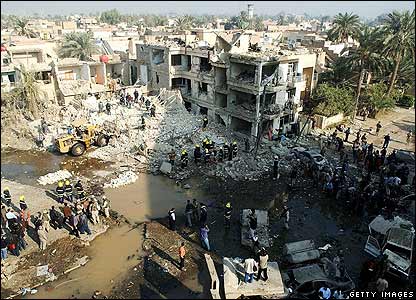
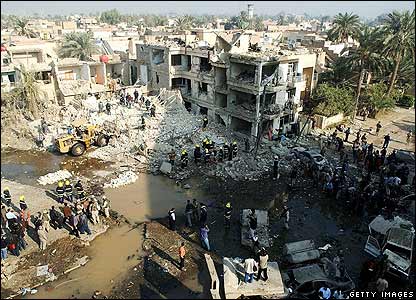
Then there is the problem that after a bombing, Baghdad looks like this:

Whereas Seoul is like, nice:
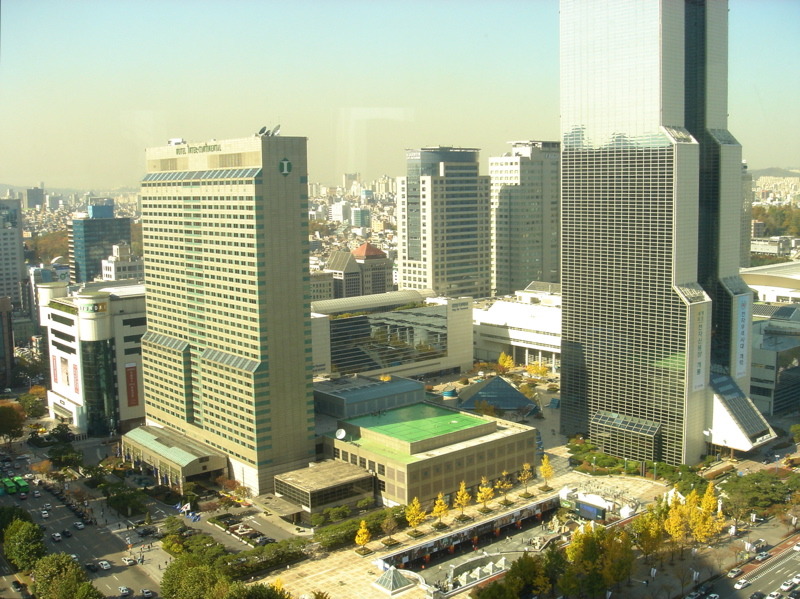


Do you notice how Iraq and South Korea are not actually very much alike? Do you really think they will become alike in the next 4 years? Could Republicans please stop using John Gaddis's brain-dead "analogy," which never made any sense to begin with?


Bushra Juhi of AP reports,
"Iraqi police say a roadside bomb has killed five people riding minibuses in Baghdad. An officer says the bomb exploded near a bridge in the mostly Shiite Hurriyah neighborhood around 10 a.m. Wednesday. He says a woman and 7-year-old boy are among the dead, and at least 10 other people are wounded. Meanwhile, police say two mortar rounds hit a busy street in the central Baghdad area of Karrada, killing a civilian and wounding five others. The officers spoke on condition of anonymity out of security concerns."


In any other city in the world, these two attacks (there was at least one more, plus 4 bodies found) would be front page news. And, note that even the report of them came from Iraqi police too afraid to give their names to the press! When police are themselves so insecure and exposed to reprisals that they they have to issue crime reports anonymously, it is not a good scene.

Ned Parker of the LAT reports that some in the al-Maliki government--and senior members of the Islamic Mission (Da'wa) Party and the United Iraqi Alliance coalition of which it is a part-- are seriously considering asking US troops to leave the country. They believe they can now handle security on their own, and that the Bush administration's demands that they surrender a great deal of national sovereignty in the proposed Status of Forces agreement are unacceptable.

Reuters reports political violence in Iraq on Wednesday:

'BAGHDAD - Five minibus passengers were killed and 10 wounded when a bomb exploded in the Kadhimiya district of northwestern Baghdad, police said. Earlier reports said it was a bomb inside a minibus.

BAGHDAD - Two people were wounded when a roadside bomb exploded near a fuel station in Binoog district of northern Baghdad, police said. . .

BAGHDAD - A civilian was killed and seven were wounded when a roadside bomb exploded near a police patrol in [Karrada,] southwestern Baghdad, police said. [Some reports say the killed and wounded were police.] . . .

BAGHDAD: 4 unidentified bodies were found in Baghdad by Iraqi Police today. 1 in Amin; 1 in al-Obaidi; 1 in Washash and 1 in Hurriyah. . .

KUT - A roadside bomb killed two policemen and wounded four others while they were on patrol in Kut, 150 km (95 miles) southeast of Baghdad, police said. . .

FALLUJA - Police said they found the bodies of five men, shot and tortured, near Falluja, 50 km (35 miles) west of Baghdad. . .

KIRKUK - A roadside bomb exploded near a police patrol, wounding four policemen and a civilian in central Kirkuk, 250 km (155 miles) north of Baghdad, police said. . .'

KIRKUK McClatchy adds, 'The social and religious committee in Kirkuk city council buried 4 unidentified dead bodies including one for a woman.'

Labels:

14 Comments:

At 8:09 AM, Anonymous Anonymous said...

He's also a bit fuzzy on Germany and Russia:

http://www.youtube.com/watch?v=s8iDT9RURwo

 
At 8:13 AM, Blogger Rational Calculation said...

In light of Cockburn's report that the US is considering withholding between $20 and $50 billion in aid from Iraq if the SOFA isn't signed, how likely is it Maliki will reject the agreement? I am hopeful that Jaafari will be able to create the public discourse necessary to convince Maliki to reject the agreement, but I am unsure of who has the most influence over Maliki. He will probably do what he can to maintain popularity, but I still see him as reluctant and unlikely, especially given Salih's position to reject the agreement.

 
At 9:58 AM, Anonymous Alex said...

Following Anand's request for more detail about the documents that were left on a train in London, and fell into the hands of the BBC, it is obvious that there isn't any and there will not be.

What we can say however is that the BBC is highly reluctant to say anything which would give a handle to the British government against them, so one can take what they do say as being well-founded, and as agreed with the security services, at least in its later versions.

I just listened to an interview with the journalist who saw the documents. Two, one about the Iraq security forces, and the other about the potential weaknesses of al-Qa'ida. He described the al-Qa'ida document as the more revealing and dangerous. The "damning assessment" didn't come again. As I can't see what there is dangerous to reveal about al-Qa'ida, which is fragmentary and hasn't done much in years other than emit the occasional tape, I take it that the truth could be the other way round, that there really was a "damning assessment", which had to be dropped after the first reports.

 
At 12:46 PM, Anonymous John Francis Lee said...

The Koreans, and the Japanese, have had about as much of the US as they can stand at this point. And that is very much what Baghdad and Iraq are about.

Seoul protest threatens to topple government

The police estimated the crowd at 100,000, while organizers claimed it amounted to 700,000.

US beef row steers Seoul into chaos

Just how American beef came to assume such importance in the democracy movement is a puzzle that historians, political scientists and psychologists will no doubt be attempting to sort out for some time, but the simple fact is that Lee's agriculture minister signed the deal for reopening South Korea's market to US beef imports in early April as Lee was about to take off for a summit with President George W Bush in Camp David...

The beef protest, though, is about much more than mad cow disease... Hostility toward US beef also reflects economic concerns.

South Korea had removed non-tariff barriers to US beef imports two years earlier as a result of the General Agreement on Trade and Tariffs signed at the Uruguay round in 1994. Despite tariffs of as high as 40%, US beef sold at less than one-third of the price of beef from Korean cattle, and exports zoomed to US$800 million a year. South Korea by the time the exports were halted was the third-biggest market for US beef.

That success was too much for Korean farmers and merchants of farm products. The complete ban on US beef revealed not just the fear of "mad cow" disease but the passions of farmers, who saw the imports as a threat to their livelihoods, and pressure from commercial interests vying to sell Korean products. Their opposition to US beef was similar to that of rice farmers, whose fervent protests have been enough to exclude rice imports totally from anything to do with any free trade agreement.

In emergency mode, a team of South Korean negotiators from Lee's government and Grand National Party has arrived in Washington hoping to explain to US officials and politicians that the deal for reopening South Korea's market to US beef just won't work. At the very least, they're calling on voluntary restraints on the export to Korea of beef from cattle more than 30 months old. That's a significant retreat from entirely opening the market here, as Lee has promised to do, but won't begin to mollify protesters spurred on by activists calling for dissolution of the US-Korean military alliance and withdrawal of America's 28,500 troops from the country.


Professor Cole, I am astounded not so much at how Obama and the rest of the American political class groveled before the AIPAC in Washington DC last week, althugh that was truly astonishing, but about the utter silence with which that grovelling by virtually the entire American political class before the Uber Lobby of just one political group was met, especially by columns such as yours.

I imagine you were as stunned as anyone else to see Obama crawling on his belly and groveling before the AIPAC, but what has inspired your silence in its wake? Are you so committed to Obama that you would rather have a made man of the Israeli Lobby as president of the United States than to call out his error and to try to force some accountability from him? Are you one of those who belive that the AIPAC and the Israeli Lobby are so powerful that resistance is useless?

What is it that has shut you up?

 
At 2:00 PM, Blogger Tea said...

Looks like the Saudis aren't getting the Bush/Cheney message that the Iranians are the devil incarnate in the ME.

[quote]
Thursday June 12, 2008
.
Saudi Kind Abdullah said on Wednesday that the United States policy toward Iran is non-diplomatic.


In a meeting with Chairman of the Expediency Council Ayatollah Akbar Hashemi Rafsanjani, the Saudi King said that the US policy toward Iran is unacceptable.

King Abdullah also said that Saudi Arabia has notified its stance about the US political mistake several times.

Referring to the vital role of the Islamic Republic in the region and the world, he said that Saudi Arabia is willing to boost bilateral ties in all fields.

He expressed hope that the two sides could work to thwart extremist thoughts aimed at demolishing the Muslim world unity.

The Saudi King appreciated Rafsanjani's recommendation to Iranian woman pilgrims who visited Baqi Cemetery in Medina, for the first time that they observed the discipline.

The Baqi is well-known as graveyard of members of the infallible household of Prophet Mohammad (PBUH), including four Imams and the beloved daughter of the Great Prophet, Hazrat Zahra (SA).

The prominent cleric arrived in Saudi Arabia on June 2 to attend an Islamic interfaith dialogue with the participation of some 500 Muslim dignitaries from more than 50 countries. [/quote]
http://www2.irna.ir/en/news/view/line-203/0806111647190533.htm

 
At 2:31 PM, Blogger El Cid said...

I have another question for the Iraq / South Korea comparison:

In Iraq, where is the De-Militarized Zone (DMZ) behind which our troops remain, NOT under attack?

 
At 5:11 PM, Anonymous Mark Konrad said...

I don't think the South Koreans are very happy with the US these days, so maybe if McCain were more in touch he wouldn't use an old Cold War analogy.

McCain often mentions Germany as well when he's making his argument about how American military bases are welcome by the locals in foreign countries.

I have first hand knowledge that suggestion is preposterous.

I was stationed in Darmstadt and Frankfurt, Germany for three years while in the army in the late '70s. I have family in Freiburg as well. I keep in contact with them regularly and manage to visit the country every two or three years.

There are maybe 20,000 Germans who are directly employed at U.S. military facilities in Germany and maybe 40,000 who are employed indirectly providing products and services to U.S. bases. Those 60,000 Germans who work for the Americans might be in favor of keeping U.S. military bases in Germany. However, if the question were put directly to the German people for a vote the overwhelming sentiment amongst the public would be to close all U.S. military bases and remove all U.S. military personnel from German soil. The suggested timetable would be "why not start this afternoon, or tomorrow at the latest."

The people of Iceland were hardly in tears when the U.S. naval air station at Keflavik was closed. The people of Japan and especially Okinawa would celebrate if U.S. facilities there were removed. Blockheads such as McCain like to pretend Americans are loved all over the world but he doesn't meet many real people on his overseas trips shuttling amongst the U.S. and foreign embassies and five star hotels and dinner parties for diplomats. If he strolled through the streets and struck up a conversation with the average working man outside the USA I'm sure he'd be UNPLEASANTLY surprised by their unfriendly attitude toward America and Americans.

.

 
At 5:43 PM, Blogger Chris Baker said...

What John McCain doesn't comprehend is that the Bush administration's Zionist-like occupation/security proposal has essentially empowered Iraqi Arab nationalists to such an extent that there may be a political accommodation between Muqtada al-Sadr and Nouri al-Maliki. Also virtually all pronouncements from Middle East allies like Saudi Arabia seem designed to prevent an Israeli attack on Iran, and that's likely why OPEC is refusing to cooperate on lowering oil prices. For example Iraq's oil minister today blaming high oil prices on "speculation" seems to be signaling don't dare attack or under-mine the Iranian administration.

 
At 8:52 PM, Blogger Steve Terranova said...

The analogy would make slightly more sense if Seoul were in NORTH Korea. Otherwise, you should compare having troops in South Korea to having troops on the Kuwait/Iraq border.

 
At 10:32 PM, Blogger Anand said...

Alex, very few journalist understand enough about military issues to interpret what they are reading.

In fact, many GIs and vets would tell you that more than 80% of "military" journalists don't have a clue what they are writing about. (this isn't editorial related . . . some journalists don't even know what "TO/E" or "TOC" means.)

I see many basic mistakes in articles about military issues all the time. (journalists confusing military terms etc.)

This is why I asked what were the reports by ISF units (and by specific function.) To give a generic report on the ISF is not very meaningful.

The Brits also had a complex and difficult relationship with Basrah Operations Command (Corps HQs) commanding Lt Gen Mohan (he sometimes didn't keep them in the loop.)

This affected how many British officers viewed the IA.

The IA leadership has a different cultural leadership style than the Brits. Some British officers have difficulty adjusting to how the IA does business.

 
At 7:06 AM, Anonymous Anonymous said...

I'm surprised anyone would try to compare South Korea, a country that has enjoyed 50 years of democracy, with Iraq, a country fundamentally damaged by 35 years of brutal tyranny. Give Iraq 20 years now that it is a democracy. I look forward to the pictures of downtown Baghdad in 2030.

Regarding our relationship with South Korea and Iraq's recently elected goverments, I don't see much difference. George Bush has close relations with both.

Lee, Bush agree to deepen economic, security alliance

It was European governments like France and Germany which had poor relationships with George W. Bush, but those governments are now gone, replaced with progressive, pro Bush administrations.

 
At 7:00 PM, Blogger Anand said...

Anonymous, South Korea did not become a prosperous free democracy until the 1980s, although South Korea was a benign and competent autocracy with increasing personal freedom before that.

There is a world of difference in another sense. South Korea was one of the poorest countries in the world in 1953, almost completely destroyed, and with a lower per capita income than India or Pakistan. South Korea however was blessed to have no oil, and chose to invest in its people.

The Iraqi government by contrast will generate $70 billion this year in oil revenue. The problem is that Iraq is not investing in its people.

Allawi's education ministry was afraid to raise standards and pressure students, less the students and their parents got upset—there was an election to win after all.

Muqtada's education ministry (since 2005) prides mediocracy in educational standards.

The contrast between the substantial improvements in Afghan education since 2001, and the Muqtada education ministry (not that Allawi and the CPA did a good job) is astounding. The Iraqis desperately need Bill Cosby.

The GoI seems to not prioritize non oil business development in the jobs of tomorrow . . . but focuses on a "rentier" state system--dividing spoils.

Iraq is becoming like Venezuela (especially in the safer parts of the country), not investing in its future.

This is an over generalization. Kurdistan and Al Anbar (especially Ramadi) are pushing business development very hard (going to global conferences . . . and showing around foreign business delegations.) Some provinces are more enlightened. But I—for one—am deeply disappointed with how most of the Iraq’s provinces and the GoI is pushing business development and education. {So are many at MNF-I.}

 
At 8:38 AM, Anonymous Corey Carroll said...

Since it takes $12 Billion / month to keep our troops in Iraq, I was wondering, what is the monthly cost of keeping our troops in South Korea, Japan, and Germany?

Couldn't we save some money by pulling out of there? Why do we have to stay there forever since those wars are over, and those countries seem capable of defending themselves now?

 
At 5:10 PM, Blogger Anand said...

To persuade America to keep troops in Germany, Japan and South Korea, the host governments compensate the US government for the additional costs of keeping troops there.

This is both a good and bad thing. Because of Iraq, the US "HAS" withdrawn troops from these three countries. This has caused considerable tension with South Korea--which felt its security and negotiating leverage with respect to North Korea was compromised. The South Koreans felt a sense of entitlement, since they paid for the US troops.

As an aside, Rumsfeld agreed with you, and tried to negotiate a large reduction of the US presence in South Korea. This greatly fueled anti-Americanism among South Korean and their army officer corp, since it was seen as being done in a way that didn’t serve South Korean interests.

Rumsfeld insisted that the 8th US Army HQs (that commanded all US and South Korean forces in the region . . . and possibly Japanese forces in the event of a war with North Korea) from now on only command US forces, and that the South Korean military develop their own national HQs (which costs many tens of billions of dollars to build, and denies the South Koreans access to US satellites, and other assets.)

More than 80% of South Koreans strongly opposed the Rumsfeld proposal. They saw this as a way to reduce the US security guarantee of South Korea.

Personally, I think the best solution is for America, Japan, South Korea, China, Russia, EU, Australia, India etc. to offer the North Koreans over $100 billion in grants over 10 years in return for them transforming themselves into a free democracy—with the possible outcome of reunification (although handling this might be tricky.) This should be coupled with a full pardon for all the crimes against humanity committed by North Korea’s leaders against the North Korean people, and a quiet bribe of billions of dollars to North Korean leaders paid by South Korea.

That would enable Japanese and South Korean forces to integrate into NATO and be used for global security deployments—since they won’t be tied down deterring North Korea. US forces would also no longer be tied up in the region.


Carey, US troop are being withdrawn from Iraq fairly rapidly. The monthly marginal costs of deploying US forces to Iraq is also falling. Violence in Iraq is now at its lowest level since March, 2004 (possibly even February, 2004.) This has convinced PM Maliki and Gen Petraeus that a quicker transition of security responsibility to the ISF is possible.

Notice how Diyala province only has 1 US (and MNF) combat brigade, versus 5 US combat line brigades a years ago. The IA even withdrew the 3rd Bde, 1st Iraqi Army Division (Iraqi Intervention Force)--one of the IA's elite combat line brigades--from Diyala (to send to Basrah) without replacement.

Even as this withdrawal of US combat brigades and the elite 3rd Bde IA took place, violence in Diyala kept falling.

Diyala is the most ethnically diverse province with the most sectarian tension inside Iraq. It was the most violent. The ISF's ability to improve security with limited MNF-I back up is extremely promising.


Post a Comment

<< Home