
One recurrent theme in the unconventional quatrains that were later gathered under the rubric of the The Rubáiyát of Omar Khayyám is surprise at having come into being unasked, and at being sentenced to non-being at the end of this bewildering life. This sentiment to my mind is a sign of medieval Persian secularism. The anonymous authors rejected the sacred history of the religions that aimed at explaining why being came into existence and at arguing for eternal life. This poetry does not show signs of belief in an afterlife. Edward FitzGerald, in his first edition of the Rubáiyát drew on a stanza in the Calcutta manuscript, no 240, to express this sentiment, according to A. J. Arberry:
XXIX
Into this Universe, and why not knowing,
Nor whence, like Water willy-nilly flowing:
And out of it, as Wind along the Waste,
I know not whither, willy-nilly blowing.
The Persian original in the manuscript Edward Cowell sent back from India went like this:
آورد به اِضطرابم اوّل به وجود
جز حیرتم از حیات چیزی نفزود
رفتیم به اِکراه و ندانیم چه بود
زین آمدن ورفتن وبودن مقصود
except that it incorrectly had nadānam (I do not know) for nadānim (we do not know). A version of it is online here .
Here is my interpretation of the original as an alexandrine:
- He brought me first into being, to my alarm.
This life increased nothing but my bewilderment;
for we were forced to leave, and we do not know what
the purpose was of all this coming and going.
—-
Order Juan Cole’s contemporary poetic translation of the Rubáiyát from
or Barnes and Noble.
or for $16 at Amazon Kindle
——-
As an undergraduate, I took a course on phenomenology, and we read Martin Heidegger’s Being and Nothingness (1927), written before he joined the Nazis. There, he termed individual being that displays itself to others the Dasein, and said it is characterized by “thrownness” (Geworfenheit).
Katherine Withy explains, “That Dasein is thrown means primarily that its “birth” is something past and something that Dasein passively undergoes. First, coming into Dasein is not the result of Dasein’s agency. It did not choose either to be or to be what it is. Second, coming into Dasein is something that has already happened. To have been thrown into existence is for the throw to have already occurred (even if, strictly, it has not yet finished). Because the throw has already been executed, that it is is now something that Dasein is stuck with or has to put up with.” The individual being displayed to the world is also thrown into a situation where it will face the possibility of death.
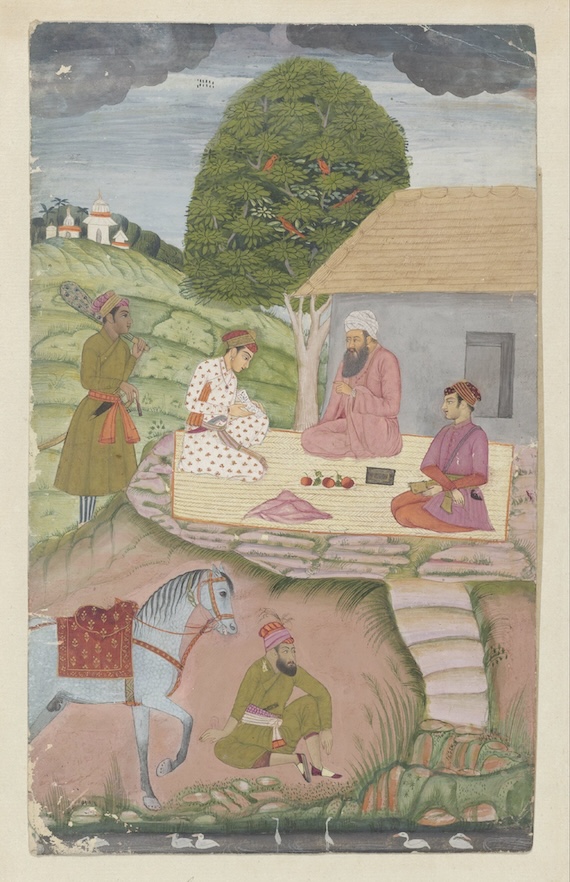
“Two young princes receiving the blessing,” by Adrianus Canter Visscher, c. 1675 – c. 1725. Drawing from the manuscript of the VOC servant Adrianus Canter Visscher, with twenty-eight Indian miniatures and two maps of locations on the Coromandel Coast at the back. Via the Rijksmuseum, Amsterdam.
Heidegger had been a Catholic but gradually relinquished conventional Christianity and, indeed, conventional religion, speaking of “the death of God.” The ideas sketched above were published well before he joined the ascendant Nazi Party in 1933, and are part of the quandary secular moderns have had to work through. Some of this conundrum is also visible in the work of the French existentialist Jean-Paul Sartre, who was as far to the left as Heidegger came to be to the right.
There is a clear resemblance between the medieval unconventional quatrains in Persian, produced by a variety of hands — perhaps some philosophers were involved — and the metaphysical bewilderment and skepticism of modern existentialists and some phenomenologists.
This aspect of FitzGerald’s book was one of its attractions for those intellectuals experiencing the Victorian crisis of faith, including poet Algernon Swinburne and novelist Thomas Hardy, among many others.
A lot of European thinkers only study the history of Europeans of Christian background, even though there have been Muslim Europeans for some 1400 years. Shockingly, a lot of the thinking produced in Europe and the Americas is ignorant of the Chinese, Japanese, Indian and Islamic traditions — despite all the modern translations and studies produced in English and other European languages in the past 65 years in particular.
So it may come as a shock that medieval Persian poetry contained sophisticated critiques of the theological worldview and presaged a kind of secularism.
In contrast, when existentialism reached modern Iran, as with authors such as Sadeq Hedayat (d. 1951), the latter clearly reached for The Rubáiyát of Omar Khayyám as part of their intellectual heritage of skepticism.
—-
For more commentaries on FitzGerald’s translations of the Rubáiyát, see
FitzGerald’s Rubáiyát of Omar Khayyám: Commentary by Juan Cole with Original Persian

 © 2026 All Rights Reserved