
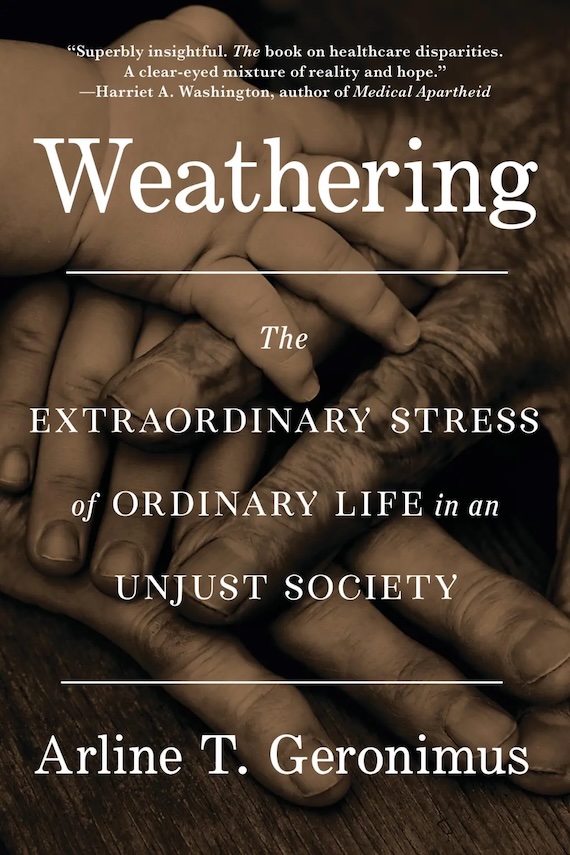
Greenfield, Mass. (Special to Informed Comment; Feature) – Health inequalities remain as intransigently rooted and malevolent today as in previous decades. Why? Professor of Public Health Arline T. Geronimus, who has studied this discrimination for decades, responds as lucidly and convincingly as any public health researcher in the United States in her new book, Weathering: The Extraordinary Stress of Ordinary Life in an Unjust Society.
After 40 years of research into racial and class inequalities, Geronimus has concluded that a process she calls weathering, a wearing out of well-being – is centrally at work in people bearing the brunt of “racial, ethnic, religious and class discrimination,” with racial inequalities persisting no matter what economic class.
“Our preoccupation with genetics and individual health behaviors” (smoking, drinking, nutrition, diet, exercise, etc.) she states emphatically “have blocked our view of other possibilities.”
Health inequalities cannot be eliminated without addressing the injustice that contributes to weathering – the physical toll down to the cellular level on those who are degraded and exploited by an unjust society. “Young people can be biologically old” and this aging continues no matter their diet and exercise, unless society addresses and undoes injustice.
Weathering can explain, for example, the (counterintuitive) fact that Black teens have better birth outcomes than Black women in their mid 20s and 30s.
Only when we are willing to understand the unjust conditions of our society that cause weathering – “the obstacles, exploitations, and the indignities” Black people especially face, no matter their class and income – can we effect genuine change. The author then launches into a series of insights and arguments, culled from 40 years of research that she calls “The Way Forward.” We must change our social environment to disrupt the “psychological stress in the most marginalized and vulnerable members of our community.” Necessary for this work is cultivating “empathy…respect and solidarity” and for those with power, moving “from hubris to humility.”
The goal is to guarantee in every circumstance – from the everyday to the institutional – that people are “seen, treated and valued.” Here are examples the author offers from proven strategies:
But more than these examples of positive impacts, we need “systemic changes,” Geronimus argues and then gives the example of a model wellness-based development project, Vital Brooklyn, a $1.4 billion program funded through the State of New York.
Given the social ills of society accumulate in our bodies, Vital Brooklyn is based on maximizing the existing abilities and positive attributes of poor and working class communities with high numbers of people of color. Grounded in the principle “do nothing without us,” residents were surveyed about the problems in their communities and what they need in their communities. Vital Brooklyn partners with small business, labor unions, universities and hospitals in the community. In doing so, it encourages/mandates in some cases local purchasing and provides educational, employment and affordable housing. Phase 2 was recently launched to build 2,000 affordable homes, improve access to open space and healthy food, expand education and economic initiatives and improve community-based violence prevention.
If we don’t address equality and justice within redevelopment plans and projects, they are doomed for failure, Geronimus states emphatically. May Vital Brooklyn, this model of community revitalization at the local level Influenced by her expertise, succeed and offer lessons to a country mired in inequality.
Professor Geronimus’ book and the weathering framework offer us a most important and original guide for achieving, racial justice especially for African Americans. The election of Mayor Zohran Mamdani heightens this possibility.
I thank my sister, Dr. Margaret Hynes, for her insightful editorial suggestions.

 © 2026 All Rights Reserved