
Florence, Italy (Special to Informed Comment; Feature) – For more than ten days now, Iranians have taken to the streets in cities across the country, protesting a set of economic decisions that pushed an already fragile economy into free fall. The immediate trigger has been the collapse of the national currency and a new surge in inflation, but the anger on display runs far deeper than any single policy error. It reflects years of accumulated frustration in a society squeezed by mismanagement, corruption, and relentless international sanctions.
In the first days, the protests bore a familiar but restrained shape. Demonstrators gathered peacefully, voicing economic grievances rather than overt political demands. The state, unusually cautious, appeared willing to tolerate what it described as “peaceful gatherings”. Security forces held back, and officials signaled openness to limited economic adjustments. For a brief moment, it seemed the regime was testing a different playbook.
That moment did not last. As protests spread to more cities, confrontations escalated. Acts of vandalism and damage to public property appeared alongside clashes with security forces. Political slogans grew sharper, and in some places the protests shifted from economic dissent to open calls for regime change. This evolution, while being swift, uneven, and volatile, reawakened the Islamic Republic’s deepest fears: not of protest itself, but of what protest might invite.
Iranian society today is exhausted. Years of economic decline have hollowed out the middle class while expanding the ranks of the working poor. Corruption scandals have become routine, and sanctions have magnified every internal failure. Yet the protests also reflect a memory of recent success. After sustained public pressure, the regime quietly eased enforcement of compulsory hijab rules, signaling that social resistance can extract concessions. That experience matters. Many Iranians now believe that if pressure could soften cultural controls, it might also force political reform, or even systemic change.
This belief intersects with a far more anxious calculation inside the state. Iran’s rulers increasingly see domestic unrest through the lens of national security. After last year’s brief but punishing war with Israel and the United States, the leadership concluded that popular restraint, not military strength alone, had helped the state survive. At the same time, it learned that popular unrest is no longer merely an internal challenge but a potential instrument of foreign pressure. Protest, in this view, becomes less a threat of revolution than a pretext for intervention.
It is in this context that Iran’s nationwide internet blackout can be understood. For many Iranians, the shutdown evokes dark memories. A widely held belief persists that when the internet goes dark, people are dying in the streets and the state is trying to hide it. Past crackdowns have taught citizens to associate digital silence with physical violence, as in the Fuel Crisis of 2018, or Mahsa Amini’s death in 2022.
There are, however, several overlapping logics behind the blackout. One is tactical: cutting internet access disrupts coordination among protesters, making it harder to organize gatherings, share locations, and sustain momentum. Fragmentation breeds exhaustion. Another logic is political. The blackout severs links between protesters inside Iran and opposition figures abroad, whether monarchists, exiled groups like the Mujahedin-e Khalgh, or social-media-driven celebrities who claim leadership roles from afar. For a regime obsessed with foreign manipulation, this disconnection is not incidental; it is the point.
There is also a more recent and less discussed dimension. During the 12-day war with Israel, Iran suffered a severe internal security shock when drones reportedly launched from within its territory struck sensitive military and nuclear sites using
civilian mobile networks. Cutting internet access during the latter phase of the war helped blunt those attacks. That lesson has not been forgotten. With Iranian leaders openly warning of another potential confrontation with Israel or the United States, and viewing mass protests as a possible opening for external aggression, the blackout takes on a preemptive character. It is meant to close multiple vulnerabilities at once, social, political, and military.
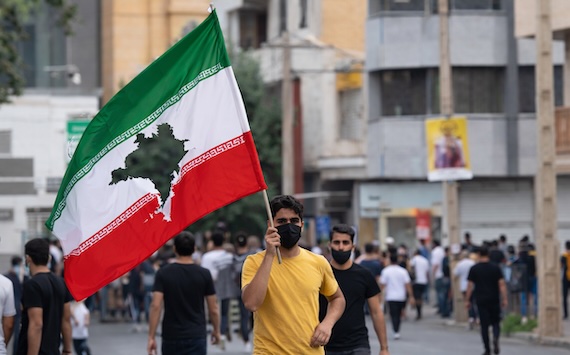
Demo in Iran Jan. 2026. Public Domain. Via Wikimedia Commons.
Many observers argue that this moment is different , and that the protests could mark the beginning of the end for the Islamic Republic. Perhaps. But revolutions are rarely legible in real time. What is clear is that the regime faces a narrowing set of choices. Repression risks reigniting public rage and inviting foreign escalation, while restraint risks emboldening a population that has learned its own leverage.
Iran’s leaders still have room to act, but that space is shrinking. Economic adjustment without structural reform will not suffice. Security measures without political re-calibration will only postpone the reckoning. If the state continues to treat popular anger as a hostile conspiracy rather than a warning, it may eventually discover that silence, digital or otherwise, cannot erase legitimacy. The question is not whether Iranians will keep speaking, but whether their rulers will finally listen before the system itself is spoken out of existence.

 © 2026 All Rights Reserved
.png )