
Edward FitzGerald’s no. 36 in his first edition of The Rubáiyát of Omar Khayyám reminds us that from dust we come and to dust we will return.
XXXVI.
For in the Market-place, one Dusk of Day,
I watch’d the Potter thumping his wet Clay :
And with its all obliterated Tongue
It murmur’d-” Gently, Brother, gently, pray!”
A. J. Arberry identifies the original as no. 89 in the Bodleian manuscript, and it is also found here on the Web:
دی کوزه گری بدیدم اندر بازار
بر تازه گلی لگد همیزد بسیار
و آن گل بزبان حال با او میگفت
«من چون تو بدم مرا تو نیکو میدار»
Literally, the first two lines of the poem go as prose, “Yesterday I saw a potter in the bazaar, stomping repeatedly on fresh clay.”
I translated the last two lines in free verse:
That lump, as in a vision, said to him,
“Please lighten up! For I was once like you.”
—-
Order Juan Cole’s contemporary poetic translation of the Rubáiyát from
or Barnes and Noble.
or for $16 at Amazon Kindle
——-
That clay, and the things made of clay like jugs and mugs, bear traces of past people who died and became clay is a common theme in classical Persian poetry, and it also appears in medieval Arab poets such as al-Ma`arri.
I think this image appealed to Edward FitzGerald because he at one point in the 1840s did some amateur archeology. His friend Thomas Carlyle collected two volumes of the letters of the seventeenth-century religious revolutionary Oliver Cromwell (d. 1658), who had led pro-parliament troops in a battle at Naseby in Northampshire against the royalist forces of Charles I during the first English civil war. FitzGerald’s fabulously wealthy family came to own those fields, and Carlyle asked him to do some excavations to locate the bodies in the battlefield so as to specify the exact location of the major encounters. FitzGerald thus dug up old skulls and skeletons and even bullets.
So he had his own experience of sifting clay for human remains.
This sort of image is also used by Hafez of Shiraz (d. 1390), who has this quatrain:
این گل ز بر همنفسی میآید
شادی به دلم از او بسی میآید
پیوسته از آن روی کنم همدمیاش
کز رنگ ویام بوی کسی میآید
It goes like this:
This clay is what remains of a lover;
It brings great joy into my heart.
That’s the reason I always seek it out —
For from it wafts to me the fragrance of someone.
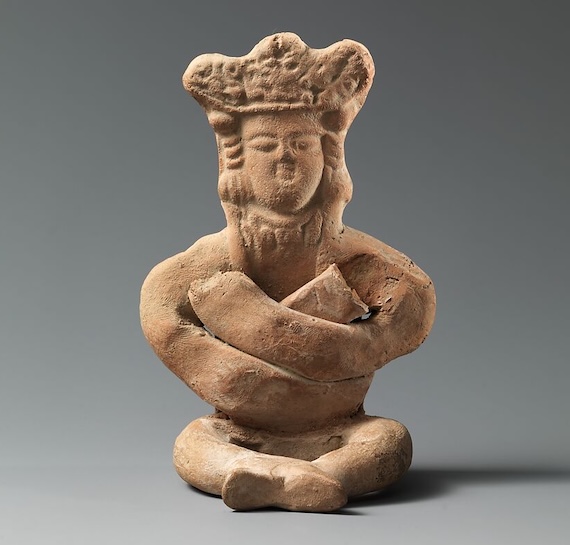
Figurine of a Seated Personage with Folded Arms and Elaborate Headdress, 12th–13th century, Iran or Iraq. NYC Met. Public Domain.
The poem attributed to Khayyam is less nostalgic and more uncompromising. A potter thumping on clay should remember that he or she will soon be clay, as well.
This sense of the fleeting character of human life animates this corpus of poetry, and as in Buddhism, the insight that life is ephemeral is used to encourage empathy with others. In fact, since some of this poetry was likely written under Mongol Buddhist rule in Iran during the 1200s, there may be Buddhist influences on its philosophy. Of course, the Omarian poetry takes the opposite lesson from the shortness of life from Buddhism. The latter urges us to give up pleasures and attachments so as to avoid the pain that comes from them. The unconventional Persian quatrains urge a humanist philosophy of pleasure and good times as the only salve for our mortality, and unlike the Buddhists, do not believe in reincarnation or an afterlife. The only reward in these poems for doing good is to feel good about yourself as the creature of a moment in a vast overpowering universe that will long outlive us.
For more commentaries on FitzGerald’s translations of the Rubáiyát, see
FitzGerald’s Rubáiyát of Omar Khayyám: Commentary by Juan Cole with Original Persian

 © 2026 All Rights Reserved