
Ann Arbor (Informed Comment) – The Algerian newspaper al-Masa’ reports that on December 24, the Algerian parliament passed a law recognizing French colonialism in that country, 1830-1962, as having been a crime that involved mass killing, rape, displacement of populations, usurpation of land, and marginalization of people. The law also makes claims on France for reparations.
The great Algerian historian Mahfoud Bennoune had made the case for the economic benefits to France of exploitation of Algerian natural resources (metals, oil), expansion of French vineyards on expropriated Algerian land, trade monopolies and the creation of Algeria as a captive market for French goods.
He wrote not only of countless massacres by French commanders of local populations but also of a vast transfer of landed wealth: “Using innumerable arbitrary measures — sequestration, confiscation, expropriation, cantonment . . . an increasing number of hectares were accumulated for the purposes of colonization . . . The subsequent booty was distributed among the colons [French colonizers]. By 1954, these 3,028,000 expropriated hectares [~116,000 sq. mi.] consisted of 2,828,000 hectares of plowland and 210,000 hectares of forest, all owned privately by the French colons. The colonial state still possessed 7,200,000 hectares, including forest, unproductive land, and pastureland.” As for the land the Algerians were crowded onto, ” two thirds of the land assigned to the peasants was minimal pasture and unproductive plots.”
Ibrahim Boughali, the speaker of the Algerian parliament, underlined that the objective of this law is not to deploy history for the purposes of revenge, but to restate the historical truth and preserve the national memory from all efforts to erase it or falsify it. At the same time, the law emphasized the necessity for the Occupying state to accept responsibility for the “systematic crimes committed against persons, land and Algerian identity.”

Or by check:
Juan Cole
P. O. Box 4218,
Ann Arbor, MI 48104-2548
USA
(Remember, make the checks out to “Juan Cole” or they can’t be cashed)
The Algerian and French governments have increasingly had bad relations in recent years. Algeria is furious that France recognized the Moroccan claim to the Spanish Sahara; Algeria supports the Polisario Liberation Front and its claim that the Western Sahara should be independent. It was territory ruled by medieval Moroccan governments that had been detached and made a colony by Spain, which relinquished it in the 1970s. Morocco immediately claimed it, insisting it was only reclaiming it.
France recognized Morocco’s claim, as did the US, as a quid pro quo under the Biden administration for Morocco’s recognition of Israel and signing on to the so-called “Abraham Accords.”
Algeria is also not happy about the increase in French racism toward the large expatriate Algerian community in France. Further, Algerians have been annoyed by the rise online of French atrocity-denialism, in which commentators dispute that France committed massacres in that country or at least excuse them. In the early 21st century some French parliamentarians strove to outlaw any deprecation of what they termed the glories of the French empire, but then President Jacques Chirac refused to go along.
European colonialism, a historically distinct amalgam of barracuda capitalism, racism, settler expansionism, and economic exploitation, killed millions of people in the global south and directed profits to the metropole even from desperately poor countries in places like Africa. That it was a set of crimes is hard to dispute.
One of the things I was surprised to discover during the Iraq War was that when I called it a colonial war, some people in Washington couldn’t get that that was a bad thing. The critique of colonialism had not reached the halls of Congress! Or, indeed, many people in middle America. Historians in the past 50 years have excavated masses of documents proving the massacres and exploitation engaged in by colonial authorities. There was actually a cover-up in the archives of the British atrocities committed in Kenya in the 1950s, which only hard historical digging managed ultimately to thwart. I’m told by colleagues who work on Libya in the Italian archives that documents on massacres committed by Italian troops in that country appear sometimes to be hidden by the staff.
That is, there is a lot of denialism out there.
But even though it is easy to demonstrate colonialism’s evils, few post-colonial countries have done what Algeria just did. In part this is because they often still have vital economic or security relationships with the former colonizer and so cannot afford to alienate them.
Never miss an issue of Informed Comment: Click here to subscribe to our email newsletter! Social media will pretend to let you subscribe but then use algorithms to suppress the postings and show you their ads instead. And please, if you see an essay you like, paste it into an email and share with friends.
While in the twentieth century the Algerian elite depended on France (and sometimes even seemed to think they were French), in 2025 things have changed. In the past two decades, Algeria has greatly diversified its import and export markets. It imports more goods from China than from France. It brings in wheat mainly from Russia, not France. It is doing more trade with Turkey and Qatar. Few Algerian firms operate in France, and the number of French firms in Algeria has fallen dramatically.
Having thrown off economic neo-imperialism, Algerian politicians are free to say what they think.
They are even introducing English in Algerian schools as of this year, with an eye toward gradually making it the country’s second language, after Arabic, rather than French, in which educated Algerians have mainly functioned since the mid-nineteenth century.
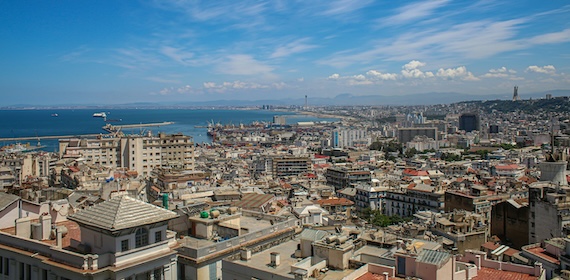
Photo of Algiers by Sid Ahmed SAOUD on Unsplash
Le Monde notes that Algerian President Abdelmadjid Tebboune has never actually presented a formal, specific request to France for reparations. It reports that the French Foreign Ministry — “the Quay d’Orsay” — denounced the new law as “manifestly hostile” and as an impediment to the ongoing dialogue between the two countries.
Algeria, a country of some 47 million, is about as populous as Spain. It has an annual nominal GDP of roughly $190 billion, placing it in the company of Greece, New Zealand and Iraq; it is the world’s 52nd largest economy.
The United States could be presented with a similar bill by the Philippines, where US troops killed or unleashed the conditions that killed some 400,000 people in the early 20th century. But that is unlikely at the moment, since the Philippines is still deeply intertwined with the US and increasingly needs the US navy as China seeks hegemony in the region and makes claims on maritime territory also claimed by the Philippines. The US is the country’s largest trading partner with $12 billion in bilateral trade, though Japan, China, Hong Kong and South Korea are also major trading partners.
The kind of trade diversification undertaken by Algeria with regard to France is unusual in post-colonial countries, which may help account for why its criminalization of colonialism is so unprecedented. But as China rises as a major trading partner for postcolonial countries, and as south-south global trade more generally burgeons, we could see more such claims.
The Congo, where Belgium is estimated to have killed 8 million of 16 million residents, is a likely plaintiff. These disputes will likely go to the International Court of Justice at the UN, the judges of which, however, have traditionally been drawn more from the Colonial north than the colonized South.

 © 2026 All Rights Reserved