
The thirty-first quatrain in the first edition of Edward FitzGerald’s translation of The Rubáiyát of Omar Khayyám continues the existentialist theme of the unknowable character of our fates and of our deaths. That is, the underlying Persian poetry as well as FitzGerald’s mid-Victorian rendering questions whether it all has a purpose.
XXXI.
Up from Earth’s Centre through the Seventh Gate
I rose, and on the Throne of Saturn sate,
And many Knots unravel’d by the Road;
But not the Knot of Human Death and Fate.
A. J. Arberry identified the original here as no. 319 in the Calcutta Manuscript, which can also be found here on the Web.
از جر حضيض خاک تا اوج زحل
کردم همه مشکلاتِ گردون را حل
بیرون جستم ز بند هر مکر و حَیَل
هر بند گشاده شد مگر بند اَجل
Here is my rendering of this quatrain in blank verse:
From earth’s dark depths to Saturn’s pinnacle
I solved the puzzles of the turning skies.
I slipped the bonds of every trick and sham;
Each shackle was removed except for death.
As can be seen, FitzGerald’s translation is fairly close to the original. One difference is that he translated band which has connotations of “bond” or being tied up, as “knot.” Since unraveling a knot suggests solving a puzzle, the East Anglian poet shifted the meaning of this stanza from being unable to escape death to being unable to understand it. Since the second hemistich actually does talk about solving the difficulties of the heavenly vault, however, FitzGerald’s interpretation is reasonable. Death is the one difficulty that the polymath of the poem cannot resolve — can neither escape nor fathom.
—-
Order Juan Cole’s contemporary poetic translation of the Rubáiyát from
or Barnes and Noble.
or for $16 at Amazon Kindle
——-
The mention of Saturn and the vault of heaven plays to the literary fiction that this poetry was written by an astronomer at the Seljuk court, Omar Khayyam (d. 1131). Khayyam was in fact a frame author, to whom unconventional, heterodox and libertine poetry by various hands was attributed. He functions as Scheherazade does for the 1,001 Nights; stories told in Cairo or Aleppo or Baghdad over the centuries were all attributed to her.
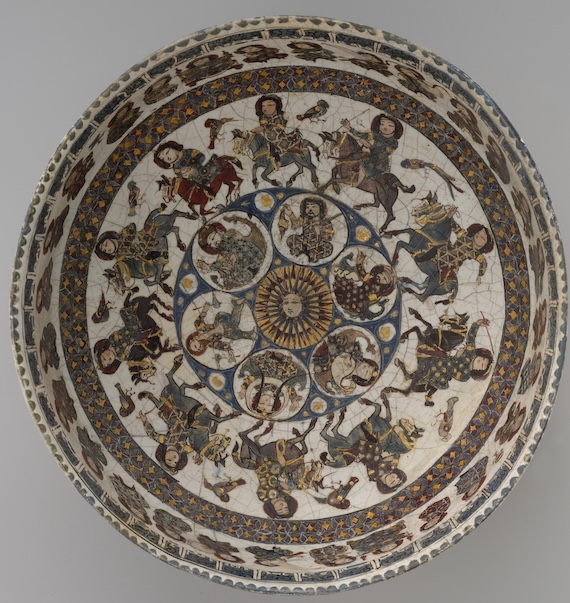
Bowl with Courtly and Astrological Motifs, late 12th–early 13th century, Central or Northern Iran. The figures and decoration on the interior of this bowl combine imagery of the courtly cycle and astronomy. In the center the sun is surrounded by personifications of the planets (clockwise) Mars, Mercury, Venus, the moon, Saturn, and Jupiter. Islamic astronomers believed the planets orbited the earth, forming seven concentric circles. An eighth, outer sphere contained the constellations and signs of the zodiac, possibly represented by the six large and twelve small gold circles between the planets’ heads. Public Domain. Metropolitan Museum, NYC.
Our inability to understand or reckon with death is a common theme in classical Persian poetry.
Take this passage from a ghazal or ode of Hafez of Shiraz (d. 1391):
مرا از ازل عشق شد سرنوشت
قضای نوشته نشاید سترد
مزن دم ز حکمت که در وقت مرگ
ارسطو دهد جان، چو بیچاره کرد
I would translate this as an alexandrine, this way:
From pre-eternity my fate was ardent love;
Once written in the stars, your fate cannot be changed.
Do not bring up philosophy, since when death comes
great Aristotle breathes his last, just like the poor.
As with the Omarian poetry that FitzGerald translated, so here Hafez insists that however clever someone may be, however many of life’s puzzles they may have solved, when death comes it takes that philosopher or scientist no less inscrutably and inexorably than it does a poor person on the street.
Aristotle was perhaps the most influential philosopher in medieval Islamic thought, though Neoplatonism was also extremely popular.
—-
For the previous quatrain, see “Another Cup to Drown the Memory:” FitzGerald’s The Rubáiyát of Omar Khayyám 1:30 .
For more commentaries on FitzGerald’s translations of the Rubáiyát, see
FitzGerald’s Rubáiyát of Omar Khayyám: Commentary by Juan Cole with Original Persian

 © 2026 All Rights Reserved