
No. 30 in the first edition of Edward FitzGerald’s The Rubáiyát of Omar Khayyám continues the theme of bewilderment that we find ourselves, unasked, in the world, without a clear idea of the meaning of this life. The English verses portray these acts of being born and dying “without asking” as “impertinence,” i.e. insolence or disrespect.
XXX.
What, without asking, hither hurried whence?
And, without asking, whither hurried hence!
Another and another Cup to drown
The Memory of this Impertinence!
Edward Heron-Allen and A. J. Arberry (Romance, p. 210) identify the original as no. 21 in the Bodleian manuscript,
چون آمدنم به من نَبُد روز نخست
وین رفتنِ بیمراد عَزمیست درست
برخیز و میان ببند ای ساقی چُسْت
کاندوهِ جهان به می فرو خواهم شست
This is no. 20 in my translation of the Rubáiyát.
I translated the first two lines this way:
- Since my advent here on that first day wasn’t up to me,
but my unwilling departure has been firmly decreed . . .
For the theme of “thrownness” into the world in modern philosophy, see my discussion of XXIX.
—-
Order Juan Cole’s contemporary poetic translation of the Rubáiyát from
or Barnes and Noble.
or for $16 at Amazon Kindle
——-
Edward Cowell was the friend of Edward FitzGerald who rediscovered the Omar Khayyam manuscript in the Bodleian library that had been collected by Sir Gore Ouseley, the first modern British ambassador to Iran 1810-1813. He made a copy for FitzGerald and appended a glossary, encouraging him to translate it. Cowell was a liberal, Emersonian sort of Christian, but the Rubáiyát was too unorthodox for him, with its denial of the afterlife and celebration of winebibbing and romance. FitzGerald, in contrast, was a frank unbeliever, and while he was not a libertine, he could see the beauty in the cynical Epicureanism of this poetry.
Cowell translated the poem this way:
My coming was not of mine own design,
and one day I must go, and no choice of mine;
Come, light-handed cupbearer, gird thee to serve,
We must wash down the care of this world with wine.
I discussed the figure of the cupbearer in Persian poetry here, in reference to 1:3. He is sort of like the bartender in country and Western songs, to whom the drinker pours out his or her heart and then asks for a refill. But in most Persian poetry he is a very handsome teenaged young man. Occasionally, e.g. in Zoroastrian or Christian taverns, there may have been women wine servers, and Persian poetry sometimes appears to refer to them. The religious minorities weren’t as strict about gender segregation. In Persian, though, it is hard to know if a man or a woman is being talked about, since Persian has no noun grammar and the third person singular pronoun, “u,” can mean either “he” or “she.”
The cheekiness of this lament about our being consigned to being without really knowing why, and our being made to die in the same way, and the resort to wine or love as a strategy for dealing with the meaningless of life, or at least the obscurity of the meaning of life, is also found in the poems of Hafez of Shiraz (d. 1391).
For instance there is a ghazal or ode of Hafez that begins this way, and is referred to in this Persian article..
با مدّعی مگویید، اسرارِ عشق و مستی
تا بیخبر بمیرد، در دردِ خودپرستی
عاشق شو اَر نَهْ روزی، کارِ جهان سرآید
ناخوانده نقشِ مقصود، از کارگاهِ هستی
Do not share the secrets of love and drunkenness with the Inquisitor,
so that he may die in ignorance, with the pain of self-worship.
Become a passionate lover, for otherwise the business of this world will wind up
before you have read the schematics of the purpose from the workshop of being.
Hafez is not saying that existence is meaningless, but he is saying that it can be meaningless if we don’t lose ourselves in passionate love (`ishq). He leaves it ambiguous whether he is talking about passionate love of God or passionate love of a human beloved, but it is perfectly possible that it is the latter. For the more humanist of the classical Persian poets, romantic love is a form of secular transcendence.
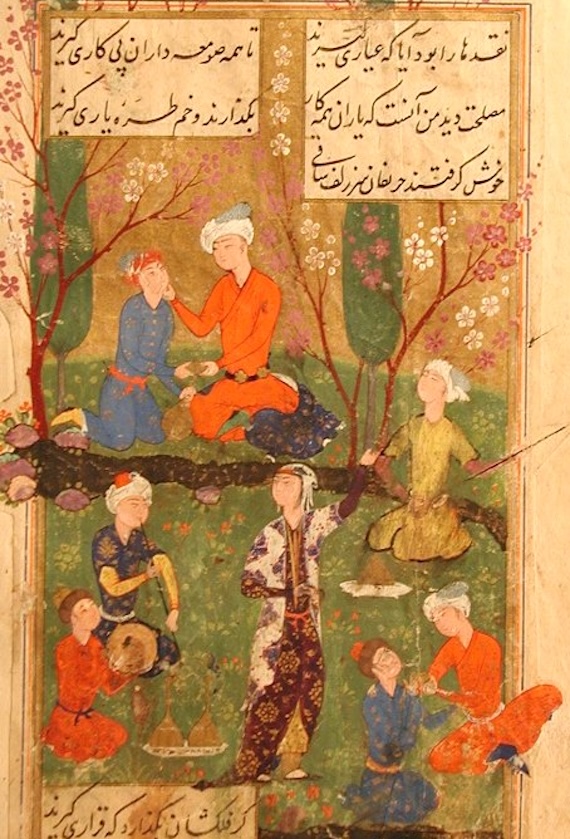
Party scene from the Divan of Hafez. Iran, 1585. Public Domain. Via Wikimedia Commons..
Without that love, Hafez says, the purpose and design of the workshop of being (what a delightful phrase) will remain opaque to you. Moreover, this passionate love and intoxication in the beloved is not something you should tell the hidebound about, who have the character of prosecutors in the service of orthodoxy. Better to let them die in ignorance and drown in their amour propre and egotism.
The passage is in someways very similar to the quatrain above, where the author says he will take refuge in intoxication because the meaning of life is obscure. Hafez turns the sentiment around, saying that unless you get drunk and experience passionate love, you won’t be able to discern the purpose of life. Hafez’s is a poetry of uplift, whereas the Khayyam corpus is filled with a sort of clear-eyed despair.
—-
For more commentaries on FitzGerald’s translations of the Rubáiyát, see
FitzGerald’s Rubáiyát of Omar Khayyám: Commentary by Juan Cole with Original Persian

 © 2026 All Rights Reserved