
Ann Arbor (Informed Comment) – How plague came to Europe around 1347 has long been debated by historians. Scientists have located the origin of the primary reservoir of the disease in today’s Kyrgyzstan, and it has long been thought somehow to have come west with the Mongol invasions of the fourteenth century.
One colorful tale by an Italian traveler described how Mongols of the Golden Horde catapulted the cadavers of plague victims over the wall of the city of Caffa, now Feodosija, in Ukraine, in an early use of biological warfare.
A new paper proposes a more robust explanation for an episode that carried away a third to a half of Europeans in the decade after 1347:
Bauch, M., Büntgen, U. Climate-driven changes in Mediterranean grain trade mitigated famine but introduced the Black Death to medieval Europe. Commun Earth Environ 6, 986 (2025). https://doi.org/10.1038/s43247-025-02964-0
Bauch and Büntgen find archeological evidence of a massive set of volcanic eruptions, at least one in the northern hemisphere, in the years 1329, 1336 and 1341 CE. The exact sites of this volcanic activity have not been identified. They left, however, extra sulphur in the sediment of that era. Moreover, studies of tree rings in Europe shows the advent of cool, rainy weather in several European regions, which cannot easily be explained by weather, which should be more localized.

Or by check:
Juan Cole
P. O. Box 4218,
Ann Arbor, MI 48104-2548
USA
(Remember, make the checks out to “Juan Cole” or they can’t be cashed)
The particles that volcanoes spew into the atmosphere reduce the ability of the sun’s rays to reach the earth’s surface, and so they temporarily cool it down. Before the Industrial Revolution, volcanic activity was one of the major drivers of climate change. However, it typically took millions of years of such activity to put so much carbon dioxide into the atmosphere that the greenhouse effect heated up the earth substantially. Humans have done it in 250 years!
While some rain is good for crops, too much floods them out or causes them to rot. So the cool, rainier climate produced temporarily by the volcanoes provoked famine in Europe.
The authors write: “The autumn of 1345 CE, as well as the springs of 1346 and 1347 CE were characterised by heavy precipitation that caused severe flooding and soil erosion in Italy, including the Po valley and the Italian regions of Tuscany and Lazio. While the winter of 1344/45 CE was particularly cold and snowy in the Middle East, drought spells and locust invasions impacted agriculture across the Levant in the winters of 1345/46 and 1347/48 CE.”
It is sometimes forgotten that the Black Death was a pan-Mediterranean event and wiped out large numbers of Egyptians and Levantines as well as Europeans, and went on circulating in this region into the twentieth century. It can now be treated with antibiotics.
The authors point out that the Italian city-states of Venice, Genoa and Pisa had a complex relationship with the Mongol Golden Horde. Some of them were at war with it, but all had extensive trade networks that reached into what is now Ukraine and western Russia. When the climate-driven famine hit, the Italians quickly brought their hostilities with the Mongols to an end, and sought to import wheat stores from the east.
Never miss an issue of Informed Comment: Click here to subscribe to our email newsletter! Social media will pretend to let you subscribe but then use algorithms to suppress the postings and show you their ads instead. And please, if you see an essay you like, paste it into an email and share with friends.
The paper argues that the fleas that carry plague can live on grain and do not necessarily need rats to survive. Either way, it infected the Mongol wheat stores. The wheat imported to save the lives of the starving allowed Yersinia Pestis, the Black Plague bacterium, to establish a bulkhead in Europe, from which it conquered the continent demographically. Plague would go on breaking out occasionally right into the twentieth century. Albert Camus took an outbreak in Oran, Algeria, in the early 1940s as a metaphor for the moral and ethical horrors of World War II, in his novel La Peste (“The Plague”).
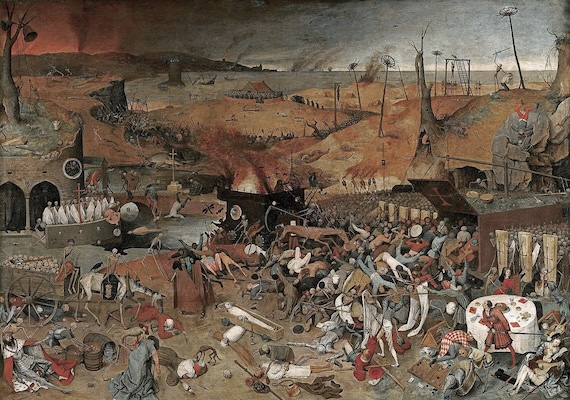
Pieter Brueghel the Elder (1526/1530–1569), “The Triumph of Death,” Museo del Prado. Public Domain. Via Wikimedia Commons.
Europeans of that era, unlike people in Central Asia, had no herd immunity to the bacterium, and so it cut them down like a gargantuan scythe. They suffered a fate similar to the one they would inflict on the indigenous Americans a little over a century later.
Not only did the Europeans not for the most part still have antibodies to fight the plague, but they were weakened by the cool, wet weather and the consequent famines. The same thing was true in the Middle East, where people wouldn’t have been prepared for cold, snowy winters caused by the occlusion of the sun by volcanic ash. That the people of the Greater Mediterranean met the bacterium in a weakened state helps explain the massacre it wrought among them, the authors argue.
The Black Death killed off so many workers that wages rose and laborers were in a position to demand payment in coin, not just in kind. These changes contributed to the decline of manorial feudalism and the rise of early modern capitalism. One virtue of this new paper is that it proposes a complex, multi-causal explanation for a complex event. The way in which climate change can expose humans to animal-borne (zoonotic) diseases should be a lesson to our generation, since all that carbon dioxide we emit from burning coal, gas and petroleum, is causing climate disasters that make both humans and animals refugees, and drive them into closer contact with one another. What could go wrong?

 © 2026 All Rights Reserved