
When dairy workers made common cause with Palestine solidarity activists, the result was radical love in the public square
This was, as one activist said, what radical love in the public square looked like
In the following months, workers downed tools at Clover factories across the country to join protests targeting Milco headquarters as well as Israeli governmental buildings. They placed stickers on Clover products in grocery stores that called them bloody and violent. And workers and activists caravaned to sit-ins at South Africa’s Union Buildings in Pretoria, a seat of national executive power, until government officials agreed to meet them.
Decisions were made by activists from a variety of racial, class, gender, sexuality, and issue organising backgrounds. They targeted the government alongside Clover and Milco, in order to force elected officials to add substance to their public positions. South African government officials have often proclaimed their commitment to both Palestine and workers’ rights, yet in action they have often left workers to the mercy of private and state-sponsored violence. The Clover protestors wanted to make such duplicity as difficult as possible to pull off.
Cultural workers also got in on the mix. Filmmakers documented the protests, songs were created for the Clover workers, and toyi-toyi – a South African marching protest dance that echoes traditional war dances – spread joy in the streets and was adopted even by aunties in hijab and uncles in floor-length kurtas. It was a striking sight.
But not always united within
This solidarity wasn’t without its pitfalls. The Clover workers at times accused middle-class activists, especially those from Palestine solidarity spaces, of lacking commitment to the fight for workers’ rights. Some Palestine solidarity activists questioned how the campaign interacted with larger BDS goals, and whether Milco was too narrow a target.
Strike funds ran low over the months of strike and protest, and many workers lost faith. When Clover bosses deployed violent private security attacks on striking workers, and when mass layoffs ensued at factories experiencing work stoppages, the Clover campaign Whatsapp groups erupted with fear and fury from workers who felt that activists – unionist and Palestine solidarity both – had left them in the lurch.
But in the end, workers gained instrumental wins. They got slightly better pay at some factories, slightly better protections and worker conditions, greater government oversight over Clover practices, and a crackdown on Milco and other Israeli-owned companies.
Most importantly in my eyes, the campaign generated and fortified meaningful relationships, even amidst the tensions and struggle. Many of the older trade union and Palestine solidarity leaders had been in relationships for decades. But younger activists and rank and file workers formed new relationships with each other on a basis of solidarity and shared experience.
All of the activists with whom I spoke described being motivated by their ethics, and their own experience of contemporary racism in South Africa – one called it “fights that pick you”. Many of the queer activists also emphasised the relationships of care and genuine friendship that they built in the Clover struggle. One called it “radical love in the public square”. Another said it was a “prime example of intersectionality and marrying worker and Palestinian struggles”.
A third said it allowed her to mobilise her queer activism towards “presence” and “showing up” in a space that didn’t so much emphasise “gay flags and representation”. A fourth said this broke down perceptions of the Palestine solidarity movement in Joburg as a “niche Indian South African thing”. In short, one said: “this Clover thing is a huge shift in direction with the Palestine solidarity movement.”
Moving forward stronger
The shifts generated by the Clover campaign continue to facilitate ongoing campaigns for broader worker justice and Palestine solidarity in South Africa, even though the strike itself has now ended.
From October 2023 onwards, many of the activists and unionists at the forefront of the Clover campaign jumped into response work against the genocide in Gaza. They propelled South Africa’s ICJ case, and they shut down the Paramount military supplies facility that held relationships with the Israeli government. They also mobilised mass support for the Stilfontein miners, whom police trapped in a shallow mine without food, water, or egress for weeks.
The scale of these responses were made possible by the relationships forged and grown during the Clover strike. Activists were able to work together in greater numbers and with greater speed, because they saw their struggles as interconnected, and they had developed radical love and trust for each other through getting out in the streets.
One of the purest invocations of this for me was during a caravan from Johannesburg to the Union Buildings. As a newcomer to South Africa, and a musician, I was always asking for translations of the struggle songs we sang while toyi-toying in protest. A young, queer, Indian South African activist translated one line of the struggle song for me. An older, Black trade unionist stepped in and nuanced his translation. And then an aunty in hijab sang another line in Zulu, while a striking worker grabbed her hand and danced alongside.
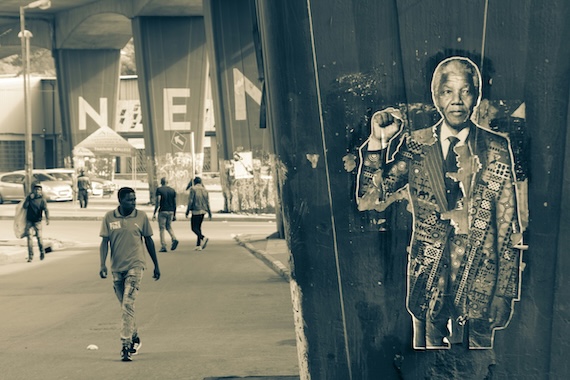
Photo by Gregory Fullard on Unsplash
This was, as one of the activists said to me, what radical love in the public square looked like. This was solidarity across siloes: where even if we don’t win all our demands, even when the campaign ends, even in moments of tension and ongoing state violence, we see each other together. We fight to create the future world we want, in the present. These moments in the Clover struggle encapsulate why we fight, together across our differences, and what makes it all worth it: relationship, trust, and hope.
Maya Bhardwaj (she/they) is a queer South Indian American scholar-activist, community organiser, consultant to social movements, writer, musician, and artist. Their research explores queer of colour politics and culture in diaspora, with specific focus on South Asian diasporic leftism and the possibility of Black and Brown solidarities. This draws on 15 years of lived experience within social movements across the US, Europe, Latin America, South Asia, and Southern Africa. Maya holds a PhD in Sociology from the University of Pretoria, a MSc from SOAS, and a BA from Northwestern University.
This article is published under a Creative Commons Attribution-NonCommercial 4.0 International licence.

 © 2026 All Rights Reserved