
Quatrain no. 34 in the first edition of Edward FitzGerald’s translation of The Rubáiyát of Omar Khayyám speaks of the finality of death.
XXXIV
Then to this earthen Bowl did I adjourn
My Lip the secret Well of Life to learn :
And Lip to Lip it murmur’d-“While you live
“Drink! — for once dead you never shall return.”
The original is no. 100 in the Bodleian manuscript, also found here.
لب بر لب کوزه بردم از غایتِ آز
تا زو طلبم واسطهٔ عمرِ دراز
لب بر لب من نهاد و میگفت به راز:
«می خور که بدین جهان نمیآیی باز »
I can’t be sure, but I wonder if FitzGerald didn’t craft the wording of the last verse to make it seem a denial of reincarnation rather than a rejection of the doctrine of resurrection, which would have been blasphemous in Victorian English. There was actually a blasphemy law on the books. Percy Bysshe Shelley’s posthumous publisher, John Moxon, was prosecuted for blasphemy for having published an unexpurgated version of Shelley’s revolutionary and atheistic poem “Queen Mab.” Moxon was found guilty and lightly fined, but the book was allowed to circulate.
FitzGerald warned the magazine Fraser’s when he submitted some of his Rubáiyát translations to it in late 1857 that a few of them were “strong” and might anger the Anglican clergy or “divines.” I suspect that the quatrains denying the afterlife were among these.
I translated the last two lines of the original, speaking of the wine bottle or flask, “It gave its mouth to mine and whispered, / Have some wine, since once you’re gone, you won’t be back.” Literally it says you won’t return to this world, which supports FitzGerald’s translation.
—-
Order Juan Cole’s contemporary poetic translation of the Rubáiyát from
or Barnes and Noble.
or for $16 at Amazon Kindle
——-
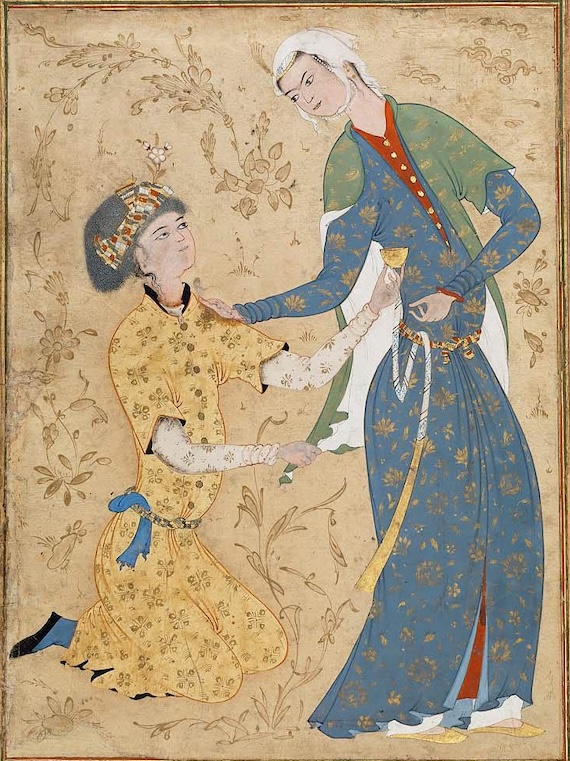
A Young Man Offering a Cup of Wine to a Girl, Safavid period, 16th century, possibly Herat, Afghanistan or Iran. Via Museum of Fine Arts, Boston. Public Domain.
The question of an afterlife was a subject of lively discussion in FitzGerald’s circles. There is an anecdote about the poet Alfred Tennyson written that he, Edward FitzGerald and the Scottish idealist Thomas Carlyle were smoking and drinking at a cafe in London in the mid-1840s.
William Watson said of Tennyson, “He spoke of Carlyle’s having come to smoke a pipe with him one evening in London, ‘when the talk turned upon the immortality of the soul, upon which Carlyle said, “Eh, old Jewish rags, you must clear your mind of all that. Why should we expect a hereafter?”‘ and likened man’s sojourn on earth to a traveller’s rest at an inn, whereupon Tennyson turned the simile against him.”
Tennyson replied that you could as well imagine a traveller resting at an inn one night, and then going on, confident in resting at another inn the next. FitzGerald said, “He’s got you there.” Tennyson said it showed the weakness of arguments by analogy.
FitzGerald, despite admitting that Tennyson’s riposte was effective, sympathized more with Carlyle’s view. He did not believe in an afterlife, and so he especially chose out those poems in the Khayyam corpus that cast doubt on it. It is in a way astonishing that a mid-Victorian intellectual should have reached for support for his materialism back to works attributed to a medieval Iranian astronomer. It is even more astonishing that Muslims treasured and transmitted such free-thinking poetry for a millennium. Aside from Lucretius, whose work was only rediscovered in the Renaissance, it is hard to think of a similar skeptical literary work treasured in early modern and modern Europe.
For the previous quatrain, see “A blind understanding:” FitzGerald’s The Rubáiyát of Omar Khayyám 1:33.
For more commentaries on FitzGerald’s translations of the Rubáiyát, see
FitzGerald’s Rubáiyát of Omar Khayyám: Commentary by Juan Cole with Original Persian

 © 2026 All Rights Reserved