
Stanza 33 of the first edition of Edward FitzGerald’s translation of The Rubáiyát of Omar Khayyám continues the theme that life’s meaning is baffling. It starts a new theme, that Fate or the Heavens, which Victorians interpreted to mean God, were no use in dispelling this existentialist gloom. The verse speaks of a kind of atheism, inasmuch as there is no provident God who will intervene to clear up the mystery.
XXXIII.
Then to the rolling Heav’n itself I cried,
Asking, “What Lamp had Destiny to guide
“Her little Children stumbling in the Dark?”
And– “A blind Understanding!” Heav’n replied.
A. J. Arberry identified the original as no. 198 in the Calcutta manuscript, a version of which is online here.
کس را پس پردهٔ قضا راه نشد
وز سرّ قـدر هیچکس آگاه نشد
هر کس بطریق عقل چیزی گفتند
معلوم نشد قصّه کوتاه نشد
Here is my translation of this one in blank verse:
No one has peeked behind the veil of fate.
No one’s discovered destiny’s secret;
each mumbled something based on mere reason–
but it stayed unknown; that tale isn’t short.
FitzGerald spoke of a non-existent lamp of destiny, whereas the original spoke of a veil or curtain behind which destiny hides. In both, people’s fate remains opaque. FitzGerald has them beseech for illumination about their destiny, only to be rebuffed and consigned to a blind understanding.
In the original, people try to discover the secret of their destiny, but wrongly try to deploy the tools of intellect for this purpose. It is an inadequate instrument, and so the mystery remains unsolved. The phrase “the story is not short” is a way of saying that the meaning of life is not something simple.
In both the original and in the translation, human beings are unable to parse their destinies, implying that they can never know the meaning of life. It is a pessimistic view, very unlike the discourse of religion, which purports precisely to unveil the secrets of life and which often depicts them as universally accessible through outward doctrines and formulas, and so are relatively simple (“short”).
Order Juan Cole’s contemporary poetic translation of the Rubáiyát from
or Barnes and Noble.
or for $16 at Amazon Kindle
——-
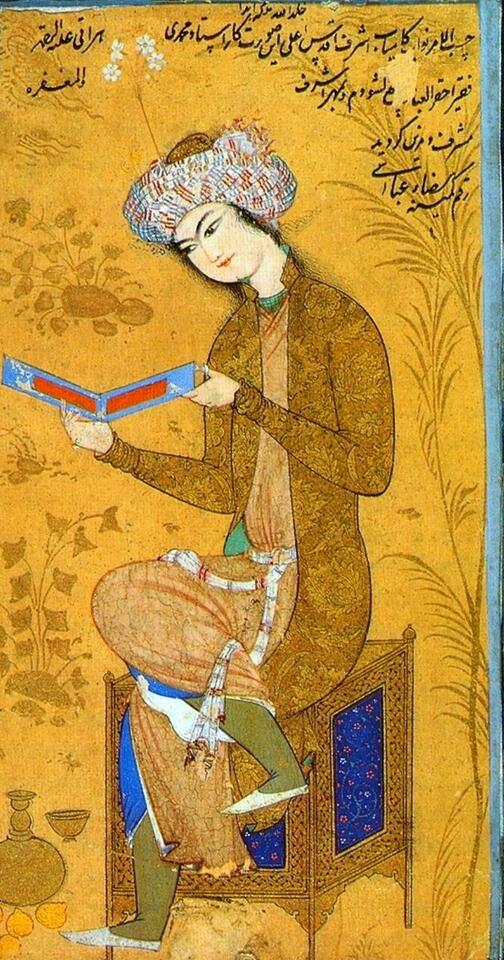
“The Reading Youth.” Reza Abbasi. Isfahan, Safavid Iran, 1625–26. Public Domain. From an exhibit in Shanghai, 2018. Held in collection of The British Museum.
That reason (`aql) is inadequate in penetrating the mysteries of the soul is also a trope in Sufi mysticism. There, however, other paths, those of spirituality and intuition, can discover life’s meaning. Sufism is as optimistic as The Rubáiyát of Omar Khayyám is pessimistic, as affirming as the latter is skeptical.
Thus, the great mystic Jalal al-Din Rumi wrote in the Divan-e Shams-e Tabriz,
Our soul is worshiping joy; our reason ruined and drunk;
The cup the soul is raised high, filled with delight, dear Lord.
Here, too, reason is inadequate to discovering the meaning of life; instead the spiritual seeker deploys an ecstasy of the soul.
The poetry attributed to Omar Khayyam does not demonstrate any belief that transcendence can be attained through such means, or by any means. All that is left is to down a fine Shiraz and spend some time with someone pretty.
—-
For the previous quatrain, see “A door to which I found no key:” FitzGerald’s The Rubáiyát of Omar Khayyám 1:32.
For more commentaries on FitzGerald’s translations of the Rubáiyát, see
FitzGerald’s Rubáiyát of Omar Khayyám: Commentary by Juan Cole with Original Persian

 © 2026 All Rights Reserved