
Ann Arbor (Informed Comment) – Although Egypt is not a party to the Iran War, it may cost the country $10 billion in extra energy outlays alone, and will put enormous pressure on the country’s fragile economy. Egypt’s inertia on green energy and EV’s is bringing the pain, as the Iran War and the virtual closure of the Strait of Hormuz provoke an energy price shock that could inflict severe damage on the Egyptian economy. Some 70% of Egyptians live below the UN’s poverty line.
Egypt imports about half of its fossil gas from Israel, which cut off that supply at the beginning of its war on Iran. That is a $3.2 billion loss for Egypt. The Israelis were sending Egypt fossil gas from two offshore fields in the Mediterranean, which they have closed for fear that they will be hit by Iranian missiles. They have kept open a third offshore field to supply Israel itself, but are hoarding that production at home and declining to export it as a security measure during the war.
Egypt will have to replace Israeli fossil gas with shipments of Liquefied Natural Gas from countries such as Russia. LNG is about 30% more expensive than gas from pipelines. Egyptian gas prices for consumers are expected to rise 15% to 20%. The government has already raised fuel and gas prices by 15% to 30%.
Instead of quickly moving to wind and solar for electricity generation and heating/ air conditioning, Egypt’s rulers want to confront the energy crisis by redoubling efforts to find fossil gas in Egypt or off its shores. But no new gas fields have been discovered there since 2015, and anyway even if they could find new fields, putting them into production would take years. A big solar farm can be built in 18 months.
That the Israelis so cavalierly cut off gas supplies to Egypt and Jordan after launching a war of aggression on Iran shows how unwise it was for Cairo to depend on Israeli gas rather than more rapidly building out its solar energy capacity. It is not that Egypt is doing nothing on renewables. It has about 9.1 gigawatts in renewable energy capacity, but it didn’t install much in the way of renewables last year. Egypt is sunlight central, and it has vast deserts, so if it wanted to invest in solar farms on a large scale it could easily get off fossil gas just as California is doing.
Egypt is also cut off from Gulf petroleum, causing gasoline prices to spike. That big increase in gasoline prices will likely cost Egypt an extra $2.9 billion this year. Moreover, because the Gulf Arab economies will contract as much as 14% this year because of the US-Israeli war on Iran and the closure of the Strait, they will not be in a philanthropic mood and so Egypt cannot expect the usual infusions of billions in aid and investment in the coming year. The Gulf countries are having to issue bonds and to borrow billions to tide themselves over until the end of the war.
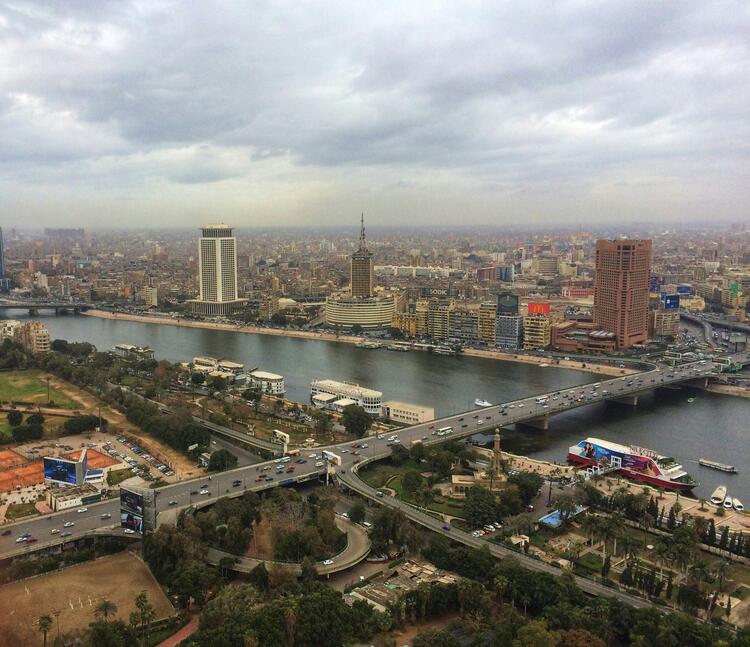
Photo of Cairo by Ahmed Ezzat on Unsplash
Egypt’s military junta has done almost nothing to move the country to electric vehicles, declining to build out a charging infrastructure. EVs account for less that 1% of the the automotive sector in Egypt. Likely, this backwardness in moving to electrify transportation derives from the Egyptian elite’s dependency on periodic hand-outs from the United Arab Emirates and Saudi Arabia, which oppose EVs, though they are less hostile to wind and solar for electricity generation. Petroleum is mainly used for car and truck transportation, and it is the primary export commodity for Saudi Arabia and the UAE. Fossil gas is used for heating, electricity generation and petrochemicals, and there Qatar is the leading regional exporter.
Egypt could have saved itself so much pain by moving to solar and EVs quickly.
Egypt depends heavily on tourism for its foreign exchange reserves. It had 19 million visitors last year, but the war could cut that number dramatically if it goes on. Rising jet fuel costs will make travel more expensive. Egypt also depends on Suez Canal tolls, which will suffer because of the war.
As it is, half of the Egyptian budget is spent on debt servicing.

 © 2026 All Rights Reserved