
London (Special to Informed Comment; Feature) – President Donald Trump has signalled that US attacks on Iran will likely last several more weeks and announced that he had called upon seven unnamed countries to help re-open the Strait of Hormuz. Iran has closed the waterway using missiles, drones and sea mines in an attempt to put economic pressure on the US and Israel, whose combined military power far outmatches Iran’s battered armed forces. In recent days, the US administration has been looking for third-party naval escorts to help it shepherd commercial vessels through the Strait. Trump has mentioned China, France, Japan, South Korea and the United Kingdom as potential contributors.
Outsiders Reluctant to Get Involved
Many foreign governments like Japan have signalled they are reluctant to ride to the US government’s rescue in the Persian Gulf. This likely reflects the danger involved in escorting commercial ships such as oil tankers, with volatile cargos, through the narrow Strait of Hormuz under Iranian fire. Other countries like China are prepared to criticize Iranian attacks alongside US ones, but have made no comment when asked about US requests for assistance in the Middle East. Iran has managed to export an estimated 12 to 13.7 million barrels of oil since the conflict began on February 28. Around 91% of Iranian oil was bought by China before the outbreak of the current conflict.
Commercial reasons and risk adversity aside, relations between the White House and many allied governments were already strained before the war. After a year of tariff chaos, White House threats to allies, and Trump’s dismissive rhetoric about past military cooperation during the War on Terror, the latest US attack is likely to add to tensions by causing an inflationary shock in Asia and Europe. This has many made leaders unsympathetic to US requests for military assistance in managing the fallout. Germany’s defence minister, Boris Pistorius, asked: “What does Donald Trump expect from, say, a handful or even two European frigates over there in the Strait of Hormuz? That they accomplish what the mighty US Navy, on its own, cannot manage to do?”
Trump Threatens Foreign Governments
So far, Germany and Australia have ruled out joining any taskforce while US ally South Korea has stalled. European states like Spain and Poland also refused any involvement. The UK has signalled it may join the US, but its navy has been depleted by multiple budget cuts in recent decades, and any aid would likely be only token in nature. The UK government also ruled out a NATO operation, backed by a German government spokesperson, who said: “NATO is an alliance for the defence of the territory… This war has nothing to do with NATO. It is not NATO’s war.”
Naval escorts for tankers are in any case widely thought likely to be ineffective, since destroyers will not have maneuvering room, could be hemmed in by the large tankers they are supposed to protect in the narrow strait, and will not be able to respond quickly enough to Iranian drones.
The reaction of individual foreign governments and the NATO alliance is likely to anger the White House, which has threatened negative consequences if contributions are not forthcoming. The US president sounded ominous about countries that did not help the US at this moment. “Whether we get support or not, but I can say this, and I said to them: We will remember,” he told journalists this week. The president also said he expected China to help the US unblock the Strait before he flew to Beijing for a bilateral summit on March 31-April 2, 2026. He threatened to delay if not, which might threaten the current US trade war truce with Beijing, already due to expire in November.
Iran Plans to Keep Strait Closed, Eyes Red Sea
The split between the US and the international community will delight Tehran, which will aim to keep the Strait of Hormuz shut as it tries to wait the US out. Iran’s main goal in the war is regime survival, which it can claim as a victory, even if it emerges militarily and economically battered from the conflict. Iranian attacks in the waterway and across the wider region against shipping did not initially target ships by nationality, but rather aimed to disrupt all commercial shipping, even where this annoyed states like China. More recently Iran has attempted to mollify China and India by allowing a small amount of transit to friendly countries.
Prior to the war, Israel estimated that Iran possessed around 2,500 ballistic missiles and 200 missile launchers. The US and Israel believe they have destroyed the majority of these, but as the war has entered its third week, Iran has continued to fire missiles overseas. Moreover, Iran was thought to possess tens of thousands of small low-cost drones, many of them with a long range, and to be capable of continuing to manufacture them even now.
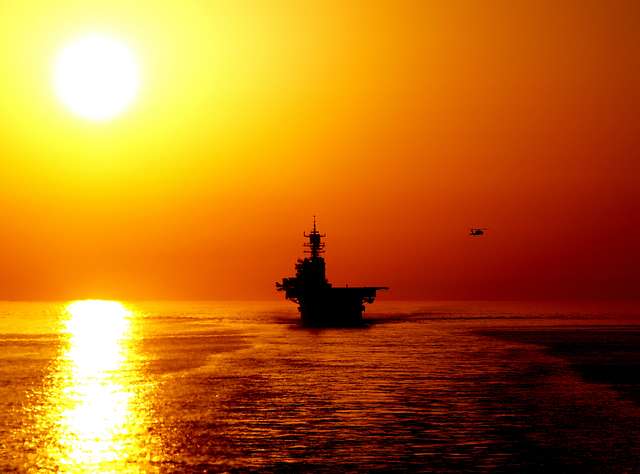
(Oct. 29, 2011) The amphibious assault ship USS Bataan (LHD 5) transits the Strait of Hormuz. Bataan is deployed to the U.S. 5th Fleet area of responsibility conducting maritime security operations and theater security cooperation efforts. (U.S. Navy photo by Quartermaster 1st Class Thomas E. Dowling). Public Domain. Via Picryl
If Iran does run low on missiles and other projectiles like drones or rockets, it is likely to tap sympathetic allies like Yemen’s rebel Houthi movement. Red Sea shipping and related critical infrastructure is a point of vulnerability for fuel, energy, and other supply chains that Iran has only attacked sporadically so far compared with its Strait closure. Targets could include the Saudi East-West oil pipeline and the UAE’s Habshan–Fujairah pipeline. Fujairah Port is already partially closed because of several Iranian rocket attacks. These land-based systems transport crude oil and refined petroleum products to Red Sea ports like Yanbu, and both they and the oil tankers that collect their hydrocarbon exports are vulnerable to Houthi missile and drone attacks. Even if they remain safe, the pipelines can transport only a fraction of Gulf petroleum.
Conclusion
Iran is likely keeping the Houthis back and avoiding a sustained campaign against Red Sea infrastructure for now, leaving itself the ability to escalate. Meanwhile, the US is sending Marines and amphibious ships to the Strait of Hormuz, creating a rapid response force there. With its multinational naval taskforce proposal unlikely to get off of the ground, the White House appears to be considering sending in troops to Iranian territory to protect commercial shipping in the waterway instead. The conflict in the Strait may be about to spread to the coasts and islands along its boundaries.

 © 2026 All Rights Reserved