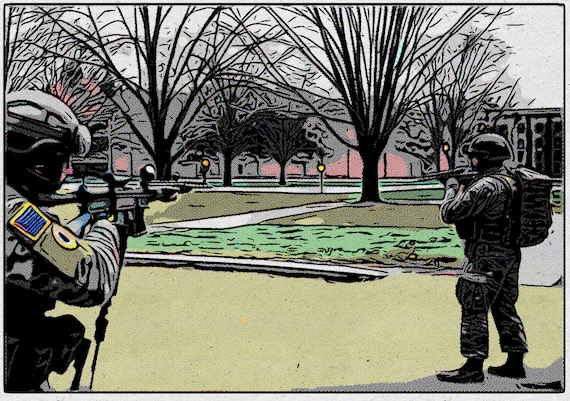
The Taliban launched a major attack in the capital of Kabul on Friday, injuring 7 people with a car bomb at the International office of Immigration, a UN-affiliated organization. In the firefight between the attackers and the Afghanistan military (which was aided by Norwegian troops), 7 persons were killed, including 5 Taliban and three bystanders.
The Taliban said they had targeted foreigners training Afghanistan troops, and especially CIA operatives.
The USG Open Source Center translates a Pashto report issued as the incident was unfolding by the Afghan Islamic Press news service:
“Taleban claim responsibility for attack in Afghan capital – agency
Afghan Islamic Press
Friday, May 24, 2013
Document Type: OSC Translated Text
Text of report by private Pakistan-based Afghan Islamic Press news agency
Kabul: At least five explosions have taken place and fighting is going on in Kabul city.
At least five heavy explosions took place in the 5th Police Station in Kabul city where fighting is under way now in which three people were killed and some others wounded.
A security official in Kabul city, who did not want to be named, told Afghan Islamic Press (AIP) that a heavy explosion took place in the Qowaye Markaz area of the 4th Police Station in Kabul city at 1600 (local time) today, 24 May, and gunmen began attacking government offices.
He added that at least three more explosions took place after the first one and it seemed suicide bombers carried out the explosions.
He also said that they have so far received reports on the death of two police officers and one civilian and the wounding of some other people, but they do not have further information about casualties.
An eyewitness at the scene of the attack told AIP that explosions and fighting took place around the National Directorate of Security’s hospital, an office of the National Directorate of Security, the office of the Interior Ministry’s Public Protection, a foreign organization’s office, IOM, and a foreign embassy.
He also reported that five explosions took place in the area and smoke was coming out of an embassy as well.
Security officials said that a few suicide bombers equipped with weapons entered a building in the area and began fighting.
The Taleban claimed responsibility for these attacks and their spokesman, Zabihollah Mojahed, told AIP that the attacks targeted the National Directorate of Security and foreign offices.
He added: “First one fighter attacked a guesthouse – where foreign trainers of personnel of the National Directorate of Security come to have food, change and rest – with an explosive-packed vehicle. After the barrier was removed, some other mojahedin equipped with heavy and light weapons entered the guesthouse and buildings around it and began attacks.”
The Taleban spokesman said that fighting is under way now, but they do not have accurate information about it.
It is worth pointing out that the Taleban spokesman told AIP in an interview three days ago, 21 May, that they were plan to carry out heavy attacks and soon these plans would be implemented.
(Description of Source: Peshawar Afghan Islamic Press in Pashto — Peshawar-based agency, staffed by Afghans, that describes itself as an independent “news agency” but whose history and reporting pattern reveal a perceptible pro-Taliban bias; the AIP’s founder-director, Mohammad Yaqub Sharafat, has long been associated with a mujahidin faction that merged with the Taliban’s “Islamic Emirate” led by Mullah Omar; subscription required to access content; URL: www.afghanislamicpress.com)”
Bill Moyers interviews Tim DeChristopher, leader of Peaceful Uprising, who just got out of jail after serving a two-year sentence for peacefully disrupting an oil and gas auction on public land that the Obama administration declared invalid.
In his speech at the National Defense University, President Obama made his most impassioned and compelling argument to date about the need to close the prison for wartime detainees at the Guantanamo Bay Naval Base. But logic and presidential will are not enough to achieve this goal. It will take an intense effort by the Administration, cooperation from international partners, bipartisan congressional support, and perhaps forceful assertion of presidential prerogatives to get this done in Obama’s second term. It is difficult to see how all these pieces will fall into place.
Remember, this issue has never been about closing a prison facility. It is about what to do with 166 people, some of whom are dangerous terrorists that will almost certainly attempt to kill innocents if they are allowed to go free.
There are three distinct groups of detainees – each with its own separate legal status and obstacles to removal from GITMO.
First, there are the 86 individuals who have been cleared for release by our defense and intelligence agencies. Critics of the Administration correctly point out that this is the one area where Obama can take unilateral action to reduce the GITMO population, as Congress has left a narrow window for the president to transfer prisoners abroad through national security waivers.
With the announcement that transfers will now be allowed to Yemen – home to a large cohort of detainees – removals from GITMO could start up again after a hiatus of almost two years. But Obama suggested that the national security waiver process would be a halting, case-by-case review, which would have to meet the exacting standard set forth by Congress.
Yemen may be able to handle some detainees – but the U.S. is not likely to release dozens of them to Yemen’s custody very quickly given the fragile security situation there and the country’s checkered record on keeping militants behind bars.
Those hoping for a rapid releases based on the national security waiver process are going to be disappointed.
In his speech yesterday, Obama called on Congress to lift all of the other legislative transfer restrictions, but we should not hold our breath waiting for them to be repealed.
These provisions have bipartisan support and therefore likely will again be included in this year’s defense authorization legislation. Obama was unwilling to veto the defense bills in prior years. Will he do so now that he has become re-energized on GITMO (and is no longer running for reelection)? Vetoing a defense bill just because of GITMO transfers would risk an override and there is no certainty that Obama could muster 1/3 of the members in either chamber to support him on this topic. Perhaps there are enough Democrats with safe seats in the House to accomplish this. But this is an issue Democrats will probably want to avoid. Republicans would like nothing more than to pummel Democrats for voting to “release terrorists to dangerous countries.”
The second category of detainees are those who have been or will be convicted of crimes by military commissions. There may be as many as two dozen of them, but we don’t know for sure as recent court rulings have limited the types of crimes that military commissions may adjudicate. Those who are eventually convicted will need to serve out their sentences somewhere – perhaps until they die many decades from now.
Obama noted that people as dangerous or more dangerous than the GITMO detainees are being held in U.S. prisons, but he did not say anything else in the speech about transferring convicted detainees to the continental U.S. If anything, this would be an even harder mountain to climb in Congress than international detainee transfers. It would require the type of congressional arm-twisting that Obama has not been particularly effective at on any issue, let alone playing the ‘no terrorists in my back yard’ game.
If Obama wants to be bold, he could exercise his commander-in-chief authority and order the convicted detainees to be moved from GITMO to military jails inside the United States. He hinted that he might be thinking about doing this because he has directed the Department of Defense to identify a place that could hold military commissions (where presumably the detainees would be able to stay both during and after trial). This move would certainly instigate a direct confrontation with Congress that, first of all, Obama may lose, and second of all, could jeopardize other parts of his agenda, like immigration reform. For these reasons, advocates for a swift closure of GITMO should not expect to see this type of provocative move any time soon. Obama might designate a place for these trials to be held, but I am dubious that he would move detainees there against congressional will.
Obama noted that the hardest parts of the GITMO matrix are the individuals (perhaps as many as 60) who represent a continuing security threat but cannot be tried because we do not have sufficient admissible evidence against them. Obama’s approach seems to be that if we can get momentum toward closure with the other two categories, then “this legacy problem can be resolved, consistent with our commitment to the rule of law.”
Reliance on this optimistic platitude shows how far we are from closing Guantanamo. Obama is absolutely right that the thought of the United States maintaining custody of hunger striking detainees who have been charged with no crime, and must be fed with feeding tubes down their noses, perhaps for decades on end, is repulsive. But there are no good alternatives and Obama gave the country no insight whatsoever into how these hard cases can be resolved.
There is an interesting linkage, however, between Obama’s discussion of the Authorization for Use of Military Force (the AUMF) and GITMO. Obama called for repeal of the 2001 AUMF, which authorizes the President to use “all necessary force” against al Qaeda (without a temporal or geographical limitation). If this law is repealed, however, there will no longer be an active armed conflict. If there is no active armed conflict, there will be no legal authority to continue holding any detainees in GITMO that have not been tried and convicted. Repeal of the AUMF, therefore, would lead to the emptying of GITMO. But this is a nuance that will not be lost on Congress and is one, among many, reasons that a total AUMF repeal will be difficult to achieve.
Obama’s call for closing GITMO in the name of national security and our values is right on the money. Renewed presidential vigor to make progress on closure — like that which infused the beginning of Obama’s first term — can certainly make a difference. But the pragmatic and political difficulties that dogged the effort for years have not changed and are likely to take the wind out of this renewed effort as well. There is no clear, achievable path to total closure. A strong effort in the second Obama term could dramatically reduce the detainee population, but this is a nettlesome problem that will probably be left for Obama’s successor to finish off.
David H. Schanzeris an Associate Professor of the Practice of Public Policy at Duke University and Director of the Triangle Center on Terrorism and Homeland Security, a research consortium between Duke, UNC-Chapel Hill and RTI International. In these capacities, he teaches courses on counterterrorism strategy, counterterrorism law and homeland security. He is also affiliated faculty of the Duke Islamic Studies Center. Prior to his academic appointments, Schanzer was the Democratic staff director for the House of Representatives Committee on Homeland Security from 2003 to 2005. He previously served as the legislative director for Sen. Jean Carnahan (2001-2002), counsel to Sen. Joseph R. Biden Jr. (1996-1998), and counsel to Sen. William S. Cohen (1994-1996). His positions in the executive branch include special counsel, Office of General Counsel, Department of Defense (1998-2001) and trial attorney, United States Department of Justice (1992-94).
Here is a photo gallery from my visit on May 9, 2013, to the Iraqi National Museum, courtesy the Ministry of Culture. Ancient Iraq or Mesopotamia was, of course, the cradle of civilization, and the treasures on display are breathtaking.
Donald Rumsfeld allowed thousands of items to be looted from the museum in 2003. (US soldiers watched the looting happen but were ordered not to intervene). Many artifacts have been recovered but 3000 – 7000 are still missing. Most of the really important and striking pieces are back on display. Some things, including precious cuneiform tablets chronicling the dawn of civilization, were forever destroyed. The damage to the museum and its collection is yet another black mark against the Bush administration and, sorry, the United States of America, which by its illegal and brutal invasion and occupation diminished our store of knowledge about a crucial period of world history.
Nabil goes in: A British Muslim responds to the Woolwich murder in which Lee Rigby, 25, of 2nd Battalion The Royal Regiment of Fusiliers, was butchered by clearly unbalanced persons. Our hearts go out to the Rigbys.
The next time you hear politicians campaigning on “lower taxes,” you should realize two things.
First, they don’t intend to lower your taxes, which are probably mostly social security. In fact, they might like effectively to raise those taxes by extending the retirement age. They mean they intend to lower taxes for rich people and corporations.
Second, what they really mean is that they intend to deny you basic social services of the sort government provides through your taxes, such as upkeep of roads and bridges. They want to allow the trucking and other corporations who use those resources to escape paying for them (most road degradation is caused by trucks), and pass the cost on to you, either in the form of tolls or of deteriorating infrastructure. I.e., when they campaign on lower taxes they are actually promising you that your bridges will collapse. Like the one in Washington state.
President Obama seems determined to give responsibility for drone strikes to the Department of Defense, taking it away from the Central Intelligence Agency. While there is no automatic Congressional oversight of Pentagon actions and programs, the Congress can at will call over DoD officials to explain themselves. At the moment, the program is largely handled by the CIA and is covert, so that its very existence could not be admitted by US officials and no public question could be answered about it by, e.g., the Secretary of State. I have argued that having it in the CIA makes the program profoundly undemocratic and unaccountable. That 16 senators and congressmen were told about the strikes after the fact (yes) is not sufficient and does not equal informing “Congress,” much less the public.
President Obama appears determined to reduce the use of drone strikes to instances where there is evidence of a clear and present danger to US territory. At the moment, drones are used in the place of hot pursuit to punish Taliban and al-Qaeda forces based in the tribal belt of Pakistan for supporting or engaging in operations against NATO and the Karzai government over the border in Afghanistan. Obama made it clear that such ‘force protection’ steps will cease at the end of 2014 with the withdrawal of US combat troops from Afghanistan. I also read him to say that while a strike might be carried out on an al-Qaeda in the Arabian Peninsula operative in Yemen if there was evidence he was imminently involved in an attack on the US, the use of drones to shore up the government in Sanaa against radical Sunni Muslim challengers would cease.
The president recognizes that a condition of permanent war inevitably undermines democracy (as James Madison held), and wants to end or deeply modify the 2001 Authorization for the Use of Force. Actually, since the AUMF refers to fighting those who planned and carried out 9/11, and since the remaining such cohort is getting to be small and long in the tooth, I think it would be enough just to interpret the AUMF more literally and to not apply it to territorial, vague al-Qaeda affiliates (Obama implied this).
Obama tried to shame the Congress into letting him close down Guantanamo, where most of the remaining prisoners have either been declared victims of false arrest or where the case against them has been compromised by the US government use of torture. Keeping under lock and key dozens of people declared eligible for release, for whom no trial is envisaged, is a profound violation of both US and international law.
The Bad:
Obama’s defense of the continued use of drones skirted many important issues. He did not admit that the evidence used in deciding to assassinate (yes) someone in a foreign country often comes from shady and manipulative sources and may not always be trustworthy. He did not admit that the courts in Pakistan, e.g., have found US drone strikes illegal and a violation of Pakistani sovereignty, and that many at the UN and the ICC have similar concerns.
Obama asserted that the drone strikes are effective. While this view prevails at the CIA and in the NSC, there are many dissenters from it. AQAP and other radical Sunni groups have grown in numbers and influence in Yemen during the period of US drone strikes, and possibly because of them. How effective, then, have they really been? Inside the Beltway analysts are obsessed with atriting the enemy’s leadership cadre. But asymmetrical terrorist groups, some of them kin-based, don’t have that big a need for alpha leaders. Kill one, and a cousin will take over. Blowing stuff up also isn’t all that hard to do, so killing people who know how to do it doesn’t stop the bombings– others just teach themselves how to make and set off explosives.
The Ugly
President Obama committed himself to the continued use of targeted assassination via drone. Although he asserted the validity of a vague doctrine of self-defense as a basis for doing so, many of the considerations above bring that justification into question.
He did not admit that NGO findings that the US has killed at least 400 innocent civilians via drone strikes have been found plausible by academic social scientists
The president spent a lot of time asking Congress to do things that that Tea Party-dominated body will not do. So, in the end, the speech changes little. Obama cannot close Guantanamo. He will continue to drone people, including American citizens, to death. He will continue to target journalists for intrusive surveillance until, he said, Congress passes a shield law (why can’t he just issue an executive order that journalists are not to be targeted)? He asked for an increase in foreign aid, which isn’t going to happen. In his flights of fancy, some of that imaginary money would be used to train security forces in Libya! That would be an excellent idea, but apparently won’t happen until the Tea Party gets behind it (never).
Obama admitted that the Israel-Palestine issue roils US relations with the Muslim world (though he did not say that it is because the US is helping Israel screw over the stateless Palestinians), and argued for more diplomacy to resolve it. But the simple fact is that Obama could unilaterally put enormous pressure on Israel to change its policy of stealing Palestinian land and resources simply by declining to use his veto at the UN when the UNSC introduces resolutions of censure against the Israeli government for its illegal actions against the Palestinians. The proposition that the government of Binyamin Netanyahu is likely to take any steps toward genuine peace with the Palestinians is risible.
I’d just like to point out in closing that counter-terrorism in the Muslim world could usefully begin with better explaining the United States. We can’t do that very well with skeleton crews cowering in embassies in Tunis and Tripoli; Obama needs to stop being so afraid of the Republicans and let the diplomats do their work out there.
Some US policy may be objectionable, but people often don’t even know the basics about the US in the region. Most of them don’t speak English (yes), and the number of solid Arabic, Persian, Urdu, Indonesian and Swahili books about the United States is tiny. I have published books in Arabic about Thomas Jefferson and Martin Luther King in the past couple of years. The US government has a small translation program, but it hasn’t really gotten the word out about real US values. It should be expanded and efforts should be made to get these books into high school and university courses. Moreover, that al-Hurra satellite television channel needs to be rethought; almost no one watches it. The US isn’t serious about communicating with people instead of droning them until it does something serious about this Information Gap.
Welcome to Informed Comment, where I do my best to provide an independent and informed perspective on Middle Eastern and American politics.
Informed Comment is made possible by your support. If you value the information and essays, I make available and write here, please take a moment to contribute what you can.