
![Painting by Soraya Sharghi: Rising with the Song of Nymphs, 2021, Acrylic on Canvas, 60 x 93 in [152,4 x 236,2 cm]. Photo courtesy of the artist.](https://globalvoices.org/wp-content/uploads/2025/11/Soraya-Sharghi-Rising-with-the-Song-of-Nymphs-2021-Acrylic-on-Canvas-60-x-93-in-800x516.jpeg)
Soraya Sharghi, ‘Rising with the Song of Nymphs,’ 2021. Acrylic on canvas, 152,4 x 236,2 cm (60 x 93 in). Photo courtesy of the artist.
( GlobalVoices.org ) – In her most recent exhibition, “Sculpture and Painting,” presented at 24 Avenue Matignon in Paris during Art Basel’s October 2025 week, Iranian-American artist Soraya Sharghi gathered recent bronze, ceramic, and painting works in a single, immersive environment.
In this presentation, Sharghi unveiled a luminous universe where mythology, memory, and material intertwine. Through hybrid figures that seem to rise from fire and color, she explores the feminine not as muse but as a generative force. Works such as “Rising with the Song of Nymphs” and her hand-shaped ceramic guardians create a continuum between painting and sculpture, where myth is reimagined as a language of survival and rebirth.
Born in 1988 in Tehran and now based in New York, Sharghi studied at the San Francisco Art Institute, where she began experimenting simultaneously with painting, sculpture, and installation. As a child, she invented elaborate stories and imaginary characters for her younger sister, narratives that later became the foundation of her visual universe. “Imagination comes naturally in childhood,” she says, “and I’ve made sure never to lose that. It still drives the way I work today.”

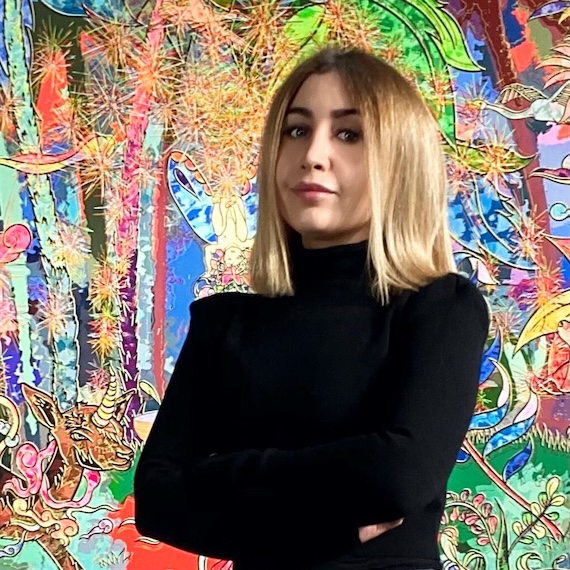
Soraya Sharghi working on her bronze sculpture in China, 2025. Photo by Lei Jianzhong, courtesy of the artist.
Her art, she explains, is a form of reclamation and protection: “Growing up in Iran, imagination became my refuge. Surrealism was not just an artistic influence; it was a way of surviving reality.” In her visual lexicon, myth becomes autobiography; every hybrid heroine is a self-created guardian of endurance, shaped by restriction, migration, and the continuous negotiation of womanhood.
Sharghi’s journey reveals a constant dialogue between discipline and rebellion. Her intricate surfaces, radiant chromatic palette, and densely worked compositions echo, in spirit, the emotionally charged figuration of artists like Niki de Saint Phalle, Hayv Kahraman and Emma Talbot, who likewise weave myth, textural pattern, and feminine subjectivity into contemporary narratives. Yet Sharghi’s voice remains unmistakably her own — unflinchingly personal, intellectually grounded, and spiritually charged.

Soraya Sharghi, ‘Rising Nymphs,’ 2025. Painted on glazed porcelain, high-fired at 1280°C. 37 x 34 x 34 cm (14.57 x 13.39 x 13.39 in). Photo courtesy of the artist.
Speaking of her multi-material approach, Sharghi says, “Each material carries its own energy and teaches me something new… together they form a map of my spiritual evolution.” In this interview with Global Voices, Soraya reflects on imagination, hybridity, mythmaking, the politics and poetics of the female body, and the alchemy of clay, fire, and color that continues to shape her expanding universe.
Excerpts of the interview follow:
Omid Memarian (OM): You often describe your art as a continuation of the imaginative worlds you created in childhood. Can you tell us about those early experiences growing up in Iran, what drew you to storytelling and visual expression, and how those early moments continue to shape your creative universe today?
Soraya Sharghi (SS): Since childhood, I’ve always created worlds of my own. I used to invent imaginary characters and tell stories to my younger sister so vividly that she believed they were real. In many ways, I’m still that same person, only now I have more tools and languages to express those ideas. Imagination comes naturally in childhood, and I’ve made sure never to lose that. It still drives the way I work today.
When I discovered visual art, it became the safest way to express myself without being fully read. I could encode feelings and stories into symbols and gestures, communicating through images rather than words.
Growing up in Iran, in a culture where girls were often told what they could or could not say, wear, or dream, imagination became my refuge. Surrealism was not just an artistic influence; it was a way of surviving reality.

Soraya Sharghi, ‘Out of Realm,’ 2017. Acrylic on canvas, 137.16 × 137.16 cm (54 x 54 in). Photo courtesy of the artist.
OM: How did your experience at the San Francisco Art Institute influence or transform your artistic practice? Looking back, what would you approach differently now after years of independent exploration?
SS: Studying at the San Francisco Art Institute opened a door to seeing myself from the outside. It was the first time anyone had asked me, ‘Who are you? What was your childhood like?’ I had to define myself beyond geography, language, and expectation. That process made me look at my culture from a distance — its poetry, its places, its complexities — with deeper understanding and renewed curiosity.
At SFAI, I was known for being ambitious. Even when the assignment was simple, I would push the limits of what was possible, experimenting with complex forms, mixing materials, and demanding more from myself. I explored painting, sculpture, and installation simultaneously, not knowing yet how they would merge. That experimental mindset still shapes my practice today.
At that time, I began exploring the female body in my work not as a subject of nudity or provocation, but as a space of emotion and healing. It was about reclaiming presence and voice, transforming experiences of restriction into freedom. My art became a process of healing and self-discovery, a way to turn silence into strength.

Soraya Sharghi, ‘The Resolution of Eve (Eve 15),’ 2020. Acrylic on canvas, 198.12 × 114.30 cm (78 x 45 in). Photo courtesy of the artist.
OM: Your practice moves fluidly between painting, drawing, sculpture, and ceramics. How did this shift across media begin, and what new possibilities did each material open for you in terms of form, storytelling, and spiritual resonance?
SS: I grew up surrounded by limitations, which is why I naturally resist them. Crossing between media feels like crossing between worlds, an act of freedom. Each material carries its own energy and teaches me something new.
Clay taught me patience and surrender. You can’t control fire; it decides what survives. Working with clay showed me that perfection is fragile and that loss can also be beautiful. Painting, on the other hand, is like facing yourself directly; it demands honesty. I believe a strong painter can do anything, because painting teaches you to see and to listen deeply.
Even when I sculpt, I think as a painter. I use glazes like pigments, layering them as if painting with fire. I love breaking rules; the chemists would tell me what not to do, and I would do it anyway, following intuition over formula. It’s that tension between discipline and rebellion that gives my work life.
Every material becomes a language for a different emotion; together, they form a map of my spiritual evolution.

Soraya Sharghi, ‘The Thinker,’ 2023-2024, Acrylic on canvas, 226.6 x 183 cm (89.21 × 72.05 in). Photo courtesy of the artist.
OM: This year, you spent a few months in China and began to explore ceramics more deeply, experimenting with material processes and cross-cultural influences. How did working in that context shape your understanding of clay and craftsmanship?
SS: When I arrived in Jingdezhen, China, the ancient city of porcelain, I was carrying many emotions, especially as war and unrest were unfolding in Iran. I spent my first weeks in silence, letting my hands speak through clay. The rough, raw textures that appeared on my female figures came directly from that state, pressing, coiling, almost sculpting my emotions into form.
Jingdezhen was transformative. The city breathes clay; every family, every street carries that energy of making. People there had such humility and devotion to their craft. Each artisan mastered one small gesture with perfection; it was deeply spiritual.
It wasn’t only about learning technique; it was about listening to clay, to silence, to the rhythm of making. In China, I learned to slow down, to let the material lead me. The people’s energy, pure, generous, grounded, reminded me that mastery is not control, it’s harmony.

‘I,’ 2025. Bronze. Soraya Sharghi: ‘A material I’ve long dreamed of working with for its permanence, weight, and history. This sculpture is called ‘I,’ a self-portrait in many forms, holding all the characters, emotions, and imagined beings that live inside me. An archive of inner voice, forged in fire.’ Photo by Lei Jianzhong, courtesy of the artist.
OM: Your works depict hybrid female figures that merge human, animal, and mythological attributes. How did you arrive at this mythopoetic visual language, and how does it reflect your lived experience as an Iranian woman navigating multiple worlds?
SS: Mythology has always been close to me. Growing up in Iran, myths were everywhere, stories of angels, heroes, and gods that shaped how we saw the world. But as a woman, I was always told who to be within those stories. So I started rewriting them.
My figures are self-created myths, hybrid guardians who protect, transform, and evolve. They often carry both beauty and pain, because that’s how survival feels. Growing up, I learned to change shapes to adapt, to mask, to survive. That transformation became my visual language.
Iran itself is surreal, a place of contradictions where dreams and restrictions coexist. My work channels that paradox, creating new beings that belong to no nation or time. They are every woman who has had to become many things to exist freely.

Soraya Sharghi, ‘She holds, she continues,’ 2025. Painted on glazed porcelain, high-fired at 1280°C. 37 x 34 x 34 cm (14.57 x 13.39 x 13.39 inches]. Photo courtesy of the artist.
OM: Your recent ceramic works reimagine Sofal-e Berjasteh, the ancient Persian embossed-glazed pottery tradition. How did you revive and transform this technique in your own practice?
SS: In my ceramic practice, I explore several different techniques. One is the Sofal-e Berjasteh-inspired work, which is an entirely new and separate process from my other clay pieces. Another includes my sculptural figures, female heads and torsos shaped by hand, where I leave the rough textures and my fingerprints visible. I also experiment with painting on vessels and forms, using glazes like watercolors to achieve layered, fluid surfaces. Each method opens a different dialogue between tradition, body, and emotion.
A few years ago, in Isfahan, I came across simple old ceramic cups that I had seen since childhood but never truly looked at. This time, they spoke to me. I became fascinated by their embossed glaze, “Sofal-e Berjasteh”, and imagined translating my paintings into this ancient craft. Since then, I had been dreaming of creating such a piece, and finally, I did.
I painted with glazes like mosaic-like colors, building the image shape by shape, entirely by hand, and creating this piece was a complete joy.
Clay remembers touch; it holds your presence long after you’re gone. The cracks, the pressure marks, even the broken pieces, they all become part of the story. Working with clay is like working with life itself: you shape it, it resists, and together you become something new.

Soraya Sharghi, ‘The Story of a Triumph,’ 2020. Acrylic on canvas, 121.92 × 187.96 cm (48 x 74 in). Photo courtesy of the artist.
OM: Your latest exhibition features monumental ceramic sculptures and hand-shaped figures that seem to rise from fire and survive it. What does this new body of work represent for you in terms of courage, vulnerability, and creative risk?
SS: This body of work was born from fire. Clay can only find its strength through burning. That process mirrors my own journey as a woman and artist, facing pressure, loss, and transformation until something new emerges.
These sculptures embody survival. They are spirits that rise from destruction and continue to sing. Each crack or glaze run becomes a testimony to endurance. I see them as self-portraits of resilience, vulnerable, yet unbreakable.
Creating them required courage because I had to let go of control and trust the elements. Fire became my collaborator. It tested my patience, my ego, my sense of perfection. What remained after the firing was the essence, truth stripped of pretense. That’s what this series is about: rising, not untouched, but reborn.

Soraya Sharghi, ‘Rise of the Rainbow From the Marsh’ 2022. Acrylic on canvas, 139.7 x 223.52 cm (55 x 88 in). Photo courtesy of the artist.
OM: In “Rising with the Song of Nymphs” (2022), memory, myth, and childhood merge into a cosmic tableau. How did this work evolve, and what does its connection to Wordsworth’s “Ode: Intimations of Immortality” reveal about your relationship to time, imagination, and rebirth?
SS: “Rising with the Song of Nymphs” is about remembering the language of the soul. When I read Wordsworth’s “Ode: Intimations of Immortality,” I felt deeply connected to his idea that childhood is a sacred memory, a place where we once saw the divine clearly, before forgetting it.
The idea for this painting actually came from an old traditional Iranian children’s game that I used to play. In this game, children form a circle while one girl sits in the middle, often pretending to cry, and the others sing for her to rise and rejoin the group. The game has many local variations across Iran and traces back to ancient ritual and performative traditions, part play, part symbolic enactment of emotion, separation, and reunion. The circle represents community; the central figure embodies longing, loss, or transformation; and when she finally stands, it becomes a moment of healing and rebirth.
Long after creating the painting, I came across Wordsworth’s poem, and it resonated so deeply. It expressed exactly what the painting had already revealed to me: that imagination is a bridge to that early, divine connection we once felt in childhood.
In this work, the nymphs represent both innocence and wisdom; they rise from memory like guardians of light. The painting became a conversation between my past and present selves, between myth and rebirth.
Some of the ceramic pieces in the exhibition carry this same spirit; their painted surfaces were inspired by “Rising with the Song of Nymphs,” echoing its imagery and rhythm in a new material form. Through clay and fire, those visions became tangible, as if fragments of the painting found a second life in three dimensions.

Soraya Sharghi at her studio in New York, working on ‘Rise of the rainbow from the marsh,’ 2023. Photo courtesy of the artist.
OM: In “She Holds, She Continues” (2025), the figure appears as both protector and creator. How does this work speak to endurance, transformation, and the feminine as a generative force?
SS: In “She Holds, She Continues,” the female figure is not passive; she is the source. She carries the weight of creation and the tenderness of care. Her gesture of holding is both an embrace and an act of power.
The imagery and characters evolved from “Rising with the Song of Nymphs,” which features girls holding hands in a circle as symbols of unity, rebirth, and feminine strength. Now, these themes are expressed in a new form through a ceramic technique I developed. This technique involves thousands of small, hand-shaped elements, each resembling a brushstroke, a cell, or a heartbeat, which merge to create a vibrant, living surface.
The initial spark came from Naghsh-e Berjasteh, the Persian embossed-design tradition, but I transformed its spirit into something my own. While inspired by the sense of relief and layered texture, the technique and visual language are new.
Through this process, the figures rise again, transformed by fire, yet still connected by touch. The work speaks to the generative force of the feminine — how creation continues quietly and powerfully through repetition, care, and persistence.

The Bridge features personal essays, commentary, and creative non-fiction that illuminate differences in perception between local and international coverage of news events, from the unique perspective of members of the Global Voices community. Views expressed do not necessarily represent the opinion of the community as a whole. All Posts
Via GlobalVoices.org



 © 2026 All Rights Reserved