
No 37 in the first edition of Edward FitzGerald’s The Rubáiyát of Omar Khayyám recognizes that life is fleeting, but urges that we concentrate on the sweetness of the present moment.
XXXVII.
Ah, fill the Cup:–what boots it to repeat
How Time is slipping underneath our Feet :
Unborn to-morrow, and dead yesterday,
Why fret about them if to-day be sweet!
The phrase “what boots it” is archaic, and means “what use is it?” the Oxford English Dictionary says that “boot” in this sense means, “Advantage; profit; avail, use. Chiefly in interrog. or negative phrases or their equivalent, as it is no boot: it avails not, it is no use. to make boot of, to make profit of, gain by; to gain.”
It cites Shakespeare, “Give him no breath, but now Make boote of his distraction.”
(- Antony & Cleopatra (1623) iv. i. 9)
That FitzGerald’s translation is full of these archaicisms was one motivation for me to translate the Rubáiyát into contemporary English.
A. J. Arberry asserts that the original here is no. 20 in the Bodleian manuscript, which is also on the Web here.
چون آب بجویبار و چون باد بدشت
روزی دگر از نوبت عمرم بگذشت
هرگز غم دو روز مرا یاد نگشت
روزی که نیامدست و روزی که گذشت
I translated it this way:
Like cascading waters, or a desert squall
another day of my life has fled.
But I never feel regret for two days:
The one that hasn’t yet arrived and the one that long since passed.
Arberry thought this translation was influenced by the last line of no. 17 in the Bodleian manuscript,
خوش باش و ز دی مگو که امروز خوش است
which I translated, “don’t speak of yesterday–rejoice today.”
—-
Order Juan Cole’s contemporary poetic translation of the Rubáiyát from
or Barnes and Noble.
or for $16 at Amazon Kindle
——-
Amir Khusrow of Delhi (d. 1325) has poetry with a similar sentiment:
مهر جانی و بهاری کایدت، خوش باش، از آنک
چند چند از نوبهار و مهر جان خواهد گذشت
خسروا، بستان متاعی در دکان روزگار
کاین بهار عمر ناگه رایگان خواهد گذشت
A literal free verse translation of this one would be,
- If soulful love and springtime come to you, be happy; for
time after time soulful love and springtime have passed away.
Khusrow, grab up some merchandise from the storefront of time,
since the springtime of life will suddenly vanish without compensation.
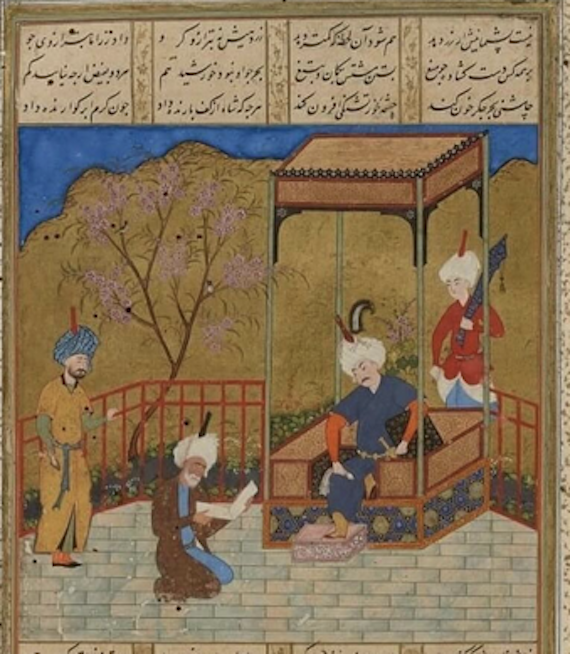
Here Amir Khusro presents a book of poetry to Delhi Sultan Alauddin Khilji (1296-1316) Folio from Khamsa from 1503-1504, Balkh. Public Domain.
For more commentaries on FitzGerald’s translations of the Rubáiyát, see
FitzGerald’s Rubáiyát of Omar Khayyám: Commentary by Juan Cole with Original Persian


 © 2026 All Rights Reserved