
Stanza 41 in the first edition of Edward FitzGerald’s translation of the Rubáiyát of Omar Khayyám shows impatience with rational philosophy and metaphysics. It also substitutes the high of being drunk on wine for the altered states of consciousness sought by the Sufi mystics. The long history of Iranian philosophy and spiritual thought shows unprecedented subtlety in treating the inner life of human beings, attentive to the smallest distinctions and achievements of the spirit.
XLI.
For “Is” and “Is-not” though with Rule and Line,
And “up-and-down” without, I could define,
I yet in all I only cared to know,
Was never deep in anything but — Wine.
A. J. Arberry identified the original as no. 120 in the Bodleian manuscript, also on the Web here:
من ظاهرِ نیستی و هستی دانم
من باطنِ هر فراز و پستی دانم
با این همه از دانشِ خود شَرْمَم باد
گر مرتبهای وَرایِ مستی دانم
Literally, the line says that the author knows the outer meaning of being and nothingness, i.e. he has mastered Greco-Islamic philosophy that speaks of these principles. Existentialist philosopher Jean-Paul Sartre entitled his book “Being and Nothingness” in 1944.
Then the next line says that the author knows the inner meaning of height and depth. Philosophers wrote on the dimensions of existence, but here the poem references the inner or esoteric meaning of these terms, likely a reference to Sufi thinking on the heights and depths that the soul can reach.
I translated the final two lines in free verse,
-
Despite all my knowledge, I would be ashamed
If I recognized a stage higher than drunkenness.
—-
Order Juan Cole’s contemporary poetic translation of the Rubáiyát from
or Barnes and Noble.
or for $16 at Amazon Kindle
——-
Sufi mystics spoke of the spiritual life as an ascent through momentary alterations in the state of consciousness, as Jean During put it at the Encyclopedia Iranica . Such as state is called ḥāl . It is not only meditation and mystical practice that can help one achieve an altered state of consciousness, but also music and culture.
During quotes the great Sufi mystic of Nishapur, Qoshayri as saying that “the Sufi “listens to music according to his ḥāl [state of consciousness] and meditates and contemplates what goes on inside him, such as feelings of blame or warning, union or separation, proximity or farness , keeping a commitment, fulfilling a promise or breaking a commitment, fear of a separation or joy of a union [with the divine Beloved].”
He adds, “According to Seyyed Hossein Nasr … for musicians ḥāl is a kind of ‘getting out of one’s physical self’ in order to attain a higher state of consciousness, the origins of which are to be sought in mysticism.”
Aside from these momentary states of altered consciousness, Sufi mystics sought to traverse stages of permanent moral improvement, called “stations” (maqāms). This progress was thought of as an ascent. Although there is some disagreement about the order and number of these stations, wrote the great scholar of Sufism Annemarie Schimmel, they are often given as seven:
1. Repentance
2. Fear of being separated from God
3. Detachment from the desire to possess things
4. Poverty in the sense of giving up love of worldly things in favor of God
5. Patience and steadfastness
6. Trust in God
7. Contentment, good-pleasure, in the knowledge that the seeker will be at one with God.
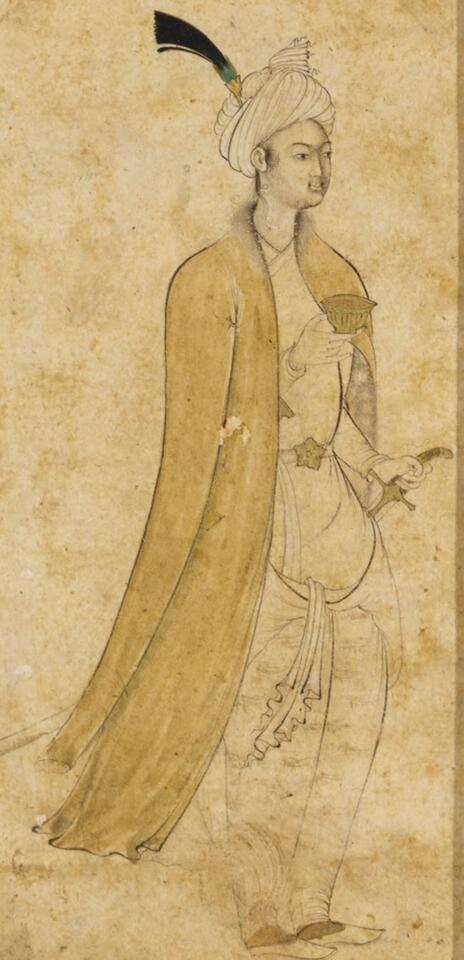
“Gentleman with a Gold Wine Cup,” Attributed to Aqa Riza Jahangiri, Afghan, c. 1600. India. Harvard Art Museums/Arthur M. Sackler Museum. Reprinted with permission for educational purposes. Via Harvard Art Museum.
This poem wickedly substitutes being drunk on wine for these stations, marking it as the highest attainment. It substitutes the altered state of consciousness produced by inebriation for the hard spiritual discipline and self-denial of the ladder of the spiritual stages.
In this regard, FitzGerald’s rendering of this poem hews close to the original.
Of course, “drunkenness” or “masti” was also a technical term in Sufism for being drunk with love of the divine Beloved, and so the poem is ambiguous if read through a mystical lens. In the corpus of poems attributed to Khayyam, however, the wine and the inebriation is the real thing. The poetry could be read and enjoyed in Muslim societies (where drinking was forbidden or frowned on) in part precisely because people could say that it is just Sufi symbolism.
For more commentaries on FitzGerald’s translations of the Rubáiyát, see
FitzGerald’s Rubáiyát of Omar Khayyám: Commentary by Juan Cole with Original Persian

 © 2026 All Rights Reserved