
At a time of war and propaganda, when Iran and Iranians are being demonized, it is important to remember the beauty of Iranian civilization and the complexity of Iranians. There is nothing wrong with being a devoted Shiite Muslim, but Iran transcends it. In history, Iranians have been Zoroastrians, Sunni Muslims, and Shiites, and some have been uninterested in conventional religion. Some have valued the mystical poetry of Rumi, others the tavern life of the worldly poet Hafez of Shiraz (d. 1390). As for Persian, it is one of the most beautiful languages in the world, and its rich poetry rivals any for insights into the human condition. I compared Rumi to Shakespeare. .
In the last third of the nineteenth century and through the twentieth century, ironically enough, most Americans only knew one thing about Iran: that it was the birthplace of the astronomer and mathematician Omar Khayyam (d. 1131), to whom was attributed the Rubáiyát or quatrains. In Edward FitzGerald’s loose translation of 1859, it became the most famous poem in the English language and a perennial bestseller.
I have been doing a running commentary on FitzGerald’s first edition here at the blog. Today we take up no. 40, which FitzGerald actually toned down from the original. Victorian England had a blasphemy law and some of the sentiments in the Persian poetry were challenging in his prudish society.
XL.
You know, my Friends, how long since in my House
For a new Marriage I did make Carouse :
Divorced old barren Reason from my Bed,
And took the Daughter of the Vine to Spouse.
A. J. Arberry identifies the original as no. 179 in the Calcutta manuscript. A version with some variants is on the internet here.
من باده به جامِ یک مَنی خواهم کرد
خود را به دو رطل می غنی خواهم کرد
اوّل سه طلاقِ عقل و دین خواهم گفت
پس دخترِ رَز را به زنی خواهم کرد
My translation of this stanza into blank verse goes this way:
I’ll pour my wine into a gallon jug,
for just two pints of it would make me rich.
When I’ve divorced faith and reason three times:
I’ll make the daughter of the vine my wife.
—-
Order Juan Cole’s contemporary poetic translation of the Rubáiyát from
or Barnes and Noble.
or for $16 at Amazon Kindle
——-
This poem makes reference to an obscure point of Muslim law, which became the subject of soap operas and Bollywood films in the modern era. The Qur’an allows a man to initiate a divorce over time and with judicial procedures. But in the Hanafi school of Sunni jurisprudence a practice grew up of instant divorce. In the latter, a man could pronounce the formula “I divorce you!” three times in a row, and it resulted in summary separation. It is not allowed in several Muslim countries, including Turkey, and it has been banned by the Modi government in India. It was never allowed in the other schools of jurisprudence such as predominate in Egypt or North Africa, and is forbidden in Shiite Islam. Once such a immediate and absolute divorce has been prounounced, jurisprudents did not allow the couple to remarry unless the woman had married someone else and then been divorced yet again. Presumably this measure was intended to make sure men did not thoughtlessly or frivolously use this provision.
In this poem, the protagonist pronounces the triple divorce not against a woman but against both faith and reason. Medieval Muslim thinkers often recognized Greek rationalism and syllogisms as paths to valid knowledge alongside religious faith. The Omarian poetry is at least agnostic about God, and some of it is atheist, so it isn’t surprising that the verse speaks of divorcing religion. Because the poetry values the intuition, alternative state of consciousness, “flow” or “peak experience” that can be achieved with wine, it also rejects dry scholastic reason.
“Girl with a wine cup Style of Muhammad Qasim Safavid Iran, Isfahan, 1640-50 Ink and opaque watercolour on paper By 1650 drawings of young men or women holding wine cups in the countryside had become standard rather than hackneyed fare in Persian art. It is unclear how the use of the bowl at the left and the long-necked bottle differed unless the bottle contained rosewater and the bowl, wine.”
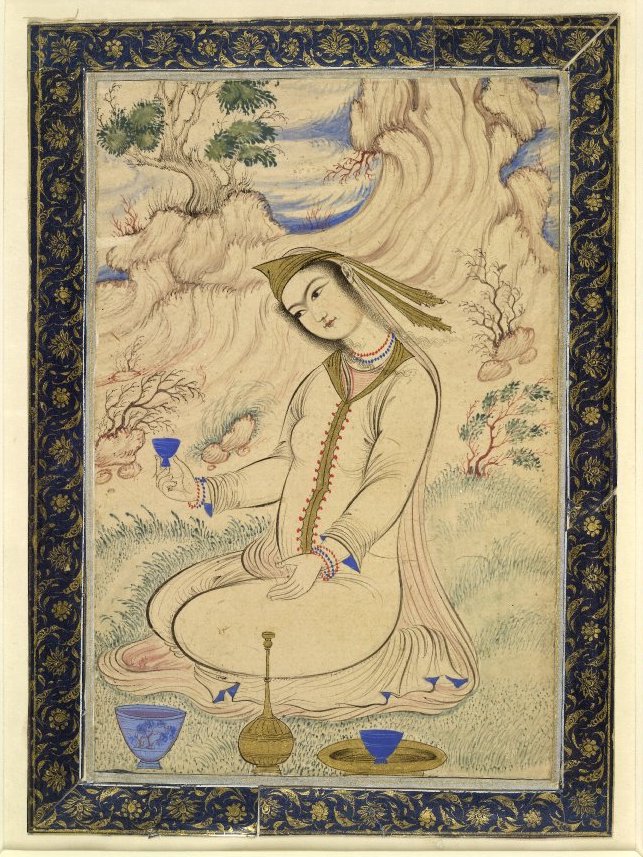
Girl with a wine cup Style of Muhammad Qasim Safavid Iran, Isfahan, 1640-50 Ink and opaque watercolour on paper By 1650 drawings of young men or women holding wine cups in the countryside had become standard rather than hackneyed fare in Persian art. It is unclear how the use of the bowl at the left and the long-necked bottle differed unless the bottle contained rosewater and the bowl, wine. Via The British Museum
FitzGerald, however, left out the bit about divorcing religion, retaining only the separation from reason — though he fully also kept the image of marrying the daughter of the vine, that is, wine. in 1858 the British parliament had passed the Blasphemy Act, and I think it made FitzGerald nervous about his translation of the scandalous Omarian poetry from Persian. He called some of the quatrains “strong,” and warned the editor of Fraser’s magazine, to whom he at first submitted them, that the divines or Anglican clerics might be upset by them.
It is amusing to think that things could be said, at least in some times and places, in medieval Iran that could not be said in the modern West of the mid-Victorian era. Less than a decade later, the publisher John Moxon retracted the first volume of the poems of Algernon Swinburne, apparently under informal legal threat from shadowy authorities. Swinburne, a fanatical admirer of FitzGerald’s Rubáiyát, found a less reputable publisher to reissue his poems, which treated atheism, sadomasochism, lesbianism, among other taboo subjects. Some of those poems show the direct influence of the Rubáiyát, with some of “Tannheuser” being in the same rhyme and meter as FitzGerald’s translation. The aaba rhyme scheme plus iambic pentameter became central to the English Rubáiyát, which had an impact on Western poetry as significant as that of the Japanese haiku, though there isn’t a good book on the former.
For more commentaries on FitzGerald’s translations of the Rubáiyát, see
FitzGerald’s Rubáiyát of Omar Khayyám: Commentary by Juan Cole with Original Persian

 © 2026 All Rights Reserved