
What Number 3000 Hides Iraqi

Posted on 12/31/2006 by Juan Cole

What the Number 3000 Hides

Iraqi guerrillas killed 6 more GIs and AP put the total dead in combat at 2998. The dreadful milestone of 3000 is upon us.

Like all statistics, this one is deceptive. It does not include US troops killed in Afghanistan, that oddly forgotten war where the US still has a division engaging in active combat. Nor is it nice to ignore NATO dead in Afghanistan, including French and Canadians (yes).

The number does not include the Coalition troops killed in Iraq. The sacrifices of the British, Italians, and others should be included.

And why ignore the seriously wounded? These brave warriors have brain damage, or spinal damage, or have lost limbs or been burned and disfigured. There are probably 8000 of them. Their sacrifice should be foregrounded. Life is not going to be easy for them, and they are not goiing to get that much help from Bush.

Indeed, why not count all the wounded? The number must be near 25000 by now.

Then there are all the I raq Vets with post traumatic stress disorder and a myriad of other combat related mental diseases. There is alcoholism, domestic violence, divorce.

The true number of Americans and US allies who are in some sense casualties of war is in the tens of thousands.

3000 is a horrible number. But it is not the only dreadful number. By concentrating on it, Washington politicians and the US press hide from us the true magnitude of the problems we face in Iraq and Afghanistan.

——

traveling and posting by treo, so no hyperlinks.

0 Retweet 0 Share 0 Google +1 0 StumbleUpon 0 Printer Friendly Send via email

Posted in Uncategorized | Comments Off

Murderers Gibbet Cole In Salon

Posted on 12/30/2006 by Juan Cole

The Murderer’s Gibbet
Cole in Salon.com on the Saddam Execution

My article on the execution of Saddam is out in Salon.com. Excerpt:

‘ The body of Saddam, as it swung from the gallows at 6 a.m. Saturday Baghdad time, cast an ominous shadow over Iraq. The execution provoked intense questions about whether his trial was fair and about what the fallout will be. One thing is certain: The trial and execution of Saddam were about revenge, not justice. Instead of promoting national reconciliation, this act of revenge helped Saddam portray himself one last time as a symbol of Sunni Arab resistance, and became one more incitement to sectarian warfare. ‘

Read the whole thing.

See also Salon.com’s Editor’s picks for 2006, ten articles that include my “Israel’s Failed-State Policy.”

Consider subscribing to Salon.com for the coming year. Much of what I’ve written there in the past year would not have been published by most other magazines.

See also Paul Richter’s article on how Saddam’s execution is not actually a turning point for Iraq. I am quoted.

0 Retweet 0 Share 0 Google +1 0 StumbleUpon 0 Printer Friendly Send via email

Posted in Uncategorized | Comments Off

For Whom Bell Tolls Top Ten Ways Us

Posted on 12/30/2006 by Juan Cole

For Whom the Bell Tolls:
Top Ten Ways the US Enabled Saddam Hussein

The old monster swung from the gallows this morning at 6 am Baghdad time. His Shiite executioners danced around his body.

Saddam Hussain was one of the 20th century’s most notorious tyrants, though the death toll he racked up is probably exaggerated by his critics. The reality was bad enough.

The tendency to treat Saddam and Iraq in a historical vacuum, and in isolation from the superpowers, however, has hidden from Americans their own culpability in the horror show that has been Iraq for the past few decades. Initially, the US used the Baath Party as a nationalist foil to the Communists. Then Washington used it against Iran. The welfare of Iraqis themselves appears to have been on no one’s mind, either in Washington or in Baghdad.

The British-installed monarchy was overthrown by an officer’s coup in 1958, led by Abdul Karim Qasim. The US was extremely upset, and worried that the new regime would not be a reliable oil exporter and that it might leave the Baghdad Pact of 1955, which the US had put together against the Soviet Union (grouping Turkey, Iraq, Iran, Pakistan, Britain and the US). (Qasim did leave the pact in 1959, which according to a US official of that time, deeply alarmed Washington.)

Iraq in the 1940s and 1950s had become an extremely unequal society, with a few thousand (mostly Sunni Arab) families owning half of the good land. On their vast haciendas, poor rural Shiites worked for a pittance. In the 1950s, two new mass parties grew like wildfire, the Communist Party of Iraq and the Arab Baath Socialist Party. They attracted first-generation intellectuals, graduates of the rapidly expanding school system, as well as workers and peasants. The crushing inequalities of Iraq under the monarchy produced widespread anger.

Qasim undertook land reform and founded a new section of Baghdad, in the northeast, which he called Revolution Township, where rural Shiites congregated as they came to the capital seeking work as day laborers (it is now Sadr City, where a majority of Baghdadis live). The US power elite of the time wrongly perceived Qasim as a dangerous radical who coddled the Communists.

1) The first time the US enabled Saddam Hussein came in 1959. In that year, a young Saddam, from the boondock town of Tikrit but living with an uncle in Baghdad, tried to assassinate Qasim. He failed and was wounded in the leg. Saddam had, like many in his generation, joined the Baath Party, which combined socialism, Arab nationalism, and the aspiration for a one-party state.

In 1959, Richard Sale of UPI reports,

‘ According to another former senior State Department official, Saddam, while only in his early 20s, became a part of a U.S. plot to get rid of Qasim. According to this source, Saddam was installed in an apartment in Baghdad on al-Rashid Street directly opposite Qasim’s office in Iraq’s Ministry of Defense, to observe Qasim’s movements.

Adel Darwish, Middle East expert and author of “Unholy Babylon,” said the move was done “with full knowledge of the CIA,” and that Saddam’s CIA handler was an Iraqi dentist working for CIA and Egyptian intelligence. U.S. officials separately confirmed Darwish’s account.’

CIA involvement in the 1959 assassination attempt is plausible. Historian David Wise says there is evidence in the US archives that the CIA’s “Health Alteration Committee” tried again to have Qasim assassinated in 1960 by “sending the Iraqi leader a poisoned monogrammed handkerchief.”

2) After the failed coup attempt, Saddam fled to Cairo, where he attended law school in between bar brawls, and where it is alleged that he retained his CIA connections there, being put on a stipend by the agency via the Egyptian government. He frequently visited US operatives at the Indiana Cafe. Getting him back on his feet in Cairo was the second episode of US aid to Saddam.

3) In February of 1963 the military wing of the Baath Party, which had infiltrated the officer corps and military academy, made a coup against Qasim, whom they killed. There is evidence from Middle Eastern sources, including interviews conducted at the time by historian Hanna Batatu, that the CIA cooperated in this coup and gave the Baathists lists of Iraqi Communists (who were covert, having infiltrated the government or firms). Roger Morris, a former National Security Council staffer of the 1960s, alleged that the US played a significant role in this Baath coup and that it was mostly funded “with American money.”. Morris’s allegation was confirmed to me by an eyewitness with intimate knowledge of the situation, who said that that the CIA station chief in Baghdad gave support to the Baathists in their coup. One other interviewee, who served as a CIA operative in Baghdad in 1964, denied to me the agency’s involvement. But he was at the time junior and he was not an eyewitness to the events of 1963, and may not have been told the straight scoop by his colleagues. Note that some high Baathists appear to have been unaware of the CIA involvement, as well. In the murky world of tradecraft, a lot of people, even on the same team, keep each other in the dark. UPI quotes another, or perhaps the same, official, saying that the coup came as a surprise to Langley. In my view, unlikely.

There really is not any controversy about the US having supplied the names of Communists to the Baath, which rooted them out and killed them. Saddam Hussein was brought back from Cairo as an interrogator and quickly rose to become head of Baath Intelligence. So that was his first partnership with the US.*

The 1963 Baath government only lasted 8 months, and was overthrown by officers who had been around Qasim. The military wing of the Baath, which was heavily Shiite, was relentlessly pursued by the new government, and was virtually wiped out. The largely Sunni civilian party, however, survived underground.

4) In 1968, the civilian wing of the Baath Party came to power in a second coup. David Morgan of Reuters wrote,

‘ “In 1968, Morris says, the CIA encouraged a palace revolt among Baath party elements led by long-time Saddam mentor Ahmed Hassan al-Bakr, who would turn over the reins of power to his ambitious protégé in 1979. “It’s a regime that was unquestionably midwived by the United States, and the (CIA’s) involvement there was really primary,” Morris says. ‘

As I noted in The Nation, in their book Unholy Babylon, “Darwish and Alexander report assertions of US backing for the 1968 coup, confirmed to me by other journalists who have talked to retired CIA and State Department officials.” It was alleged to me by one journalist who had talked to former US government officials with knowledge of this issue that not only did the US support the 1968 Baath coup, but it specifically promoted the Tikritis among the coup-makers, helping them become dominant. These included President Ahmad Hasan al-Bakr and his cousin Saddam Hussein, who quickly became a power behind the throne.

5) The second Baath regime in Iraq disappointed the Nixon and Ford administrations by reaching out to the tiny remnants of the Communist Party and by developing good relations with the Soviet Union. In response, Nixon supported the Shah’s Iran in its attempts to use the Iraqi Kurds to stir up trouble for the Baath Party, of which Saddam Hussein was a behind the scenes leader. As supporting the Kurdish struggle became increasingly expensive, Mohammad Reza Shah Pahlevi of Iran decided to abandon the Kurds. He made a deal with the Iraqis at Algiers in 1975, and Saddam immediately ordered an invasion of Iraqi Kurdistan. The US acquiesced in this betrayal of the Kurds, and made no effort to help them monetarily. Kissinger maintained that the whole operation had been the shah’s, and the shah suddenly terminated it, leaving the US with no alternative but to acquiesce. But that is not entirely plausible. The operation was supported by the CIA, and the US didn’t have to act only through an Iranian surrogate. Kissinger no doubt feared he couldn’t get Congress to fund help to the Kurds during the beginnings of the Vietnam syndrome. In any case, the 1975 US about-face helped Saddam consolidate control over northern Iraq.

6) When Saddam Hussein invaded Iran in 1980, he again caught the notice of US officials. The US was engaged in an attempt to contain Khomeinism and the new Islamic Republic. Especially after the US faced attacks from radicalized Shiites in Lebanon linked to Iran, and from the Iraqi Da`wa Party, which engaged in terrorism against the US and French embassies in Kuwait, the Reagan administration determined to deal with Saddam from late 1983, giving him important diplomatic encouragement. Historians are deeply indebted to Joyce Battle’s Briefing Book at the National Security Archives, GWU, which presents key documents she sprung through FOIA requests, and which she analyzed for the first time.

I wrote on another occasion,

‘ Reagan sent Rumsfeld to Baghdad in December 1983. The National Security Archive has posted a brief video of his meeting with Hussein and the latter’s vice president and foreign minister, Tariq Aziz. Rumsfeld was to stress his close relationship with the U.S. president. The State Department summary of Rumsfeld’s meeting with Tariq Aziz stated that “the two agreed the U.S. and Iraq shared many common interests: peace in the Gulf, keeping Syria and Iran off balance and less influential, and promoting Egypt’s reintegration into the Arab world.” Aziz asked Rumsfeld to intervene with Washington’s friends to get them to stop selling arms to Iran. Increasing Iraq’s oil exports and a possible pipeline through Saudi Arabia occupied a portion of their conversation.

. . . The State Department, however, issued a press statement on March 5, 1984, condemning Iraqi use of chemical weapons. This statement appears to have been Washington’s way of doing penance for its new alliance.

Unaware of the depths of Reagan administration hypocrisy on the issue, Hussein took the March 5 State Department condemnation extremely seriously, and appears to have suspected that the United States was planning to stab him in the back. Secretary of State George Shultz notes in a briefing for Rumsfeld in spring of 1984 that the Iraqis were extremely confused by concrete U.S. policies . . . “As with our CW statement, their temptation is to give up rational analysis and retreat to the line that US policies are basically anti-Arab and hostage to the desires of Israel.”

Rumsfeld had to be sent back to Baghdad for a second meeting, to smooth ruffled Baath feathers. The above-mentioned State Department briefing notes for this discussion remarked that the atmosphere in Baghdad (for Rumsfeld) had worsened . . . the March 5 scolding of Iraq for its use of poison gas had “sharply set back” relations between the two countries.

The relationship was repaired, but on Hussein’s terms. He continued to use chemical weapons and, indeed, vastly expanded their use as Washington winked at Western pharmaceutical firms providing him materiel. The only conclusion one can draw from available evidence is that Rumsfeld was more or less dispatched to mollify Hussein and assure him that his use of chemical weapons was no bar to developing the relationship with the U.S., whatever the State Department spokesman was sent out to say. ‘

7) The US gave
practical help to Saddam
during the Iran-Iraq War:

‘ As former National Security Council staffer Howard Teicher affirmed, “Pursuant to the secret NSDD [National Security Directive], the United States actively supported the Iraqi war effort by supplying the Iraqis with billions of dollars of credits, by providing US military intelligence and advice to the Iraqis, and by closely monitoring third country arms sales to Iraq to make sure that Iraq had the military weaponry required.” The requisite weaponry included cluster bombs. . . ‘

Richard Sale of UPI also reported that military cooperation intensified:

‘ During the war, the CIA regularly sent a team to Saddam to deliver battlefield intelligence obtained from Saudi AWACS surveillance aircraft to aid the effectiveness of Iraq’s armed forces, according to a former DIA official, part of a U.S. interagency intelligence group. . .

According to Darwish, the CIA and DIA provided military assistance to Saddam’s ferocious February 1988 assault on Iranian positions in the al-Fao peninsula by blinding Iranian radars for three days. ‘

8) The Reagan administration worked behind the scenes to foil Iran’s motion of censure against Iraq for using chemical weapons. I wrote at Truthdig:

‘ The new American alliance might have been a public relations debacle if Iran succeeded in its 1984 attempt to have Iraq directly condemned at the United Nations for use of chemical weapons. As far as possible, Shultz wanted to weasel out of joining such a U.N. condemnation of Iraq. He wrote in a cable that the U.S. delegation to the U.N. “should work to develop general Western position in support of a motion to take ‘no decision’ on Iranian draft resolution on use of chemical weapons by Iraq. If such a motion gets reasonable and broad support and sponsorship, USDEL should vote in favor. Failing Western support for ‘no decision,’ USDEL should abstain.” Shultz in the first instance wanted to protect Hussein from condemnation by a motion of “no decision,” and hoped to get U.S. allies aboard. If that ploy failed and Iraq were to be castigated, he ordered that the U.S. just abstain from the vote. Despite its treaty obligations in this regard, the U.S. was not even to so much as vote for a U.N. resolution on the subject!

Shultz also wanted to throw up smokescreens to take the edge off the Iranian motion, arguing that the U.N. Human Rights Commission was “an inappropriate forum” for consideration of chemical weapons, and stressing that loss of life owing to Iraq’s use of chemicals was “only a part” of the carnage that ensued from a deplorable war. A more lukewarm approach to chemical weapons use by a rogue regime (which referred to the weapons as an “insecticide” for enemy “insects”) could not be imagined. In the end, the U.N. resolution condemned the use of chemical weapons but did not name Iraq directly as a perpetrator. ‘

9) The Reagan administration not only gave significant aid to Saddam, it attempted to recruit other friends for him.

‘ Teicher adds that the CIA had knowledge of, and U.S. officials encouraged, the provisioning of Iraq with high-powered weaponry by U.S. allies. He adds: “For example, in 1984, the Israelis concluded that Iran was more dangerous than Iraq to Israel’s existence due to the growing Iranian influence and presence in Lebanon. The Israelis approached the United States in a meeting in Jerusalem that I attended with Donald Rumsfeld. Israeli Foreign Minister Ytizhak Shamir asked Rumsfeld if the United States would deliver a secret offer of Israeli assistance to Iraq. The United States agreed. I traveled with Rumsfeld to Baghdad and was present at the meeting in which Rumsfeld told Iraqi Foreign Minister Tariq Aziz about Israel’s offer of assistance. Aziz refused even to accept the Israelis’ letter to Hussein.” It might have been hoped that a country that arose in part in response to Nazi uses of poison gas would have been more sensitive about attempting to ally with a regime then actively deploying such a weapon, even against its own people (some gassing of Kurds had already begun). ‘

10) After the Gulf War of 1991, when Shiites and Kurds rose up against Saddam Hussein, the Bush senior administration sat back and allowed the Baathists to fly helicopter gunships and to massively repress the uprising. President GHW Bush had called on Iraqis to rise up against their dictator, but when they did so he left them in the lurch. This inaction, deriving from a fear that a Shiite-dominated Iraq would ally with Tehran, allowed Saddam to remain in power until 2003.

===

Readers of this column may also enjoy Eric Blumrich’s Flash slideshow.


*The account in 1-3 above was challenged once I put it up by two retired US government officials who had positions of responsibility in the Middle East in this period. The alternative account of one of them is here.

Against this insider account must be put the evidence of a memo by Robert Komer at the National Security Council dated the day of the 1963 coup that clearly demonstrates that he had foreknowledge of it, and in which he commends a US agency (it is blacked out) for good penetration of the Baath Party. Komer’s memo does not demonstrate that the US made the coup, but it does challenge the idea put forward by my informant above that it came as a surprise to the US government. Nathan Citino and Bill Zeman have discussed this memo in their academic writing. Roger Morris wrote me to say that he had seen national security documents proving US involvement in the 1963 coup.

3 Retweet 25 Share 7 Google +1 0 StumbleUpon 1,191 Printer Friendly Send via email

Posted in Uncategorized | Comments Off

Riverbend Is Back Riverbend Weighs In

Posted on 12/29/2006 by Juan Cole

Riverbend is Back

Riverbend weighs in on the condition of Iraq and Saddam’s impending execution.

I disagree with her about Jalal Talabani (the old-time Kurdish politician who is now Iraq’s president), who has opposed the death penalty all his political life, and I think that he genuinely won’t sign the death decree for reasons of principle.

I also don’t agree that the Bush administration was deliberately trying to break up Iraq. It wants it whole (international corporations like to sign their contracts just once, thank you). It is just that its plan, of putting the Shiites and Kurds in power and making the Sunni Arabs subordinate to them, was never practical and did have the effect of pushing the country toward a break-up.

As always, her comments are canny and give a good sense of what educated, secular Sunni Arabs in Iraq are thinking. It isn’t a position you’d hear in an interview in US corporate media.

0 Retweet 0 Share 0 Google +1 0 StumbleUpon 0 Printer Friendly Send via email

Posted in Uncategorized | Comments Off

Alexandrovna Guest Op Ed Saddams

Posted on 12/29/2006 by Juan Cole

Alexandrovna Guest Op-Ed:
Saddam’s Execution and the Campaign Against Iran

Saddam’s Execution is about Iran

Larisa Alexandrovna

‘PROLOGUE:

When someone does something obviously egregious, we tend to look past it because it is our nature to believe that people are naturally sane, good, and honest. We cannot imagine that anyone would willfully destroy their own country, violate their own laws, trample on their own people, and do it with such naked bravado while the world looked on.

But people have done it and do it even still, because there is also a darker side to human nature. Those of us who see the good in people look past actions that appear to be willfully evil not only because it is in our nature but it is also a foundation of our culture, as Americans, we believe guilt must be proved.

So we do not see what is going on before our eyes and directly in front of us. We look past it, around it, through it, but not at it. We cannot look directly at it, because if we do, we lose the vision of our beloved America and see something so sinister, that our minds would rather collapse than accept it.

But chess forces us to abandon our preconceptions and emotions. It pushes us to think in terms of cause and effect and it forces us to consider each action and counteraction in terms of the whole game. That is to say, chess forces us to think beyond our own present and fixed position, forcing us to reason every possible outcome of each action and counteraction.

Furthermore, chess teaches us to calculate not against a person, or a group, or a nation, but against a strategy that has no inherent religious, moral, or human characteristics. Master players can suspend their fixated self at will. Sadly, I am no master, and so I continue to struggle in seeing the game despite my human nature as an obstacle.

But sometimes, it just happens, something sets it off and there you are, inside the board, walking each action out in your mind and seeing the whole from beginning to end.

QUESTIONS AND SEEING THE BOARD

Sometime this morning, all the various and truly bizarre events the Bush administration has been engaged in recently with regard to troop levels and surges suddenly crystallized for me, as though I were sitting at a chess board and seeing the entire strategy unfold before my eyes.

This is of course my opinion and I may very well be wrong. In fact, I hope I am wrong. But the news that Saddam Hussein would be executed soon, and then the news that it would be in the next 48 hours, boggled my mind. Why on earth would anyone want to set off an ideological bomb during an already chaotic situation? I do not defend Saddam Hussein, not by any measure. But when Iraq is falling into total chaos and civil war, and as American troops continue to die, why would anyone want to add fuel to that fire, enough fuel to destroy what is left?

Suspend your emotions and think strategically. Now look at the question again and in context.

The administration is stalling as it supposedly weighs its Iraq options, when in fact they have already made their decision. How do I know they have made their decision? One need only look at the slow leaks coming out, not the least of which was Joe Lieberman’s op-ed in the Washington Post, to understand that we are going to be sending more troops to Iraq. So why does the administration wait to tell us this?

In the meantime, naval carriers are deployed to send Iran “a warning,” as though the threats thus far and the passing of sanctions are not warning enough. Add to that the detainment of Iranian diplomats invited to Iraq by the Iraqi leadership. Why is the US arresting diplomats invited to a country that the US claims is a sovereign nation governing itself?

And what about those sanctions, which ultimately mean nothing and sadly mean everything? The sanctions are so watered down as to have no real effect on the Iranian population or economy. Why even bother passing them?

Why censor Dr. Leverett’s opinion piece on Iran when the CIA already cleared it?

Now given this entire context, ask yourself again why Saddam Hussein is being executed now, during Hajj even? What is the urgency?

THE UGLY STRATEGY I SEE

This is what I think may be playing out, my opinion of course. And yes, the strategy is so brazenly obvious, arrogant, and antithetical to everything America is supposed to be and stand for that it will be difficult to digest.

What the Bush administration appears to be waiting for, stalling for, while they allegedly mull over the Iraq question, is for the naval carriers and other key assets to fall into position. This will happen in the first week of January. Saddam Hussein is being executed (and I would not be surprised if every major network aired it) to enrage tempers and fuel more violence in Iraq. This violence will justify an immediate need for a troop surge, although I think it will be described as temporary. Remember too that the British press has for the past week done nothing but report that Britain will be attacked by the New Year. Clearly they are preparing themselves for a contingency, and that contingency is the massive violence that will erupt across the Muslim world as they watch (and I really believe it will be televised) Saddam’s hanging just before the New Year.

Why is the rush to execute Saddam Hussein not account for Hajj? Or does it?

The carriers will be in position. I imaging there will be an event of some sort in Iraq, or the violence will spill into friendly (our friends) territory. It will be dramatic, even more so than the immediate violence.

The attacks will be blamed on Iran, with the help of the Saudis and Pakistan. Iran will be blamed for something that happens in Iran. The naval carriers, again, will be in position. The sanctions, as watered down as they are, have given the administration the blank check they needed from the world (and they still have their blank check from Congress) to order aerial strikes. The surge troops will be in position, and I estimate that ground support will begin around late February, early March.

Saddam’s execution and the violence will also be a convenient cover while the administration moves pieces into position.

But what the planners in the administration don’t seem to realize is that the Persians are the most expert of chess players, and they are a patient, strategy minded opponent. They are watching this develop, all of it, and they too are planning their counteraction. They know better than to strike first, because in doing so, they would lose the moral argument in the eyes of the world, as well as the advantage of counteraction. The US has a superior air force, but Iran has a formidable navy, and while the house of Saud will fuel this, the fallout will be fatal. Why?

Here is why: Because the US is too stretched to be able to protect Israel, and Israel cannot sustain a long term attack. They can sustain a few hits, but they will not be able to sustain a full blown attack.

If you have any doubt, go back to the recent war with Lebanon. The British will pull out, despite promises of support. Blair is on his way out, and the British public will not tolerate support for Israel, because of its help in supporting US imperialistic aggression. Whatever terrorist cells lurk in the US, and make no mistake, our administration has done little to address this issue, will be activated.

Also consider that the house of Saud is not prepared to defend itself against an uprising, and that the US cannot protect it while simultaneously operating on three different fronts and covertly in god knows how many. Despite the various sectarian differences in the Muslim world, there are two enemies that they all agree to fight and die fighting against: the US and Israel. This attack will set off a Muslim counterattack so large, that nothing will be able to stop it or contain it.

But our leadership does not see this, because they cannot think strategically and won’t think in human terms, so they are left with nothing but arrogance. And we ae left with a world ablaze. ‘

Larisa Alexandrovna maintains the blog At-Largely and is Managing Editor – of Raw Story.

0 Retweet 0 Share 0 Google +1 0 StumbleUpon 1 Printer Friendly Send via email

Posted in Uncategorized | Comments Off

Guerrillas Kill 5 Gis Security Alert

Posted on 12/29/2006 by Juan Cole

Guerrillas Kill 5 GIs
Security Alert over Saddam Sentence
Al-Aamiri killing Roils Shiite Politics

The US military announced that Iraqi guerrillas killed 5 GIs on Thursday in separate incidents. All but one attack clearly occurred in Sunni Arab areas. One was in the east of Baghdad, but since there are Sunni Arab districts between the Green Zone and Sadr City, it isn’t clear what the sectarian coloration of that area was.

There were unconfirmed reports of a US military helicopter going down near Baquba, as well.

As the death toll for US troops nears 3,000, Reuters says, it is provoking more and more vigils and anti-war protests out in the US heartland. In the past three months, the death toll has been running on average over 100 a month, which suggests that next year this time, it will be 4,000– and that is assuming that there is not a change for the worse or an outbreak of major combat.

Reuters reports that police found 42 bodies in Baghdad, and three more in Mosul. They mostly showed signs of torture and are evidence of the nocturnal sectarian civil war. In addition, there were major bombings in Baghdad, Mosul and Hawija. Reuters says of Baghdad:

‘ BAGHDAD – A car bomb exploded at a petrol station near the Shaab stadium in central Baghdad, killing 10 people and wounding 25, police said.

BAGHDAD – Two roadside bombs exploded in Bab al-Sharji in central Baghdad, killing seven people and wounding 35, Interior Ministry and police sources said. ‘

Reuters reports that Iraqi officials in Najaf are complaining that they were not consulted by the US military before the fatal raid on the home of Sahib al-Aamiri, Muqtada al-Sadr’s number 2 man in Najaf. The US maintains that the operation was spearheaded by a unit of the Iraqi 8th Division, which had 8 US troops embedded with it, and was directed by the Iraqi Department of Defense. Prime Minister Nuri al-Maliki has opened an investigation.

The killing of al-Aamiri led to a further postponement of any session of the Iraqi parliament, where Prime Minister Nuri al-Maliki had hoped to convince Sadrist deputies to rejoin his coalition.

The judgment against Saddam Hussein has been published, and the Iraqi government has formally requested that the US turn Saddam over to it. These are signs of a fast track to his execution, which may come very soon.

Al-Hayat reports in Arabic that Iraq is going on a high state of alert for fear of unrest as a result of Saddam’s execution. All leave for Iraqi troops has been cancelled.

The London pan-Arab daily says that there is a split in the Iraqi government over how fast to move. One consideration is that the Sadr bloc in parliament has made Saddam’s execution a precondition for its rejoining the government.

There are unconfirmed reports that the US has released the two Iranian diplomats it was holding after a raid last week on a compound connected to Iraqi Shiite leader Abdul Aziz al-Hakim. Although the US military attempted to tie the Iranians to the importation of shaped charges of the sort use against US troops, its spokesmen never explained how that made any sense. Most roadside bombs are set by Sunni Arabs. The Shiite Iranians are not giving Sunni Arab guerrillas weapons. That would be crazy. They would be used against Iranian clients like al-Hakim (who has been targeted for assassination more than once, and whose brother was blown up by the Baathists in late August, 2003).

If the charge is that the Iranians were giving al-Hakim weapons, then it isn’t a very serious charge. Al-Hakim is the leader of the major coalition in parliament. Bush hosted al-Hakim in the White House recently, and al-Hakim has never been tied to attacks on US troops. In fact, he has called for them to stay in Iraq. The whole thing makes no sense, and the US military should explain why they think it does if they want us to believe it. Unfortunately, I have a sinking feeling that the US troops that arrested the Iranians wouldn’t be able to distinguish between Sunni guerrillas and Shiite militiamen.

The NYT reports on the problems of housing faced by Iraq’s 1.6 million internally displaced persons.

Hannah Allam of McClatchy (formerly Knight Ridder) goes back to Baghdad, and doesn’t find the changes encouraging. Her old sources are dead or ethnically cleansed, the shops she knew are shuttered, Shiite militias compete as authors of mayhem with the Sunni Arab guerrillas, fuel and electricity are in short supply, and it is now dangerous to so much as snap a photo.

Al-Sharq al-Awsat/ Reuters report that 108,000 Iraqis were forced from their homes in December.

Baghdad and the Kurdistan Regional Government have reached an agreement on federal revenue-sharing, whereby Kurdistan will receive 17% of the national budget, most of it generated by sales of petroleum from the southern Rumayla oil field, in Shiite territory. This agreement, if it is real, is good news as far as it goes. Anything that gives the Kurds an incentive not to formally secede is good for stability in Iraq and in the region.

The bad news is that the Iraqi government was unable to increase oil production in 2006, and 2007 is unlikely to be better, according to UPI’s Ben Lando.

Presidential candidate John Edwards wants to get 50,000 US troops out of Iraq, the same number that Fred Kagan wants to put in.

0 Retweet 0 Share 0 Google +1 0 StumbleUpon 0 Printer Friendly Send via email

Posted in Uncategorized | Comments Off

Thousands Demonstrate In Najaf Sunnis

Posted on 12/28/2006 by Juan Cole

Thousands Demonstrate in Najaf;
Sunnis Clash with Gov’t in Baghdad over Saddam Sentence;
Ford blasts W., Cheney on Iraq

Iraqi guerrillas killed three US GIs on Wednesday in two separate bombings.

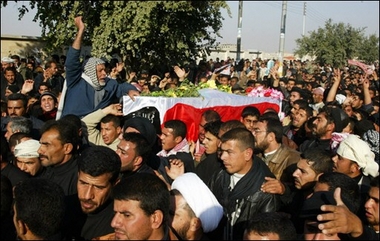
Thousands of protesters came out into the streets in the holy Shiite city of Najaf on Wednesday, protesting the killing by US troops of Sahib al-Aamiri in a raid on his home. The US military accused him of being involved in setting roadside bombs. Shiites in East Baghdad also protested, but the demonstrations turned into bloody clashes between Mahdi Army militiamen and US troops.


Najaf Demo courtesy KarbalaNews.net.

Al-Aamiri was a leader of the Sadr Movement in Najaf, which follows young nationalist cleric Muqtada al-Sadr. KarbalaNews.net in Arabic quotes a leader of the Sadrist bloc in parliament, Nassar al-Ruba’i, expressing condolences for the death of this “martyr” who “was killed by the American forces,” after he had performed his dawn prayers, “in front of his wife and children.” He added, “This action is considered a clear violation of Iraqi sovereignty, especially coming only days after the security file in Najaf was surrendered last week.” He demanded that the Iraqi government open an urgent inquiry into the killing. Family members said that US troops assaulted his home in the wee hours and killed him, accusing him of resisting capture. Al-Ruba’i accused the US of trying to bring down the government of Nuri al-Maliki, whose Da’wa Party is allied politically with the Sadrists.

Another Sadrist MP, Baha’ al-A`raji, said, “We demand that political forces take a united stand against the Occupation forces and in favor of a timetable for their withdrawal, because silence will lead to a timetable for the expulsion of Iraqis from their own country by the Occupation, and to the Americans remaining in Iraq.”

WaPo reports that the US military is saying that the raid was led by the 8th Iraqi Division. But the article also implies that the political leaders of Najaf were unaware of the planned raid. The Iraqi army still reports to US officers [An informed reader points out that 3 divisions do not, and that the 8th is one of these; regret the error]. And, the 8th Army is largely Shiite and likely linked to the Supreme Council for Islamic Revolution in Iraq and its Badr Corps paramilitary, which means that the decision to raid the home of a Sadrist rival might not be purely a matter of law enforcement.

Mark Santora of the NYT explains what is meant by “civil war” in Iraq. There are two sides and they are fighting each other over territory and political power. They kill many more of each other than of the US troops, who willy nilly mainly take the side of the Shiites and Kurds, who dominate the elected government.

By the way, the October 2005 referendum on the new constitution demonstrates conclusively that the Shiites are a majority in Iraq. The Sunni Arabs participated heavily in that voting, and they were universally against the constitution, but they were only able to reject it in three provinces. Sunni Arab Iraqis widely believe that the Sunni Arabs are a majority, or that Sunnis are a majority if you count the Kurds. None of the ways we have of measuring these things (including the Dec. 2005 parliamentary elections) points to this conclusion.

The LAT on Sunni Arab snipers in al-Anbar province that manage to pick off US troops.

Saddam Hussein, condemned to death and with all appeals exhausted, is trying to turn his death into a “sacrifice” for the Iraqi nation. In April 2003 Saddam was universally reviled but the country is now in such a horrible state that some Sunni Arabs do see Saddam as a symbol of the united Iraqi nation. Saddam, however, spoke in his typical racist way of the need to fight the “raiders and the Persians”, according to al-Hayat in Arabic (i.e. the Americans and the Shiites). Sadr Movement spokesmen demanded that he be executed on the eve of the Day of Sacrifice (Eid al-Adha)–i.e. this weekend.

Al-Hayat reports that several Sunni Arab districts of Baghdad saw armed men come out into the streets and engage in bloody clashes with Iraqi security forces, apparently in protest against the confirmation of Saddam’s death sentence.

Al-Hayat also says that a communique from the Baath Socialist Party of Iraq posted at a web site threatened to hit US interests around the world if Saddam was executed. So like the Baath Socialist Party of Iraq would be nice to the US if only Saddam were kept alive? Really.

Bob Woodward reveals in WaPo that the late President Gerald Ford deeply disagreed with George W. Bush’s Iraq War. Excerpts:

‘ “Rumsfeld and Cheney and the president made a big mistake in justifying going into the war in Iraq. They put the emphasis on weapons of mass destruction,” Mr. Ford said. “And now, I’ve never publicly said I thought they made a mistake, but I felt very strongly it was an error in how they should justify what they were going to do . . .”

Mr. Ford took issue with the notion of the U.S. entering a conflict in service of the idea of spreading democracy. “Well, I can understand the theory of wanting to free people,” Mr. Ford said, referring to Mr. Bush’s assertion that the U.S. has a “duty to free people.” But the former president said he was skeptical “whether you can detach that from the obligation No. 1, of what’s in our national interest.” He added: “And I just don’t think we should go hellfire damnation around the globe freeing people, unless it is directly related to our own national security. . .”

“He was an excellent chief of staff. First class,” Mr. Ford said of Mr. Cheney. “But I think Cheney has become much more pugnacious” as vice president. He said he agreed with former Secretary of State Colin Powell’s assertion that Mr. Cheney developed a “fever” about the threat of terrorism and Iraq. “I think that’s probably true.”

“I don’t think, if I had been president, on the basis of the facts as I saw them publicly,” he said, “I don’t think I would have ordered the Iraq war. I would have maximized our effort through sanctions, through restrictions, whatever, to find another answer.”

Ahem. I wrote yesterday, “The blowback from that Reaganesque era of private armies of the Right helped push the US after 2001 toward an incipient fascism at which Ford, the All-American, the lawyerly gentleman, the great Wolverine, must have wept daily in his twilight years.”

Some of Ford’s points would have made good additions to my Top Ten Myths about Iraq 2006.

0 Retweet 0 Share 0 Google +1 0 StumbleUpon 0 Printer Friendly Send via email

Posted in Uncategorized | Comments Off