Dubai is back. Its economy grew 3.2 percent in 2012, owing in part to good economic growth among its two major trade partners, China and India, and in part to the United Arab Emirates federal government having stepped in to use government stimulus to achieve a classic Keynesian growth effect. (Rajoy in Spain and the US tea party are just wrong and need to take economics 101).
So a little good cheer for us all from a bright spot in the Middle East.
Demonstrations and rallies began being held in the largely Sunni Arab province of al-Anbar and spread to Samarra (Salahuddin) and Nineva in Iraq on December 26. Sometimes crowds flew the flag of the Free Syrian Army, with which Iraqi Sunnis often identify, since the FSA is fighting a Shiite-dominated regime.
The Sunni Arab youth are chanting, “the people want the fall of the regime,” in emulation of the revolutionary crowds two years ago in Tunisia and then Egypt. The initial protests concerned the arrest of 10 bodyguards of the Finance Minister, Rafi al-Issawi, on suspicion of involvement in terrorism.
On Sunday, 3 people were injured in a melee that broke out when deputy prime minister Saleh Mutlak attempted to address angry demonstrators in al-Anbar. Mutlak is a prominent Sunni Arab and a member of the Iraqiya political party. The angry crowds cut him no slack for being a Sunni Arab. What enraged them was that Mutlak serves with al-Maliki at all. They pelted Mutlak and his entourage with stones and empty bottles, driving them away.
that Prime Minister Nouri al-Maliki (a Shiite) cease being a puppet of neighboring Shiite Iran,
that the Shiite-led government release the thousands of young Sunni Arab men and women it has arrested (they say arbitrarily),
that the banning of the Baath Party cease and former Baathists be allowed to reenter public life under a general pardon
Better services from the government
Thy allege that Sunni young women imprisoned by al-Maliki’s forces are raped in prison. Al-Maliki said Monday morning that the women prisoners would be released. The practice of arbitrarily arresting thousands of Sunnis who happened to be in the vicinity of attacks began under the US military when it occupied Iraq. In 2007 there were some 25,000 Iraqi prisoners, mostly Sunni Arab, in US prisons in Iraq, and 25,000 in the hands of the Shiite government in Baghdad.
Shiite member of parliament Abd al-Salam al-Maliki, representing the ruling State of Law coalition of PM Nouri al-Maliki, warned that elements of the Free Syrian Army and al-Qaeda might come over the border to Falluja, Samarra and Mosul, and infiltrate the demonstrations, using them as a cover to commit terrorist attacks. MP Abd al-Salam’s statements are outrageous, since there is no Free Syrian Army operating in the Sunni areas of Arab Iraq, and he is attempting to tar the demonstrators with the brush terrorism.
His remarks reveal the close connection Baghdad sees between instability in Syria and instability in Iraq, in both cases, the MP alleged, driven by nothing more than American hatred of the Shiites.
Some of the slogans and demands of the demonstrations have evinced nostalgia for Sunni rule of Iraq, and there have even been rumors that the crowds want to fly the Saddam Hussein version of the Iraqi flag. The USG Open Source Center paraphrased a report on Dec. 28 in Al-Sabah newspaper “citing Al-Anbar Governor Qasim al-Fahdawi as affirming that during their telephone conversation yesterday, 28 December, Prime Minister Nuri al-Maliki agreed to transfer the cases of alleged raped female prisoners to the Al-Anbar Court of Appeal. The report cites Salah al-Ubaydi, spokesman for Shiite Leader Muqtada al-Sadr, as regretting the raising of sectarian slogans at the demonstrations staged in the Al-Anbar Governorate. The report cites Hakim al-Zamili, parliament member for the Al-Ahrar Bloc, as saying that his trend does not participate in demonstrations raising the former regime’s flag. The report focuses on the demonstrations staged in Al-Ramadi and Mosul yesterday [Dec. 27].”
Iraq was ruled by a Sunni-dominated Baath regime 1968-2003, which was overthrown by George W. Bush. Under American rule, the majority Shiites came to power. They instituted ‘debaathification,’ politically banning many Sunni Arabs.
The book centers on an American telecom company hoping to make a sale in Saudi Arabia, which requires literally camping out at a prospective artificial city (King Abdul Aziz Economic City) near Jidda on the Red Sea coast. The protagonist, Alan Clay, had made his career earlier in life at an American bicycle manufacturer, but the factories had all been shipped off to China. He rages at one point that it should matter where something is made. He was now trying to sell communications technology abroad, without having the knowledge of technical specifications possessed by his much younger support staff.
Waiting for King Abdullah of Saudi Arabia to show up at the planned city to see the holographic pitch prepared for him is a bit like waiting for Godot. In the meantime, Clay gets to know a couple of Saudis. One is a ne’er-do-well young man who serves as his driver and takes him at one point to his father’s vacation home in the hills. He has had an affair and is afraid the woman’s in-laws are planning his murder. Then there is an alluring female physician (Clay is a bit of a hypochondriac).
Clay is made to symbolize a post-industrial America in decline. He is the ultimate victim of globalization, and it renders him somewhat impotent. He doesn’t know whether he will be able to put his daughter through college. His wife had a volcanic temper and had left him. He drinks too much. He goes out into the Middle East not as a conqueror or the confident representative of a superpower colossus but as a supplicant and a curiosity, as someone Saudis are only marginally curious about. He is repeatedly humiliated, intentionally or no.
Eggers makes many fine choices, beginning with setting his novel in Saudi Arabia, since the Gulf oil states exemplify the postmodern condition. Obviously, his Saudi characters are seen through American eyes. But Eggers showed in his nonfiction account, Zeitoun, which had an expatriate Syrian protagonist, that he avoids the banal antinomies of Orientalist stereotype. His characters are fundamentally human, flawed, and unable to achieve their fondest desires.
The style is direct and unpretentious. It is easy to forget that you are reading literary fiction. A hint of danger in various sinister social situations, and the question of whether the sale will go through, create dramatic tension despite the postmodern plot’s refusal to go much of anywhere.
I can’t say much more without risking spoilers. Just to say that I’m confident that anyone who reads this blog regularly and enjoys literary fiction will profit from (I won’t say enjoy, since the novel has many hard truths) this remarkable and profound book.
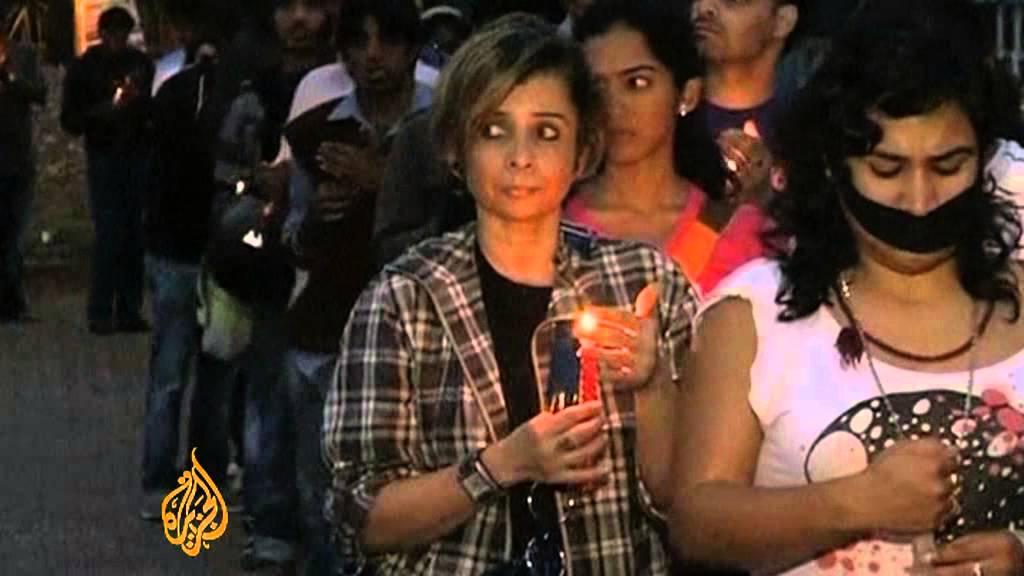
The unnamed Indian woman who was gang-raped on a bus in New Delhi and had to be sent to Singapore for medical treatment has died and her body has been cremated back in Delhi, provoking further protests throughout India.
Rape is always about power, not sex. India is a highly patriarchal society. In some parts of India, women’s literacy is half that of men. Marriages are for the most part arranged, and a majority of young men has never been on a date with a woman or have a framework for interacting with strangers of the opposite sex. Because of the high value placed on a bride’s virginity (especially in traditional milieus) and the dangers to a girl’s future if there is a taint on her honor, rape is often not reported, and the men who rape are counting on this reticence to go public.
Sometimes caste hierarchies are at play – low-caste women are at greater risk of being raped. (Classical Hinduism recognizes 4 castes, though there are many sub-castes; members high-ranking castes such as Brahmins and Kshatriyas often can mistreat Shudras and Dalits with impunity. In short, the problem of rape is in part the problem of a highly unequal society where women are low status and often somewhat segregated and disadvantaged. Economist Amartya Sen estimated that because girls are less valued and less well taken care of when ill, there are millions of missing girls in India – girls who died from relative neglect compared to what their brothers got. There is also a growing problem of families aborting daughters once the sex of the embryo is known via ultrasound. In India, typically the bride’s family must provide the groom with many expensive gifts, so that marrying off the girls of the family is extremely expensive and poor fathers and mothers would like to have high-value sons instead.
I have created an annual Amun-Ra award for heroic green energy responses to our global climate crisis. Climate change is by far the most urgent of the threats to human existence that human beings can do something about. We are moving rapidly, by virtue of our massive carbon emissions, toward a climate that may be too unstable to sustain human life.
The award is named for an ancient Egyptian composite deity, since Egypt is among the countries most threatened by rising seas over the next 80 years. Amun was a god of the wind and patron deity of ancient Thebes (modern Luxor). Ahmose I (c. 1550–1525 BCE), from Thebes, led a rebellion against the foreign Hyksos dynasty based in the Delta to his north, and managed to overthrow them and unite upper and lower Egypt. At that point, the local wind god Amun was joined to the national god of the sun, Ra, becoming Amun-Ra. Since wind power and solar power are two of our great hopes for avoiding the worst climate disasters that will be brought about if we continue to depend on coal, gas and oil, Amun-Ra is a good symbol for renewables.
There are many worthy activists and policy-makers in this field. Green Party figures in Germany and the present Chancellor, Angela Merkel, have made that country a powerhouse in the renewables field. Scientists such as James Hansen and Michael E. Mann have done the hard and dangerous work of demonstrating the reality of climate change. But since I can only give one this year, I decided to bestow the honor on the most ambitious practical policy-maker on the issue.
Winner: The 2012 Amun-Ra award goes the far-sighted First Minister of Scotland, Alex Salmond, one of the contemporary world’s great heroes. Scotland gets the award because it has the ambitious goal of getting 100% of its electricity from renewables by 2020, and it is making amazing progress toward attaining it. Although many provinces or countries get 60% or more of their electricity from renewables, most of these depend mainly on hydro-electic. For those without riparian resources, the challenge is to implement other renewable energy generating technologies. Scotland is favorably situated to develop wind power, and is going for it in a big way.
In 2011, Scotland was already getting 36 percent of its electricity from green energy, ahead of its target of 31 percent! In 2012 alone, renewables are estimated to have attracted $1 billion in investments. Pete Danko writes of these investments, which have produced 11,000 jobs at a time of economic retrenchment, “Maybe this is what happens if you have a national policy that encourages not just incremental but radical transitioning to renewable energy: Not only do you get clean energy, you get a lot of the manufacturing infrastructure that comes with it.”
In 2011, Scotland had generated 13.735 gigawatt hours from renewable sources (up 44.3% from 2010 and an increase of 97.3% from 2006). Unlike in Portugal, a relatively small portion– only about a gig — of that was from hydroelectric.
Some of the Scottish have even put in solar panels and use solar thermal to heat water. Although solar is a harder technology to profit from in overcast Scotland than wind, it can be part of the renewable mix there. The government is also now experimenting with wave energy, which could be huge for Scotland, as well as tidal energy.
The UK in general is now wavering on commitment to renewables, under the Tory government of David Cameron, and national policy may hobble Scotland’s efforts a bit. BP and other Big Carbon interests (and Donald Trump) are propagandizing against wind as ruining the beauty of the countryside, as though oil rigs do not, or as though catastrophic climate change would be better.
A warm congratulations to First Minister Salmond, and heartfelt thanks from this member of the small McIlwee clan (my maternal grandfather’s line) for making Scotland a leader in saving our world.
1. The end of any potential ‘two state solution’ to the Israeli-Palestinian conflict. Israel’s far right wing Likud government, headed by Binyamin Netanyahu, built or committed to build thousands of new family domiciles for Israeli squatters in Palestinian territory. In the absence of a Palestinian state, Palestinians are doomed to statelessness and a lack of basic human rights, living under Israeli military occupation. The only other possibility, given that they live on territory unilaterally annexed by Israel, is for them ultimately to gain Israeli citizenship. In the meantime, Israel’s treatment of the occupied Palestinians looks even worse than Apartheid or racial segregation and systematic discrimination in South Africa before 1990. Israeli Apartheid is likely to result in the country being sanctioned and boycotted by the international community. Meanwhile, With Israeli parliamentary elections looming early in 2013, Prime Minister Netanyahu launched a brief Gaza war in November, so as to burnish his credentials as a hawk and gain popularity. He found, however, that he was boxed in by the Obama administration and the new Muslim Brotherhood president, Muhammad Morsi, in Egypt. Netanyahu, much weakened in the Middle East, had to stand down from Gaza with few tangible achievements. Does this failure signal a weakening of Israel diplomatically in the wake of the Arab upheavals of the past two years?
2. Yemen’s president Ali Abdullah Saleh was finally forced from office. His vice president, Abed Rabbo Mansour Hadi, was elected president in a nationwide referendum held last February, with 80% turnout. Yemen then faced a number of crises, including resurgent religious fundamentalism, southern separatism, American drone strikes, and a worrying water shortage.
3. Egypt moved decisively from military to civilian rule. For the first time in its history, Egypt elected its president, Muhammad Morsi of the Muslim Brotherhood.(There had been indirectly elected prime ministers in the Liberal Age, 1922-1952). Since the young officers coup of July, 1952, Egypt’s president had come from the upper ranks of the officer corps. As 2012 opened, the 23-member Supreme Council of the Armed Forces (SCAF) was the de facto executive of the country, which had appointed the prime minister and approved his cabinet. In June 2012, the supreme administrative court dissolved the parliament that had been elected late in 2011, and SCAF promptly declared itself the interim national legislature, attempting to limit the powers of the incoming elected president, Muhammad Morsi of the Muslim Brotherhood. Morsi gradually made senior officers retire and got an agreement from the junior generals that he promoted that they would return to the barracks. On August 15, Morsi abrogated the SCAF decree on the legislature. By the crisis of the referendum on the constitution from November 22 until December 22, the military had been effectively sidelined or turned into an instrument of the Muslim Brotherhood president. Egypt has many problems, including the question of whether the Muslim Brotherhood really respects individual human rights. But it is indisputable that the country’s basis for legitimate government has become free and fair parliamentary elections. Meanwhile, Egypt moved decisively toward Muslim fundamentalist governance, with the passing in December of a new constitution, crafted in large part by supporters of political Islam.
4. The ruling Baath regime in Syria, over the course of 2012, lost more and more territory to the revolutionaries. They lost control of the border crossings to Iraq and Turkey. They lost much of Aleppo, the country’s second city. Then in November and December, the revolutionaries began taking military bases in the north and looting them for medium weaponry. The regime still controls substantial territory, and some smaller cities, such as Homs. But its losses in 2012 have been highly significant, raising the question of how much longer the regime can survive. In the meantime, Syria refugees in Turkey, Syria and Lebanon mushroomed in number and they faced severe difficulties in their often unsanitary and inadequate tent cities. In Syria, as in Bahrain and Yemen, sectarian considerations began to enter into the movements against authoritarian governance. The Alawi Shiite minority dominates the Baath Party in Syria, and Sunni fundamentalists have targeted that group (and vice versa). The government is supported by Shiite Iran, the rebels by Wahhabi Qatar and Saudi Arabia. If the Damascus government falls, Iran will be weakened, as will its ally, Hizbullah of Lebanon.
5. Libya held a series of municipal elections in spring of 2012, then in July held successful parliamentary elections. After the first prime minister to come from the parliament proved unable to please the elected delegates in parliament, they removed him and put in a second prime minister. Despite the series of violent incidents in Benghazi, the second-largest city, Libya’s transition from the quirky dictatorship of Muammar Qaddafi to elective government has been anything but smooth, but such a transition is certainly taking place. Political Islam fared poorly in Libyan elections, where nationalists took center stage for the most part, since people are suspicious of ideologies after four decades of Qaddafi.
6. Angry members of a small fundamentalist terrorism group attacked the US ad hoc consulate on September 11, killing the ambassador, Christ Stevens, and 3 other Americans. In late December fighting broke out between the state and fundamentalists in Benghazi, leaving several policemen dead and many hard line demonstrators or attackers jailed.
7. In revolutionary Tunisia, 2012 saw a political struggle between the small but violent minority of Salafis or hard line fundamentalists, and, well, everybody else. Salafi attacks on unveiled women provoked a huge anti-Salafi rally in the capital, Tunis. In summer, some Salafis attacked an art exhibit in tony LaMarsa. In September, Salafis of a more al-Qaeda mindset set fire to the parking lot of the American embassy and looted some of its offices. The leader of the movement for political Islam in Tunisia, the al-Nahda Party’s Rashid Ghanoushi, was caught on tape warning the Salafis that if they continued to be so provocative, they risked instigating a civil war like that in Algeria (where some 150,000 Algerians died in a struggle between secularists and Muslim fundamentalists in 1991-2002).
8. The US Congress’s National Defense Authorization Act contained an anti-Iran provision that went into effect July 1. It requires the US government to strong-arm the countries still purchasing Iranian oil to stop buying it. The boycott cut Iran’s oil sales in half in 2012 (though 2011 was a particularly lucrative year for the regime). At the same time, Saudi Arabia flooded the market by pumping extra petroleum, keeping the prices from rising astronomically. This economic blockade of Iran’s petroleum is unlikely to change the regime or its behavior, but it will likely kill the Iranian reform movement. And it could be a path for rising tensions and war between Iran and the United States.
9. The beginning of the end of the Afghanistan War, America’s longest: The Obama administration withdrew the 30,000 extra troops from Afghanistan it had sent in as part of the troop escalation or “surge.” That counter-insurgency strategy appears largely to have failed, and its author, Gen. David Petraeus, fell victim to a Washington scandal. The remaining some 66,000 US troops will be withdrawn over the next two years.
10. Bahrain’s government continued to face demonstrations and political unrest as the majority Shiite community campaigns for a more equitable constitution. The US was forced to reduce the number of navy and other military personnel stationed in Manama. The hard line Sunni monarchy accuses its Arab Shiites of being cat’s paws of Iran, but this is a red herring. The regime has resorted to the most despicable arbitrary arrests, absurd charges, punishments for thought crimes, and torture. The US has not done enough to condemn this situation or dissociate itself from the monarchy.
Schwarzkopf was among the military leaders who repositioned the United States as a Middle Eastern hegemon.
The US had interests in the Middle East from World War II forward, but the region was frankly on the back burner. The central American military and diplomatic commitments were dictated 1945-1991 by the Cold War. Thus, American tanks were assembled in Germany to face down the Red Army’s armored division. US interest in Lebanon and Iran were all about the possible spread of Communism and Soviet influence in the area. The US of course also wanted to keep the Middle East’s petroleum out of Moscow’s hands and freely flowing to capitalist allies such as France, Britain and Japan.
When he was Israeli ambassador to Washington in the early 1970s, Yitzhak Rabin complained that he had difficulty getting appointments in the American capital. US officials were preoccupied with Vietnam, and just not that interested in the Middle East.
It was the Gulf War of 1991 that changed everything and brought the US into the Middle East as a Great Power. In 1990, Saddam Hussein’s Iraq had invaded and annexed Kuwait, in part over disputes on oil policy.
Iraq’s action underlined how vulnerable the small oil emirates of the Persian Gulf were. In Europe, smaller principalities had been absorbed by larger nations through the nineteenth century, through war or diplomacy. Bismarck crafted German unification, incorporating many small polities into the new country.
But in the Gulf, British naval power advanced by a series of treaties with the small principalities along its Arab littoral, turning them into protectorates. They were thus called trucial states.
Britain withdrew from the Gulf gradually through the 1960s, and pulled out altogether in 1971, as part of decolonization. In the meantime, many of the former trucial states had discovered petroleum and were getting rich just as their Great Power patron was departing.
Rich, tiny countries with no armies of their own to speak of were vulnerable to being annexed by the larger states in the region. Iraq claimed Kuwait, Iran claimed Bahrain, and even the somewhat larger Saudi Arabia was not secure from annexation.
It was not inevitable that the US should fill the power vacuum left behind by the British. President Richard M. Nixon and his Secretary of State, Henry Kissinger, attempted to arrange for the king of Iran, Muhammad Reza Pahlavi, to replace Britain. The Shah sent forces to Oman to put down an allegedly Communist tribal insurgency. But then he was overthrown by Imam Ruhollah Khomeini in 1979, and the Iran proxy plan crashed and burned.
Then from about 1983, President Ronald Reagan attempted to replace Iran as guardian of the Gulf with Saddam Hussein’s Iraq.
But Saddam’s invasion of Kuwait made him unsuitable to the task from the point of view of Washington.
In deciding to push Iraq back out of Kuwait and guarantee the status quo ante in the Gulf, George H. W. Bush and his Centcom commander Gen. Schwarzkopf took the fateful step that would lead to the US replacing Britain as the Great Power in the Gulf. Schwarzkopf is said to have helped convince Saudi Arabia’s King Fahd to allow the pre-positioning of hundreds of thousands of US and allied troops on Saudi soil in advance of the 1991 invasion of Kuwait.
Once the US pushed Iraq out of Kuwait, it established a no-fly zone in the south of Iraq, and ultimately another one in the north. The Shiites and Kurds had rebelled against a humiliated Saddam Hussein in spring of 1991, and the regime used helicopter gunships to crush the protesters. In the aftermath of that PR embarrassment, the US had little choice but to put in the no-fly zones to prevent the Baath regime in Baghdad from further massacring the Shiites and the Kurds. Washington leased the Prince Sultan airbase from Saudi Arabia, and did the overflights over Iraq from there. The US was stuck
The US also had leased a naval facility at Manama, Bahrain, taking over from the British in 1971. But from 1997, the US presence at the base was much expanded.
The US thus become the guarantor of Gulf security, finally replacing the British.
Usama Bin Laden and his al-Qaeda fighters, who had been allied with Ronald Reagan in the quest to evict the Soviets from Afghanistan, really, really minded Gen. Schwarzkopf and his troops being in the Muslim Holy Land (i.e. Saudi Arabia, the site of the holy cities Mecca and Medina). That outrage against the Americans led, along with other causes, to the September 11 attacks on the World Trade Tower.
President George W. Bush took advantage of public anger in the US over the September 11 attacks to launch a war of choice against Iraq, which had had nothing to do with September 11.
Schwarzkopf made it clear that he disapproved of the invasion of Iraq and that he thought the Bush team was under-estimating how difficult the task would be.
The Obama administration says it wants to ‘rebalance’ toward East Asia, which makes a lot of sense. But because of oil, Israel and naval routes, the US is likely to be a hegemon in the Middle East for some time to come.
The turning point was the Gulf War, and the late Gen. Schwarzkopf was among the architects of the new American military role in the Gulf.
By 2018 or so, by which time solar panels will likely be cheaper than petroleum and gas, the importance of the oil in the Gulf will decline rapidly. Perhaps a Green America can finally come home and leave the Middle East alone.
Welcome to Informed Comment, where I do my best to provide an independent and informed perspective on Middle Eastern and American politics.
Informed Comment is made possible by your support. If you value the information and essays, I make available and write here, please take a moment to contribute what you can.